The Professor: Loss of Air Conditioning Cooling
For this column I want to discuss a real life situation regarding poor cooling in a residence and reduced airflow coming from the registers in the house.
The air conditioner is a three ton (36,000 btuh), HCFC-22, split type, air conditioner with the A-coil in the plenum of the furnace located in the basement. The evaporator has an orifice for a metering device. The condensing unit is located on the east end of the house. The residence is a 1,800-square-foot ranch house located in a subdivision in Flint, Mich. The homeowners are an elderly couple and rely on air conditioning for health reasons. It has been an unseasonably hot summer and temperatures in the house are reaching 80°F. In fact, the homeowners said that temperatures inside the house have been rising steadily in the last two weeks. They try to keep the house at 72° throughout the entire summer. They are also complaining of high humidity inside the house.
A service technician soon arrives. After introducing himself and his company, the technician converses with the two homeowners for about 10 minutes trying to get as much information and history about the a/c problem as possible. The technician then goes outside to the condensing unit and installs both of his gauges. He instantly notices that the suction pressure is reading 50 psig (26°). The normal suction pressure should be about 70 psig (41°) for the outdoor temperature and humidity conditions that day. The head pressure is also low at 190 psig for the 90° day. The head pressure should be in the 255–265 psig range. The technician also notices the compressor sweating heavily from top to bottom.
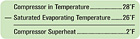 The technician then touches the crankcase area or bottom to the compressor and finds that it is extremely cold. This means that the compressor has been suffering from liquid floodback during the day at some point during its run cycle. Floodback is liquid refrigerant entering the crankcase of the compressor during the running cycle. The technician then installs a temperature probe on the suction line about 6 inches from where it enters the compressor. The temperature reads 28°. The technician then subtracts the saturated evaporating temperature of 26° from the compressor inlet temperature 28° and finds out that there is only 2° of compressor superheat (See Equation 1).
This reinforces that there is a floodback problem during the running cycle. Floodback can ruin a compressor by diluting the compressor’s oil with liquid refrigerant. This has a tendency to ruin the lubricity of the oil and score bearing surfaces in the compressor. Floodback also causes oil foaming, which can cause oil to be pumped out the discharge valve and into the system. Discharge valve damage can also occur from the oil foam/refrigerant rich mixture.
The technician then decides to check the air filter located in the return air cabinet before the evaporator or A-coil. He notices that it is completely filled with dust and lint. However, even with the air filter pulled, there still is a restricted air flow problem and the fan motor continues to pull low current. He then decides to have a look at the A-coil itself. He shuts off power to the unit and removes the plenum. He finds that the A-coil is completely covered with a blanket of ice and frost. The technician then melts the iced coil with a large wattage blowdryer. After putting the plenum back on the unit and installing a new air filter, the technician starts the air conditioner. The proper airflow has been established and the suction pressure is normal at 70 psig. The fan motor is now drawing normal current of about 7 amps.
The technician then explains to the homeowner that a dirty air filter has caused a restricted airflow to the A-coil. He then explains the importance of keeping the air filter clean. This restriction in the airflow has caused a low suction pressure because of a reduced heat load entering the evaporator coil. This caused a slower vaporization rate of refrigerant in the evaporator. The low suction pressure made the refrigerant flowing through the evaporator below freezing (26°). This finally froze the evaporator coil solid with ice. The restricted airflow also unloaded the fan motor causing it to draw low current.
Once the evaporator coil froze solid, the refrigerant saw very little heat and humidity load. This caused a low vaporization rate and some of the liquid refrigerant (R-22) trickled down the suction line to the compressor’s crankcase causing floodback. This is why there were only 2° of compressor superheat and the crankcase area was cold to the touch.
The low heat and humidity load on the evaporator also caused the head pressure to be low. This happened because if there was very low heat being absorbed in the evaporator section, there will be hardly any heat to be rejected into the condenser section of the system. This will keep condensing (head) pressures down.
In this case, something as simple as a dirty air filter was the culprit in freezing the coil and causing low head and suction pressures. In this case, the low airflow was the major clue to the problem, and it wouldn’t have been noticed if the technician did not converse the homeowner before troubleshooting. Hopefully, the service technician would have eventually taken a subcooling reading if the low airflow problem was not noticed.
Publication date: 08/01/2011
The air conditioner is a three ton (36,000 btuh), HCFC-22, split type, air conditioner with the A-coil in the plenum of the furnace located in the basement. The evaporator has an orifice for a metering device. The condensing unit is located on the east end of the house. The residence is a 1,800-square-foot ranch house located in a subdivision in Flint, Mich. The homeowners are an elderly couple and rely on air conditioning for health reasons. It has been an unseasonably hot summer and temperatures in the house are reaching 80°F. In fact, the homeowners said that temperatures inside the house have been rising steadily in the last two weeks. They try to keep the house at 72° throughout the entire summer. They are also complaining of high humidity inside the house.
A service technician soon arrives. After introducing himself and his company, the technician converses with the two homeowners for about 10 minutes trying to get as much information and history about the a/c problem as possible. The technician then goes outside to the condensing unit and installs both of his gauges. He instantly notices that the suction pressure is reading 50 psig (26°). The normal suction pressure should be about 70 psig (41°) for the outdoor temperature and humidity conditions that day. The head pressure is also low at 190 psig for the 90° day. The head pressure should be in the 255–265 psig range. The technician also notices the compressor sweating heavily from top to bottom.
Equation 1.
This reinforces that there is a floodback problem during the running cycle. Floodback can ruin a compressor by diluting the compressor’s oil with liquid refrigerant. This has a tendency to ruin the lubricity of the oil and score bearing surfaces in the compressor. Floodback also causes oil foaming, which can cause oil to be pumped out the discharge valve and into the system. Discharge valve damage can also occur from the oil foam/refrigerant rich mixture.
FINDING A CAUSE
The technician then checks the airflow problem and agrees with the homeowners that there is a reduced airflow problem. The technician then takes a current reading of the fan motor and finds it to be 4.2 amps. This is far from the nameplate current of 8 amps. This tells the technician that the fan motor is only partially loaded and is not moving the proper amount of air it is designed to move.The technician then decides to check the air filter located in the return air cabinet before the evaporator or A-coil. He notices that it is completely filled with dust and lint. However, even with the air filter pulled, there still is a restricted air flow problem and the fan motor continues to pull low current. He then decides to have a look at the A-coil itself. He shuts off power to the unit and removes the plenum. He finds that the A-coil is completely covered with a blanket of ice and frost. The technician then melts the iced coil with a large wattage blowdryer. After putting the plenum back on the unit and installing a new air filter, the technician starts the air conditioner. The proper airflow has been established and the suction pressure is normal at 70 psig. The fan motor is now drawing normal current of about 7 amps.
The technician then explains to the homeowner that a dirty air filter has caused a restricted airflow to the A-coil. He then explains the importance of keeping the air filter clean. This restriction in the airflow has caused a low suction pressure because of a reduced heat load entering the evaporator coil. This caused a slower vaporization rate of refrigerant in the evaporator. The low suction pressure made the refrigerant flowing through the evaporator below freezing (26°). This finally froze the evaporator coil solid with ice. The restricted airflow also unloaded the fan motor causing it to draw low current.
Once the evaporator coil froze solid, the refrigerant saw very little heat and humidity load. This caused a low vaporization rate and some of the liquid refrigerant (R-22) trickled down the suction line to the compressor’s crankcase causing floodback. This is why there were only 2° of compressor superheat and the crankcase area was cold to the touch.
The low heat and humidity load on the evaporator also caused the head pressure to be low. This happened because if there was very low heat being absorbed in the evaporator section, there will be hardly any heat to be rejected into the condenser section of the system. This will keep condensing (head) pressures down.
TALK IS GOOD
Many technicians will try to add refrigerant when they experience low suction and low head pressures simultaneously. This is not always the answer. It is true, an undercharge of refrigerant will cause low head and low suction pressures, but that is not the only thing that will cause both pressures to be low. An undercharge will have low subcooling readings on the high side, where a dirty air filter for the evaporator will not produce low subcooling readings.In this case, something as simple as a dirty air filter was the culprit in freezing the coil and causing low head and suction pressures. In this case, the low airflow was the major clue to the problem, and it wouldn’t have been noticed if the technician did not converse the homeowner before troubleshooting. Hopefully, the service technician would have eventually taken a subcooling reading if the low airflow problem was not noticed.
Publication date: 08/01/2011
Looking for a reprint of this article?
From high-res PDFs to custom plaques, order your copy today!


