Drill, Baby, Drill

United Air Temp purchased a Vermeer 7x11 Series directional drill, which reduces property damage and is less noisy than larger drill rigs.
There are many different ways to install a closed loop geothermal heat pump system but all involve burying pipes in the ground or submersed in a body of water, in order to take advantage of the constant temperature that exists below the frost line. While backhoes are still often used to dig trenches for horizontal piping, drilling equipment is needed for vertical piping, in order to bore holes up to several hundred feet into the ground. Horizontal directional drills are also becoming more popular, as they can bore tunnels at 6-8 feet below the surface with minimal disturbance to the existing landscaping.
These drills cost a lot of money and require a good deal of ongoing maintenance, which is why many contractors choose to subcontract out the drilling portion of geothermal jobs to companies that specialize in loop field installation. Other contractors choose to purchase their own drilling equipment, particularly if they install large numbers of geothermal heat pump systems.
TIME TO BUY
Mike Giordano, president, United Air Temp, Washington, D.C. area, is one of those contractors who recently decided to buy his own drilling equipment. “We sporadically installed geothermal systems back in the 1970s but became heavily involved when the tax credits came out. Now we’re installing between $2 and $3 million of residential geothermal systems each year, and we always have a backlog.”Giordano decided to purchase a Vermeer 7x11 Series directional drill, which would allow him to expedite the backlog, as well as take total control of each installation. “With one vendor responsible for the entire job, the homeowner only needs to call one place for service. And you don’t end up with two companies pointing their fingers at each other saying, ‘It’s not my fault.’ ”
Another reason why Giordano decided to buy his own equipment was that he had read about horizontal directional drills and was curious to see how they would work in his area. “We were hoping they would provide a cleaner installation for our customers than a traditional drill rig could. Most of our installations are for existing homeowners, and we wanted a drill that would reduce the damage to the property - which would require less clean-up - and also be less noisy.”
Giordano bought the new drill in early 2009 for just under $100,000 and subsequently developed an insertion tool and method (under patent application) to insert the loops in the ground. The drill requires regular maintenance, including the need to replace the drill head and rods every 1,200 to 1,500 hours, which typically costs around $12,000. In addition, the drill requires regular oil changes, maintenance of hydraulics, and periodic cutting head replacements. Giordano noted that he usually has to replace at least one cutting head on each job.
Even considering these expenses, Giordano noted that the drill has already paid for itself. In addition, he has been pleased with the greater amount of flexibility the new drill has offered, noting that it has a smaller footprint, which allows access to certain areas a larger drill just can’t go.
That being said, the drill is definitely better suited for residential applications and would be underpowered for most commercial applications, as it does not go through certain ground conditions, such as shale, very well. This is one of the reasons why Giordano is already looking to buy a more powerful multiangle drill. Until then, Giordano will continue to use the horizontal drill on jobs where it will work well, and subcontract out the other jobs to local drilling companies.
For contractors who may be thinking about buying a drill, Giordano counsels, “Buy a more powerful drill than you think you need; make sure you have the proper authority to drill in your area; if you buy a used drill, make sure it has low hours, because components are expensive to replace; and be aware that drilling is not as easy as it looks!”
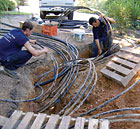
Many contractors are now purchasing their own equipment in order to install loop fields for geothermal systems. (Courtesy of United Air Temp)
TOTAL CONTROL
Keeven Heating & Cooling, Inc., New Haven, Mo., has been installing geothermal systems since 1994, but business really started taking off over the last few years, noted Lois Keeven. “We averaged five to six geothermal jobs a year until 2006, when we did a 52-ton job for an assisted living facility. In 2008, we installed 92 tons for 13 different jobs; in 2009, it was 145 tons and 28 jobs; and in 2010, it was 223 tons for 41 jobs. Geothermal is 90 percent of our business today, and we do residential and commercial projects with both horizontal and vertical drills, depending on the site space and topography.”Originally the company used a backhoe to install loop fields in new homes, but on retrofit applications, they found they needed to bring in a well driller, which often left a mess in the yard. That issue, combined with an increasing number of geothermal jobs, led Keeven to start looking into purchasing its own drilling equipment.
Keeven purchased a horizontal drilling rig in July 2008, but the company found it was still having to hire a well driller for jobs that did not have 250 feet of yard available. “The mess that the 80,000-pound well driller’s rig left us with made us feel frustrated and out of control on the job, which is why we started looking into buying a vertical rig for small yards, which we did purchase in August 2009,” said Keeven.
Purchasing the horizontal and vertical drilling equipment was expensive, ranging from $80,000 for a used horizontal rig to $380,000 for the vertical rig and its peripheral equipment. And then there are the maintenance costs that include component replacement and regular cleanings, but even so, the investment was definitely worthwhile, noted Keeven. “By owning our own rig, we have complete control over the installation. We are not waiting for a well driller to fit us in, and we have very little yard disturbance for our retrofit jobs.”
Homeowners also benefit by having only one company on their property, because if there is a problem, they have only one company to deal with. “We are extremely happy with our equipment, as owning our own rigs has helped us survive the last two years of a very poor economy for HVAC contractors,” said Keeven. “That being said, there is a big difference between the installation of the inside geothermal equipment and the outside loop system. We would only recommend that contractors buy a geothermal drill rig if they have experience in the outside loop field drilling.”

United Air Temp’s drill is better suited for residential applications and would be underpowered for most commercial applications.
FINDING A PARTNER
Those who are not experienced in loop field installation – or those who do not want to invest in the equipment – may choose to partner with a local geothermal loop installation contractor, such as LoopMaster, Indianapolis. LoopMaster has been in business for over 25 years, specializing in commercial and residential geothermal loop installations.LoopMaster installs approximately 200 residential loop fields each year, and they run the gamut from horizontal to vertical to pond loops to directional bore. The only configuration the company does not install is open loop systems. According to Pat Cline, general manager, LoopMaster Residential, contractors benefit from working with a dedicated geothermal loop contractor for several reasons.
“The investment in the equipment is extremely expensive,” said Cline. “Once a contractor purchases a drill, it can’t just sit in the parking lot – it needs to be at a job site, generating income. Number two, it costs a lot to maintain the equipment, even if that just means keeping the brakes adjusted or the tires inflated. Finally, there are costs associated with the Department of Transportation - just putting the equipment on the highway and keeping it legal, as well as having the proper license for the operator to haul the equipment around. Those are all big costs.”
Contractors should also realize that there are numerous geothermal loop companies available that can provide assistance on just about any job, said Cline. “There are looping contractors available all over, due to the economy. For example, a lot of water well drilling companies are converting to geothermal drilling, because there is decreasing demand for private wells. These companies have already invested in the drilling equipment, and now they’re diversifying into geothermal well drilling. The same can be said for excavation equipment or boring machines and their operators.”
Most looping contractors out there also bring experience to the table, which can ultimately benefit the contractor, said Cline. “There is an art and a skill to drilling - it is not simple. We have been installing loop fields for a long time, and we’ve learned working with professionals within their trades can make a project go smoother and more cost effective. With proper training in geothermal drilling, these contractors can become great partners with years of drilling and excavation experience. This can help to eliminate the costly mistakes and damages created by the learning process.”
Obviously, there are many factors contractors need to take into consideration when deciding whether to buy their own drills or partner with a local loop contractor. These factors include how many geothermal systems they install each year; how much money they want to invest in their geothermal business; and whether or not they have the personnel available to take care of and operate the equipment. Ultimately it is up to each contracting firm to decide whether it is more beneficial to own or to partner, as both paths can lead to success.
Publication date: 07/25/2011
Looking for a reprint of this article?
From high-res PDFs to custom plaques, order your copy today!


