ACHR News
search
Ask ACHR NEWS AI
cart
facebook twitter instagram linkedin youtube
  • Sign In
  • Subscribe
  • Sign Out
  • My Account
ACHR News
  • NEWS
    • Breaking News
    • New HVAC Products
    • Featured Products
    • Manufacturer Reports
    • HVAC Data
    • Legislation
    • ACHR NEWS Centennial
  • RESIDENTIAL
    • Air Conditioners
    • Furnaces
    • Residential Heat Pumps
    • Ductless
    • Residential IAQ
    • Testing, Monitoring, Tools
    • Components & Accessories
  • COMMERCIAL
    • Air Handlers
    • Rooftop Units
    • Chillers and Cooling Towers
    • Commercial Heat Pumps
    • Boilers and Hydronics
    • VRF/Ductless
    • Commercial IAQ
  • REFRIGERATION
    • Refrigerants
    • Refrigerant Regulations
    • Leak Management
  • CONTRACTOR PRO
    • Geothermal
    • Homeowner Study
    • VRF and VRV Ductless
    • Unitary Trends
  • EDUCATION
    • Training and Education
    • Business Management
    • Service and Maintenance
    • Continuing Education
    • Market Research >
      • HVAC Brand Awareness Report
      • VRV, VRF, VRVZ Report
      • Unitary Trends Report
      • Water Heat Professionals Report
    • Webinars
    • Sponsor Insights
    • eProducts Info
    • White Papers
  • EVENTS
    • HVAC Contractor Forum
    • Industry Events and Webinars
  • MEDIA
    • Videos
    • AHR Expo 2025 Videos
    • Podcasts >
      • ACHR News Podcast
      • HARDI Podcasts
      • AHR Expo Podcasts
      • ACCA Podcasts
    • Interactive Spotlights
    • Quizzes
    • eBooks
    • HVAC Talkback
  • HVAC GROUP
    • ACHR NEWS >
      • Current Issue
      • Digital Edition
      • Subscribe
    • Distribution Trends
    • SNIPS NEWS >
      • Join SNIPS NEWS
    • Engineered Systems News >
      • Join ES News
    • HVACR Directory
    • Contests
    • Newsletters
    • Contact
    • Advertise
    • My Account
Components & AccessoriesCompressors

The Professor: Compressor Amperage Data

By John Tomczyk
March 7, 2011

My Feb. 7 column focused on ice flake machine troubleshooting. I will have more to say on that specific topic in my April 4 column. For this column, I want to take a look at amperage as it relates to HVACR compressors.

• Full Load Amperage (FLA). As the load or torque on a motor increases, the amperage draw required to power the motor will also increase. When the full-load torque and horsepower of the motor is reached, the corresponding amperage the motor is drawing is referred to as the full load amperage (FLA). FLA is determined in a laboratory situation and is printed on the motor’s nameplate. It is used to select the correct wire size, overload, and motor starter devices to serve and protect the motor.

• Rated Load Amperage (RLA). As it relates to HVACR, Rated Load Amperage (RLA) is a mathematical calculation used to get Underwriters Laboratories (UL) approval for a certain compressor motor. It should not be confused with Full Load Amps (FLA). The term Full Load Amps (FLA) has not been used by compressor manufacturers since 1972, when UL changed the term to Rated Load Amps (RLA).

• Maximum Continuous Current (MCC). Compressor manufacturers will conduct many tests on a compressor motor to find the maximum continuous current value the compressor motor will handle before its protector (overload) opens or trips, thus stopping the compressor. This maximum current value is referred to as the Maximum Continuous Amperage (MCA) or Maximum Continuous Current (MCC). MCC and MCA mean the same. It is the actual maximum continuous current value that the compressor’s motor protector will carry without opening. Any additional amperage over the MCC will cause the overload protector to open.

According to Underwriters Laboratories, divide the MCC by 1.56 to determine the Rated load Amperage (RLA). Often, compressor manufacturers will divide the MCC by 1.44 to determine the RLA of their compressors to meet certain other protection specifications.

• Compressor Amperage Data. Refrigeration and air conditioning service technicians deal with compressor motors whose loads and amp draws vary and are dependent on the:

• Surrounding ambient temperature;

• Condensing and evaporating temperatures;

• Compressor return gas temperatures;

• Liquid temperatures entering the metering device;

• Voltage at the compressor.

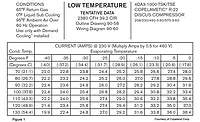
In these cases, the service technician must obtain compressor performance data from the compressor manufacturer. Many times, this data can be found on the Internet at the appropriate compressor manufacturer’s website, which can include compressor data in table form as shown in Figure 1. In that form, it can be seen that the amperage drawn by the compressor depends on both the condensing and evaporating temperature. This type of data also comes in curve form. It is often referred to as a rating chart or performance data for a particular compressor. Compressor manufacturers publish a rating or performance chart for each compressor they manufacture. Here is a field problem in which such a chart comes in handy.

Let’s assume the HCFC-22 compressor is operating at 230 volts and has an evaporator temperature of -15o°F and a condensing temperature of 1,00o°. Determine the correct current (amp) draw for this compressor using the table.

Solution: Using the current (amperage) table, the intersection of the 1,00o° condensing temperature with a -15o evaporating temperature results in an amp draw of 29.4 amps. This data tells us that this compressor operating under these pressures should draw close to 29.4 amps at 230 volts. The allowable tolerance is +/-10 percent. If the compressor was operating at 460 volts, the amperage values in the table would have to be multiplied by ½. Remember, the compressor must be operating at the proper voltage for the table to be meaningful.

If the service technician now actually measures the compressor amps with an ammeter at the compressor and finds the amps to be very close to 29.4 amps, he has a pretty good idea that the compressor is up to specifications. If, however, the technician measures the current draw of the compressor and finds that it is pulling only 13 amps at these same conditions, there is a problem somewhere. Below is a list of causes why a compressor may draw low amperage:

• Bad suction and/or discharge valve;

• Starved evaporator;

• Worn rings;

• Leaking head gasket or valve plate gasket;

• Restricted liquid line or filter drier;

• Undercharged system;

• Weak motor;

• Metering device starving evaporator.

The service technician must now systematically check each of the above causes and find the one that is the cause for the low amp draw. Amperage tables like the one used in this example are invaluable tools in systematically troubleshooting and diagnosing compressor problems. As the condensing temperature decreases, so do the amperage. This is assuming a constant evaporating temperature.

Also, as the evaporating temperature decreases, so does the amperage. This is assuming a constant condensing pressure. Decreased condensing temperatures mean lower condensing pressures and a lower compression ratio. The compressor’s piston now operates with less pressure against it as it compresses the suction gases. This, in turn, is less stress on the motor and less amperage draws. Also, as the evaporating temperature decreases, so does the evaporating pressures. These lower pressures entering the compressor’s cylinders mean less dense vapors filling the cylinders. Less mass flow rate of refrigerant vapor is pumped by the compressor. This causes a decreased amp draw.

Note: Other operating conditions other than just evaporating and condensing temperatures (pressures) are used for these tables. The conditions in the upper left hand corner of data chart for our example must be met for the values to be 100 percent accurate. The conditions are:

• 65°F return gas temperature;

• 0° liquid subcooling;

• 95° ambient air over the condenser;

• 60 Hz operation.

If these conditions do not exist, the table will not be 100 percent accurate. However, for purposes of systematic field troubleshooting, these inaccuracies are not great enough to have any great effect on a good service technician’s judgment.

The point is, when troubleshooting a refrigeration or air conditioning compressor’s motor, the RLA or FLA value should not be used to determine if the compressor is good or bad, or if it is drawing the correct amps. Compressor performance data for a specific compressor must be used. If the RLA or FLA has any value to a refrigeration or air conditioning service technician, it is simply to determine at what amperage draw the compressor motor’s overload protector will open. RLA is also used to size wires, fuses, and contactors for the compressor.

Remember, the nameplate RLA does not change as the compressor motor load changes with temperatures and pressures. Again, the RLA should not be used by the refrigeration or air conditioning service technician to determine the proper refrigerant charge, or to determine if the compressor is running properly.

In summary, never compare or check the compressor’s actual amp draw against the nameplate RLA or FLA stamped on the compressor to determine if it is operating properly. Always refer to compressor performance or rating data for that compressor from the compressor manufacturer.

Publication date: 03/07/2011
KEYWORDS: maintenance for HVACR troubleshooting and HVACR

Share This Story

Looking for a reprint of this article?
From high-res PDFs to custom plaques, order your copy today!


John Tomczyk is HVACR professor emeritus, Ferris State University, Big Rapids, Michigan, and coauthor of Refrigeration & Air Conditioning Technology, published by Cengage Learning. Contact him at tomczykjohn@gmail.com.

Recommended Content

JOIN TODAY
To unlock your recommendations.

Already have an account? Sign In

  • HVAC-enrollment

    The Trades Are Back: HVACR Programs See Nearly 30% Enrollment Spike

    A new wave of future technicians is entering the pipeline.  
    News
    By: Matt Jachman
  • 2025 Top 40 Under 40

    2025 Top 40 Under 40 HVACR Professionals List

    The 11th annual Top 40 Under 40 list highlights those...
    News
    By: Hannah Belloli-Oster
  • LG Ductless Mini-Split Systems

    The 9 Types of Heat Pumps

    As the U.S. moves toward electrification, heat pumps are...
    HVAC Residential Market
    By: Joanna R. Turpin
Subscription Center
  • Create an Account
  • Start a Subscription
  • Manage My Account
  • Sign Up for Newsletters
  • Visit Customer Service
  • Update Preferences

More Videos

Sponsored Content

Sponsored Content is a special paid section where industry companies provide high quality, objective, non-commercial content around topics of interest to The News audience. All Sponsored Content is supplied by the advertising company and any opinions expressed in this article are those of the author and not necessarily reflect the views of The News or its parent company, BNP Media. Interested in participating in our Sponsored Content section? Contact your local rep!

close
  • Piggy Bank
    Sponsored byWatercress Financial

    Energy Prices, Inflation, and HVAC: What Today’s Homeowners Care About

  • Refrigerated Food
    Sponsored bySolstice Advanced Materials

    R-455A Refrigeration: A Cold Storage Solution for the Future

  • Airex Rooftop Units
    Sponsored byAirex Manufacturing Inc

    Consolidating Roof Penetrations: A Growing Trend in Multifamily HVAC Design

Popular Stories

HVAC-Price-Increase-graphic

HVAC Price Increase List: June 2026

Trump-Section-232.jpg

Trump Reduces Section 232 Tariffs on HVAC Equipment to 15%

Refrigerants-and-gauge.jpg

HVAC Industry Warns of Counterfeit Refrigerants Entering U.S. Supply Chain

Midea-training.jpg

HVAC Workforce Crisis Expands Beyond Technicians to Instructor Shortages

U.S. Supreme Court building

95% Furnace Efficiency Rule to Get New Hearing

View The ACHR NEWS
Centennial Anniversary Timeline

The ACHR News Timeline Chart
Submit a Letter
Submit a letter to our editors.

Events

November 6, 2025

Next-Gen Data Center Cooling: HVAC Innovation and Real-World Solutions

On Demand As AI workloads and high-density computing push traditional cooling methods to their limits, the data center industry is accelerating the adoption of next-generation HVAC technologies.

June 17, 2026

Decarbonization Without Disruption

This webinar will explore practical HVAC decarbonization strategies that minimize disruption while maximizing long-term performance and ROI.

View All Submit An Event

Poll

Summer Staff

Are you fully staffed for the summer season?
View Results Poll Archive

Products

BNI Mechanical/Electrical Square Foot Costbook, 2026 Edition

BNI Mechanical/Electrical Square Foot Costbook, 2026 Edition

See More Products
Decarbonization Without Disruption - Free Webinar - 6/17/2026

Related Articles

  • The Professor: Compressor Amperage Curves

    See More
  • Table 1

    The Professor: Understanding Compressor Amperage Curves

    See More
  • The Professor: Compressor Overheating

    See More

Related Products

See More Products
  • compressormotorwindingsdvd.jpg

    UNDERSTANDING COMPRESSOR MOTOR WINDINGS

  • 0071829598.jpeg

    HVAC Equations, Data, and Rules of Thumb, Third Edition

  • new cover.jpg

    Profit is An Attitude: The Strategies You Need to Optimize Profits

See More Products

Events

View AllSubmit An Event
  • March 11, 2026

    Insulating the Cloud: Insulation Solutions for Data Center Demands

    On Demand Gain practical insights into material selection, efficiency optimization, and real‑world challenges faced in fast‑growing data‑center environments. Join us to elevate your understanding of high‑performance mechanical insulation strategies.
  • May 6, 2014

    Scroll Compressor Technology Day—INLD-STT1

    The Scroll Compressor Technology Day provides a concise overview of the applicable Copeland brand compressors and their varying applications. The course then follows up with proven troubleshooting techniques and practices.
View AllSubmit An Event

Related Directories

  • Carlyle Compressor

    Count on Carlyle. Carlyle compressors can be found around the world - from the first nuclear sub to your grocer's freezer to entire bus fleets.
  • Aspen Compressor LLC

    Manufactures the world's smallest miniature rotary BLDC refrigeration compressors for use in extremely compact, lightweight and efficient cooling systems for mobile, solar, and other applications.
×

Sign Up. Stay Informed.

The #1 trusted source for the HVACR industry since 1926

SUBSCRIBE
  • RESOURCES
    • Advertise
    • Contact Us
    • Advisory Board
    • Classifieds
    • Submit a Letter
    • Directories
    • Store
  • ACCOUNT CENTER
    • Create an Account
    • Start a Subscription
    • Manage My Account
    • Sign Up for Newsletters
    • Visit Customer Service
    • Update Preferences
  • SERVICES
    • Marketing Services
    • Reprints
    • Market Research
    • List Rental
    • Survey/Respondent Access
  • STAY CONNECTED
    • LinkedIn
    • Facebook
    • Instagram
    • YouTube
    • X (Twitter)
  • PRIVACY
    • PRIVACY POLICY
    • TERMS & CONDITIONS
    • DO NOT SELL MY PERSONAL INFORMATION
    • PRIVACY REQUEST
    • ACCESSIBILITY

Copyright ©2026. All Rights Reserved BNP Media, Inc. and BNP Media II, LLC.

Design, CMS, Hosting & Web Development :: ePublishing