ACHR News
search
Ask ACHR NEWS AI
cart
facebook twitter instagram linkedin youtube
  • Sign In
  • Subscribe
  • Sign Out
  • My Account
ACHR News
  • NEWS
    • Breaking News
    • New HVAC Products
    • Featured Products
    • Manufacturer Reports
    • HVAC Data
    • Legislation
    • ACHR NEWS Centennial
  • RESIDENTIAL
    • Air Conditioners
    • Furnaces
    • Residential Heat Pumps
    • Ductless
    • Residential IAQ
    • Testing, Monitoring, Tools
    • Components & Accessories
  • COMMERCIAL
    • Air Handlers
    • Rooftop Units
    • Chillers and Cooling Towers
    • Commercial Heat Pumps
    • Boilers and Hydronics
    • VRF/Ductless
    • Commercial IAQ
  • REFRIGERATION
    • Refrigerants
    • Refrigerant Regulations
    • Leak Management
  • CONTRACTOR PRO
    • Geothermal
    • Homeowner Study
    • VRF and VRV Ductless
    • Unitary Trends
  • EDUCATION
    • Training and Education
    • Business Management
    • Service and Maintenance
    • Continuing Education
    • Market Research >
      • HVAC Brand Awareness Report
      • VRV, VRF, VRVZ Report
      • Unitary Trends Report
      • Water Heat Professionals Report
    • Webinars
    • Sponsor Insights
    • eProducts Info
    • White Papers
  • EVENTS
    • HVAC Contractor Forum
    • Industry Events and Webinars
  • MEDIA
    • Videos
    • AHR Expo 2025 Videos
    • Podcasts >
      • ACHR News Podcast
      • HARDI Podcasts
      • AHR Expo Podcasts
      • ACCA Podcasts
    • Interactive Spotlights
    • Quizzes
    • eBooks
    • HVAC Talkback
  • HVAC GROUP
    • ACHR NEWS >
      • Current Issue
      • Digital Edition
      • Subscribe
    • Distribution Trends
    • SNIPS NEWS >
      • Join SNIPS NEWS
    • Engineered Systems News >
      • Join ES News
    • HVACR Directory
    • Contests
    • Newsletters
    • Contact
    • Advertise
    • My Account
RefrigerationRefrigerants

How's Your Recovery Unit Doing?
By Peter Powell
March 7, 2011
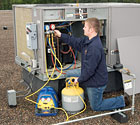
Newer recovery units are able to do far more than their predecessors. (Feature photos courtesy of Ritchie Engineering Co., Yellow Jacket Products Division.)


It has been more than two decades since the first refrigerant recovery unit came to the HVACR market and became part of the tool arsenal for service technicians.

Over that time, two things have become clear: Even a repairable unit doesn’t last forever and the newest units are able to do far more than their predecessors.

Said Tim Naylor, sales manager for RefTec International Systems, “Recovery equipment generally needs replacing/rebuilding when the recovery rate diminishes due to deterioration of the compressor seals.”

As noted by Mary Jo Gentry, marketing communications manager for Ritchie Engineering Co., Yellow Jacket Products Division, “Although most units now are field replaceable, technology changes pretty quickly. If you have your recovery unit for two to five years, you may want to consider replacing the equipment.”

While manufacturers say there is no “rule of thumb” when it is time to replace, they agree that after a couple of years, it would be good to make sure the unit is operating as close to optimum as possible. And if not, it is possible that, as Naylor noted, “Rebuilding may add some years to the unit.

“Over the last decade, units have been designed with higher quality components which lead to longer life.” He also noted, for example, that his company’s units “can be rebuilt down the road for a fraction of the price of buying new.”

Gentry did add that the life span of any recovery unit depends “on how hard you use them.”

WHAT'S OLD

Recovery units surfaced in our industry in the 1980s. They came about, recounted Don Bowman of the eHow.com website, “when it was discovered that chlorofluorocarbons were depleting the ozone layer. Once this was discovered, CFCs were taken off of the market and maintenance facilities were advised that they needed to have a way of capturing (refrigerant) when extracted. It became illegal to release it into the atmosphere. The recovery machine was quickly developed and certification course was necessary to own and operate one at a shop.”

When recovery units were first introduced, they were new kids on the block subject to a bit of trial and error. In the early days, some contractors tried to build their own units in their backyards, some units came over from the automotive sector which had to recover refrigerant ahead of stationary mandates, and still others seemed to have been thrust onto the market just so a contractor could say they had a unit as mandated by the U.S. Environmental Protection Agency (EPA).

Over the years, reputable and established companies, such as those quoted in this article, have developed units that do what the manufacturers say they do - and those manufacturers stand behind their products.

With rising costs of refrigerants and ever more cost-conscious customers, being able to reuse recovered refrigerant is especially important.

WHAT'S NEW

Changes have come as the result of newer and better ways to do recovery and to deal with new refrigerants such as HFCs and new lubricants such as POEs.

“The newer equipment allows you to do some of the higher pressure refrigerants like HFC-410A,” said Gentry. “Equipment manufacturers have come a long way in making R-410A and other refrigerants easier to deal with.”

Noted Naylor, “Newer recovery equipment should be able to recover a wide range of refrigerants such as R-410A, HCFC-22, and HFC-134a. They should be lightweight, quiet, and durable. Newer recovery equipment should also be offered with low pressure shut-off switches and float cables to add an extra layer of safety.”

Gentry agreed with the need for such newer elements as part of a recovery unit. “Automatic shut-off and restart will allow the technician to do other work on the property to not have to babysit the unit. The automatic shut off and restart will extend the life of the compressor since it is not running any longer than it needs to.”

A PRACTICAL REALITY

The early days of recovery came about as a way to avoid venting refrigerant to the atmosphere and avoid fines levied by the EPA.

Now with the rising cost of refrigerants, cost consciousness is paramount especially since recovered refrigerant can be reused over and over again - and more than likely that refrigerant is the least expensive a contractor has in his inventory.

Publication date: 03/07/2011
KEYWORDS: HCFC refrigerants HFC refrigerants R-22 refrigerant R-410A

Share This Story

Looking for a reprint of this article?
From high-res PDFs to custom plaques, order your copy today!


Peter Powell is Refrigeration Editor. He can be contacted at 815-654-7270 or peterpowell@achrnews.com. Peter was formerly Editor/Publisher of Service & Contracting, where he gained his refrigeration experience. Among his duties, Powell is responsible for the monthly Refrigeration Zone sections in The NEWS

Recommended Content

JOIN TODAY
To unlock your recommendations.

Already have an account? Sign In

  • HVAC-enrollment

    The Trades Are Back: HVACR Programs See Nearly 30% Enrollment Spike

    A new wave of future technicians is entering the pipeline.  
    News
    By: Matt Jachman
  • 2025 Top 40 Under 40

    2025 Top 40 Under 40 HVACR Professionals List

    The 11th annual Top 40 Under 40 list highlights those...
    HVAC Contracting
    By: Hannah Belloli-Oster
  • LG Ductless Mini-Split Systems

    The 9 Types of Heat Pumps

    As the U.S. moves toward electrification, heat pumps are...
    Air Source Heat Pumps
    By: Joanna R. Turpin
Subscription Center
  • Create an Account
  • Start a Subscription
  • Manage My Account
  • Sign Up for Newsletters
  • Visit Customer Service
  • Update Preferences

More Videos

Sponsored Content

Sponsored Content is a special paid section where industry companies provide high quality, objective, non-commercial content around topics of interest to The News audience. All Sponsored Content is supplied by the advertising company and any opinions expressed in this article are those of the author and not necessarily reflect the views of The News or its parent company, BNP Media. Interested in participating in our Sponsored Content section? Contact your local rep!

close
  • Piggy Bank
    Sponsored byWatercress Financial

    Energy Prices, Inflation, and HVAC: What Today’s Homeowners Care About

  • Refrigerated Food
    Sponsored bySolstice Advanced Materials

    R-455A Refrigeration: A Cold Storage Solution for the Future

  • Airex Rooftop Units
    Sponsored byAirex Manufacturing Inc

    Consolidating Roof Penetrations: A Growing Trend in Multifamily HVAC Design

Popular Stories

Outdoor-condensing-units.jpg

EPA Removes R-410A Installation Deadline

Trump-Section-232.jpg

Trump Reduces Section 232 Tariffs on HVAC Equipment to 15%

cooling-habits.jpg

50 Percent of Americans Have Skipped HVAC Maintenance

ACHR NEWS Editor Chris Gray Presenting HVAC Minute 5-18-2026

HVAC Manufacturers Fight Pricing Lawsuits

tim-brooks.jpeg

2026’s Best Distributor Partners With Customers

View The ACHR NEWS
Centennial Anniversary Timeline

The ACHR News Timeline Chart
Submit a Letter
Submit a letter to our editors.

Events

November 6, 2025

Next-Gen Data Center Cooling: HVAC Innovation and Real-World Solutions

On Demand As AI workloads and high-density computing push traditional cooling methods to their limits, the data center industry is accelerating the adoption of next-generation HVAC technologies.

June 9, 2026

Before You Go All In on AI: Set Up Your Business to Actually Win

In this webinar, we'll walk you through exactly what to get in place before you add AI to your business. You'll leave with a clear picture of where you stand today and a practical action plan to set yourself up for real results.

View All Submit An Event

Poll

EPA Decision

Are you happy the EPA decided contractors can continue to install R-410A equipment?
View Results Poll Archive

Products

BNI Mechanical/Electrical Square Foot Costbook, 2026 Edition

BNI Mechanical/Electrical Square Foot Costbook, 2026 Edition

See More Products
A2L Refrigerants - Free Webinar - May 21, 2026

Related Articles

  • Proper Maintenance of a Recovery Unit

    See More
  • Bacharach Inc.: Refrigerant Recovery Unit

    See More
  • Bacharach Inc.: Refrigerant Recovery Unit

    See More

Related Products

See More Products
  • front cover only.jpg

    How to Market Your HVAC Business

  • srepm.png

    System Recovery & Evacuation

See More Products

Related Directories

  • Howe Corp.

    Howe manufactures flake ice making equipment for use with virtually any refrigerant including natural such as R-744, and R-717, Ice storage bins, Condensing units for our ice flakers.
  • Energy Recovery

    Energy Recovery's PX G1300 pressure exchanger for CO2 refrigeration systems lowers operating costs and energy consumption, increases efficiency, and reduces emissions.
  • Your Bargain Mart

    We are a MRCOOL Dealer and carry contractor-grade HVAC equipment, air handlers, condensers, heat pumps, gas furnaces, evaporator coils and heat pumps, gas, and electric packaged units.
×

Sign Up. Stay Informed.

The #1 trusted source for the HVACR industry since 1926

SUBSCRIBE
  • RESOURCES
    • Advertise
    • Contact Us
    • Advisory Board
    • Classifieds
    • Submit a Letter
    • Directories
    • Store
  • ACCOUNT CENTER
    • Create an Account
    • Start a Subscription
    • Manage My Account
    • Sign Up for Newsletters
    • Visit Customer Service
    • Update Preferences
  • SERVICES
    • Marketing Services
    • Reprints
    • Market Research
    • List Rental
    • Survey/Respondent Access
  • STAY CONNECTED
    • LinkedIn
    • Facebook
    • Instagram
    • YouTube
    • X (Twitter)
  • PRIVACY
    • PRIVACY POLICY
    • TERMS & CONDITIONS
    • DO NOT SELL MY PERSONAL INFORMATION
    • PRIVACY REQUEST
    • ACCESSIBILITY

Copyright ©2026. All Rights Reserved BNP Media, Inc. and BNP Media II, LLC.

Design, CMS, Hosting & Web Development :: ePublishing