ACHR News
search
Ask ACHR NEWS AI
cart
facebook twitter instagram linkedin youtube
  • Sign In
  • Subscribe
  • Sign Out
  • My Account
ACHR News
  • NEWS
    • Breaking News
    • New HVAC Products
    • Featured Products
    • Manufacturer Reports
    • HVAC Data
    • Legislation
    • ACHR NEWS Centennial
  • RESIDENTIAL
    • Air Conditioners
    • Furnaces
    • Residential Heat Pumps
    • Ductless
    • Residential IAQ
    • Testing, Monitoring, Tools
    • Components & Accessories
  • COMMERCIAL
    • Air Handlers
    • Rooftop Units
    • Chillers and Cooling Towers
    • Commercial Heat Pumps
    • Boilers and Hydronics
    • VRF/Ductless
    • Commercial IAQ
  • REFRIGERATION
    • Refrigerants
    • Refrigerant Regulations
    • Leak Management
  • CONTRACTOR PRO
    • Geothermal
    • Homeowner Study
    • VRF and VRV Ductless
    • Unitary Trends
  • EDUCATION
    • Training and Education
    • Business Management
    • Service and Maintenance
    • Continuing Education
    • Market Research >
      • HVAC Brand Awareness Report
      • VRV, VRF, VRVZ Report
      • Unitary Trends Report
      • Water Heat Professionals Report
    • Webinars
    • Sponsor Insights
    • eProducts Info
    • White Papers
  • EVENTS
    • HVAC Contractor Forum
    • Industry Events and Webinars
  • MEDIA
    • Videos
    • AHR Expo 2025 Videos
    • Podcasts >
      • ACHR News Podcast
      • HARDI Podcasts
      • AHR Expo Podcasts
      • ACCA Podcasts
    • Interactive Spotlights
    • Quizzes
    • eBooks
    • HVAC Talkback
  • HVAC GROUP
    • ACHR NEWS >
      • Current Issue
      • Digital Edition
      • Subscribe
    • Distribution Trends
    • SNIPS NEWS >
      • Join SNIPS NEWS
    • Engineered Systems News >
      • Join ES News
    • HVACR Directory
    • Contests
    • Newsletters
    • Contact
    • Advertise
    • My Account

Should ERVs be Installed in Northern Climates?

April 24, 2006
Energy recovery ventilators (ERVs) fill a need in home ventilation, but a growing number of industry insiders question their installation in homes where cold winters are the norm.

Through a combination of fans, controls, and heat recovery elements, both ERVs and heat recovery ventilators (HRVs) bring in fresh air from the outdoors and exhaust stale air from the home, creating a balanced ventilation system. Continuously running, they provide a steady supply of fresh air while recovering a portion of the energy normally lost through nonheat recovery ventilation.

But in an industry cluttered by often-unsubstantiated claims, anecdotal evidence, and inaccuracies, a debate ensues over the effectiveness of ERVs in northern climates - focusing on such concerns as the durability and long-term reliability of the systems.

"The durability of ERVs is certainly a concern," said Dennis Dietz, Ph.D., vice president of engineering with Sarasota, Fla.-based American ALDES Ventilation Corp. "Homeowners should be asking how long the unit is going to last in a cold climate, how immune is the product to freeze damage?"
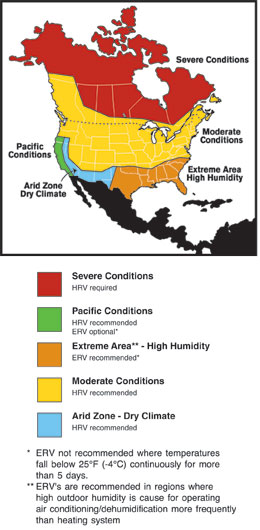
This map offers an idea of which climate zones are appropriate, or inappropriate, for ERVs.

CORE DAMAGE AND HUMIDITY

"Many manufacturers claim ERV cores are made of resin static plates, but these are actually paper-based cores, which often freeze. When ERV cores are exposed to low temperatures, the paper resin material will absorb the water, which will freeze. If you have liquid condensation on the core, that liquid gets into the paper, comprising the core.

"In the Green Bay area, one company rep told me he had replaced units that had been used in the prior winter," said Dietz. "They froze, destroyed themselves, turned into mush. The paper had disintegrated. I really have concerns about the excessive use of ERVs in cold climates."

Ola Wettergren, president of Fantech and chairman of the Home Ventilating Institute (HVI), said that while his company sells both HRVs and ERVs, he steers customers in northern climates away from the latter.

"Typically we say that ERVs are ideal in southern climates where hot, humid weather is predominant and air conditioning is used most of the year," he said. "In northern climates, ERVs can actually add to humidity problems if the indoor humidity is already high, as is typical in new construction homes. Unlike an HRV, the ERV will allow humidity back into the building, adding to the problem," said Wettergren.

"Generally the performance difference between the two is not great enough to justify using an ERV in colder climates. It's better to have a humidifier for adding humidity and an HRV to control elevated humidity and efficiently introduce fresh air."

"An HRV has a lifetime warranty on the core [heat exchanger element]," Wettergren explained. "An ERV in a northern climate likely has a more limited lifespan, so logically the HRV is the better choice and the one we suggest. An HRV core can be easily cleaned and there is no question about durability or buildup in the core. You could go back six, seven, eight years or more after the purchase and the HRV is very likely to be functioning exactly the same way at the time of purchase."

Looking for quick answers on air conditioning, heating and refrigeration topics? Try Ask ACHR NEWS, our new smart AI search tool. Ask ACHR NEWS →
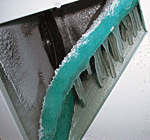
Manufacturers of energy recovery ventilators are steering their customers away from that product’s application in northern climates. The potential for ice formation in the cores is the main reason for their joint warning.

HOMEOWNER EDUCATION

Homeowners are confronted with a number of issues when considering the installation of an ERV or HRV in their homes.

Nutech, for example, looked carefully at marketing ERVs to both warm and cold climates, but it had a requirement that the ERVs must survive a cold winter. In testing, however, ERVs just did not work satisfactorily, so the company continues to advocate HRVs for cold climates.

You can put a lifetime warranty on cores that are aluminum based, which is what Nutech uses as its heat transfer material. Paper has a much shorter warranty period. The problem is that consumers really don't know if their heat exchanger has been damaged by water or ice. When the ERV core is damaged, it may not be evident. Deterioration of the ERV core leads to leakage and a loss of efficiency and airflow - another major problem.

I tell potential customers the most reliable way of avoiding these problems is to check the Home Ventilating Institute (HVI) Website (www.hvi.org). Founded in 1955, HVI is the premier nonprofit association of home ventilating product manufacturers. It represents a wide range of home ventilating products made by companies in the United States, Canada, Asia, and Europe.

A salesperson can say whatever he wants. But to get the real information, you just look up the product on the Website to find out under what conditions the system was tested. You'll find that almost all ERVs are tested at temperatures above 32°F. This will tell the consumer that there is an issue.

If an ERV was truly suitable for regions of North America where temperatures fall below freezing in the winter, it should have a defrost mechanism installed, and ratings related to temperatures experienced in those regions. A very common rating for cold temperatures in North America is -13°. Some of the ERV cores in our labs, and even HRVs without proper defrost mechanisms, will start to freeze well above -13°.

QUALIFIED CLAIMS

Dietz said even companies that extol the virtues of using ERVs in colder climates do so with qualifiers attached to their claims. “There is a hesitation in their own literature about the use under certain conditions. It’s clear that you need to have the indoor conditions dry, otherwise they will not have frost-free performance. The systems will freeze and potentially damage themselves.”

Wettergren, who has an extensive background as an aeronautical engineer, said that while there are different views on the subject, there is no dispute over the climate map from Building Science Corp.

“It really makes what product to use quite clear.”

“We manufacture both ERVs and HRVs,” he said. “My direct advice is that an HRV is a better choice anywhere you have conditions that will cause freezing inside the machinery. [HRVs] are clearly the better choice under such conditions.”

Grinbergs is chairman of the HRV and ERV Committee of HVI (www.hvi.org).

Editor’s Note: Letters from the Board of Directors of HVI and from Douglas Steege of RenewAire were later published that refute opinions expressed in this article. To read those letters, click here.

Publication date: 04/24/2006

Share This Story

Looking for a reprint of this article?
From high-res PDFs to custom plaques, order your copy today!


Recommended Content

JOIN TODAY
To unlock your recommendations.

Already have an account? Sign In

  • HVAC-enrollment

    The Trades Are Back: HVACR Programs See Nearly 30% Enrollment Spike

    A new wave of future technicians is entering the pipeline.  
    Training and Education
    By: Matt Jachman
  • 2025 Top 40 Under 40

    2025 Top 40 Under 40 HVACR Professionals List

    The 11th annual Top 40 Under 40 list highlights those...
    HVAC Residential Market
    By: Hannah Belloli-Oster
  • LG Ductless Mini-Split Systems

    The 9 Types of Heat Pumps

    As the U.S. moves toward electrification, heat pumps are...
    Air Source Heat Pumps
    By: Joanna R. Turpin
Subscription Center
  • Create an Account
  • Start a Subscription
  • Manage My Account
  • Sign Up for Newsletters
  • Visit Customer Service
  • Update Preferences

More Videos

Sponsored Content

Sponsored Content is a special paid section where industry companies provide high quality, objective, non-commercial content around topics of interest to The News audience. All Sponsored Content is supplied by the advertising company and any opinions expressed in this article are those of the author and not necessarily reflect the views of The News or its parent company, BNP Media. Interested in participating in our Sponsored Content section? Contact your local rep!

close
  • Piggy Bank
    Sponsored byWatercress Financial

    Energy Prices, Inflation, and HVAC: What Today’s Homeowners Care About

  • Refrigerated Food
    Sponsored bySolstice Advanced Materials

    R-455A Refrigeration: A Cold Storage Solution for the Future

  • Airex Rooftop Units
    Sponsored byAirex Manufacturing Inc

    Consolidating Roof Penetrations: A Growing Trend in Multifamily HVAC Design

Popular Stories

Outdoor-condensing-units.jpg

EPA Removes R-410A Installation Deadline

Trump-Section-232.jpg

Trump Reduces Section 232 Tariffs on HVAC Equipment to 15%

cooling-habits.jpg

50 Percent of Americans Have Skipped HVAC Maintenance

ACHR NEWS Editor Chris Gray Presenting HVAC Minute 5-18-2026

HVAC Manufacturers Fight Pricing Lawsuits

tim-brooks.jpeg

2026’s Best Distributor Partners With Customers

View The ACHR NEWS
Centennial Anniversary Timeline

The ACHR News Timeline Chart
Submit a Letter
Submit a letter to our editors.

Events

November 6, 2025

Next-Gen Data Center Cooling: HVAC Innovation and Real-World Solutions

On Demand As AI workloads and high-density computing push traditional cooling methods to their limits, the data center industry is accelerating the adoption of next-generation HVAC technologies.

June 9, 2026

Before You Go All In on AI: Set Up Your Business to Actually Win

In this webinar, we'll walk you through exactly what to get in place before you add AI to your business. You'll leave with a clear picture of where you stand today and a practical action plan to set yourself up for real results.

View All Submit An Event

Poll

EPA Decision

Are you happy the EPA decided contractors can continue to install R-410A equipment?
View Results Poll Archive

Products

BNI Mechanical/Electrical Square Foot Costbook, 2026 Edition

BNI Mechanical/Electrical Square Foot Costbook, 2026 Edition

See More Products
A2L Refrigerants - Free Webinar - May 21, 2026

Related Articles

  • New ‘Hot’ Heat Pump For Northern Climates

    See More
  • Letters: 06/05/2006

    See More
  • Sept. 11, 2008: Largest Solar Power Tracking System in Eastern U.S. to be Installed

    See More

Related Products

See More Products
  • EHEP002028.jpg

    Principles of Heating, Ventilation, and Air Conditioning in Buildings, 1st Edition

  • 0880690186-228x228.jpg

    Airflow in Ducts

  • Lessons Learned in a Boiler Room: A common sense approach to servicing and installing commercial boilers

See More Products

Events

View AllSubmit An Event
  • November 13, 2025

    4 Lead Generation Mistakes You Might Be Making in Your Business & How to Fix Them

    On Demand From website gaps to follow-up breakdowns, you’ll walk away with practical tips to improve your lead flow process and turn your marketing investment into actual revenue results.
View AllSubmit An Event

Related Directories

  • Northern Air Systems

    Manufactures custom engineered HVAC systems for mission-critical and ruggedized applications. Mobile, medical, broadcast, aviation, military, O&G, agriculture, datacenters, e-houses, hazardous zones and extreme locations.
×

Sign Up. Stay Informed.

The #1 trusted source for the HVACR industry since 1926

SUBSCRIBE
  • RESOURCES
    • Advertise
    • Contact Us
    • Advisory Board
    • Classifieds
    • Submit a Letter
    • Directories
    • Store
  • ACCOUNT CENTER
    • Create an Account
    • Start a Subscription
    • Manage My Account
    • Sign Up for Newsletters
    • Visit Customer Service
    • Update Preferences
  • SERVICES
    • Marketing Services
    • Reprints
    • Market Research
    • List Rental
    • Survey/Respondent Access
  • STAY CONNECTED
    • LinkedIn
    • Facebook
    • Instagram
    • YouTube
    • X (Twitter)
  • PRIVACY
    • PRIVACY POLICY
    • TERMS & CONDITIONS
    • DO NOT SELL MY PERSONAL INFORMATION
    • PRIVACY REQUEST
    • ACCESSIBILITY

Copyright ©2026. All Rights Reserved BNP Media, Inc. and BNP Media II, LLC.

Design, CMS, Hosting & Web Development :: ePublishing