ACHR News
search
Ask ACHR NEWS AI
cart
facebook twitter instagram linkedin youtube
  • Sign In
  • Subscribe
  • Sign Out
  • My Account
ACHR News
  • NEWS
    • Breaking News
    • New HVAC Products
    • Featured Products
    • Manufacturer Reports
    • HVAC Data
    • Legislation
    • ACHR NEWS Centennial
  • RESIDENTIAL
    • Air Conditioners
    • Furnaces
    • Residential Heat Pumps
    • Ductless
    • Residential IAQ
    • Testing, Monitoring, Tools
    • Components & Accessories
  • COMMERCIAL
    • Air Handlers
    • Rooftop Units
    • Chillers and Cooling Towers
    • Commercial Heat Pumps
    • Boilers and Hydronics
    • VRF/Ductless
    • Commercial IAQ
  • REFRIGERATION
    • Refrigerants
    • Refrigerant Regulations
    • Leak Management
  • CONTRACTOR PRO
    • Geothermal
    • Homeowner Study
    • VRF and VRV Ductless
    • Unitary Trends
  • EDUCATION
    • Training and Education
    • Business Management
    • Service and Maintenance
    • Continuing Education
    • Market Research >
      • HVAC Brand Awareness Report
      • VRV, VRF, VRVZ Report
      • Unitary Trends Report
      • Water Heat Professionals Report
    • Webinars
    • Sponsor Insights
    • eProducts Info
    • White Papers
  • EVENTS
    • HVAC Contractor Forum
    • Industry Events and Webinars
  • MEDIA
    • Videos
    • AHR Expo 2025 Videos
    • Podcasts >
      • ACHR News Podcast
      • HARDI Podcasts
      • AHR Expo Podcasts
      • ACCA Podcasts
    • Interactive Spotlights
    • Quizzes
    • eBooks
    • HVAC Talkback
  • HVAC GROUP
    • ACHR NEWS >
      • Current Issue
      • Digital Edition
      • Subscribe
    • Distribution Trends
    • SNIPS NEWS >
      • Join SNIPS NEWS
    • Engineered Systems News >
      • Join ES News
    • HVACR Directory
    • Contests
    • Newsletters
    • Contact
    • Advertise
    • My Account

Reducing the First Cost of Heat Pumps
August 31, 2009
The length of the ground heat exchanger piping for a given building is affected by the building’s heating and cooling loads, wrote John Shonder and Jeffrey D. Spitler; “minimizing those loads minimizes the heat exchanger length, which in turn minimizes installation costs.”


Consumers are showing more and more interest in ground-source heat pump (GSHP) systems, due in part to consumer efficiency research and the availability of federal and local efficiency rebates. However, their first cost can still deter consumers’ best intentions.

According to a paper by John Shonder and Jeffrey D. Spitler (both of Oak Ridge National Laboratory [ORNL], and published in IEA Heat Pump Centre Newsletter Vol. 27, Issue 1, 2009), “the use of ground source heat pumps in residential applications is limited by the cost of installing ground heat exchangers.” However, they found some solutions that could help the technology become more palatable by lowering those first costs.

According to the authors, a collaborative research project between ORNL, Oklahoma State University, and De Montfort University is examining potential solutions and developing design tools.


MINIMIZED LOADS, MINIMIZED LENGTHS

A major factor in the high first cost of GSHP is due to the cost of the drilling/excavation needed to install ground heat exchanger piping, they pointed out.

“In general, the length of the ground heat exchanger piping required for a given building is a function of the building’s heating and cooling loads,” they wrote; “minimizing those loads minimizes the heat exchanger length, which in turn minimizes installation costs.”

Zero energy homes, for instance, have space conditioning loads that are so low, “the excavations made for the basement/foundation - along with other excavations such as those required for water and sewer lines - may be sufficient to contain all of the ground heat exchanger piping necessary,” said Shonder and Spitler.

“Where existing excavations are insufficient” - in other words, where the home’s air conditioning loads are much higher - “auxiliary heat sources and/or sinks, such as mechanical ventilation, could satisfy the remainder of the requirement.”

In either case, they wrote, “foundation heat exchangers can eliminate the need for separate drilling or trenching for ground heat exchangers, thereby significantly reducing or eliminating the cost premium associated with ground source heat pumps.”


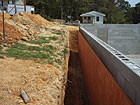
This image shows the foundation heat exchanger for a house during construction, before it was backfilled.

EXPERIMENTAL WORK

According to Shonder and Spitler, ORNL has already demonstrated the feasibility of foundation heat exchangers. This was in a 2,600-square-foot residence in Lenoir City, Tenn.

They cautioned that more study is needed before the technology can be applied on a large scale. For instance, they need to study interactions between the basement/foundation, soil, ground loops, and ambient conditions at the ground surface.

At that point, design tools could be developed. Right now, however, “there are no design tools available to size foundation heat exchangers or the supplemental heat sources/sinks that may be required.”

The research is underway. It involves four research homes built around Oak Ridge, Tenn., and an alliance between ORNL, the U.S. Department of Energy, Tennessee Valley Authority, a construction company, and various equipment and building material manufacturers.

The houses, which will incorporate a number of energy-efficient technologies, will be monitored to assess their performance - monitored to a very high degree. As we might expect, one of the technologies is the foundation heat exchanger.

The mass of soil around the foundation is subject to heat transfer from the foundation itself, and from the heat exchanger pipes by way of conduction within the soil. Moisture flow also takes place within the soil. At the surface, heat is transferred through convection, radiation, and evapo-transpiration.

The bottom image above shows the foundation heat exchanger for one of the houses during construction, before it was backfilled. Three parallel loops are located in the basement/foundation overcut. The installation also applies trenching for water and sewer connections.

According to the authors, “ORNL is collecting data on water inlet and outlet temperatures, pipe surface temperatures at various points along the length, soil temperatures both within the trenches and at undisturbed locations, heat flux across the foundation walls, and other variables of interest.”

At the same time, the team from Oklahoma State University and De Montfort University is developing a series of two- and three-dimensional heat transfer models. These are expected to be the basis for both a stand-alone design tool and a simulation model (to be incorporated into building energy analysis programs such as EnergyPlus). This shows preliminary results of temperature distribution in the ground surrounding a foundation heat exchanger, calculated with an analytical model.

Shonder and Spitler said the stand-alone design tool can help system designers figure out whether or not a foundation heat exchanger will sufficiently meet the heat rejection/extraction needs of the GSHP system over the life of the system. “If it will not be sufficient, the design tool will support the sizing of an alternative supplementary heat source or sink,” they said. The simulation model will be able to predict entering fluid temperature to the heat pump, from the foundation heat exchanger, in hourly or shorter time steps.


CONCLUSIONS

The authors summed it up: “Foundation heat exchangers have the potential to reduce the cost of using ground-source heat pumps in zero-energy homes and other low-energy buildings.

“With calibrated design tools and simulation models available, engineers and architects will be able to specify the use of foundation heat exchangers in buildings, leading to reductions in energy consumption and carbon emissions.”

For more information, contact John Shonder, Oak Ridge National Laboratory; shonderja@ornl.gov; 865-574-2015.

Publication date: 08/31/2009

Share This Story

Looking for a reprint of this article?
From high-res PDFs to custom plaques, order your copy today!


Recommended Content

JOIN TODAY
To unlock your recommendations.

Already have an account? Sign In

  • HVAC-enrollment

    The Trades Are Back: HVACR Programs See Nearly 30% Enrollment Spike

    A new wave of future technicians is entering the pipeline.  
    News
    By: Matt Jachman
  • 2025 Top 40 Under 40

    2025 Top 40 Under 40 HVACR Professionals List

    The 11th annual Top 40 Under 40 list highlights those...
    HVAC Commercial Market
    By: Hannah Belloli-Oster
  • LG Ductless Mini-Split Systems

    The 9 Types of Heat Pumps

    As the U.S. moves toward electrification, heat pumps are...
    HVAC Commercial Market
    By: Joanna R. Turpin
Subscription Center
  • Create an Account
  • Start a Subscription
  • Manage My Account
  • Sign Up for Newsletters
  • Visit Customer Service
  • Update Preferences

More Videos

Sponsored Content

Sponsored Content is a special paid section where industry companies provide high quality, objective, non-commercial content around topics of interest to The News audience. All Sponsored Content is supplied by the advertising company and any opinions expressed in this article are those of the author and not necessarily reflect the views of The News or its parent company, BNP Media. Interested in participating in our Sponsored Content section? Contact your local rep!

close
  • Piggy Bank
    Sponsored byWatercress Financial

    Energy Prices, Inflation, and HVAC: What Today’s Homeowners Care About

  • Refrigerated Food
    Sponsored bySolstice Advanced Materials

    R-455A Refrigeration: A Cold Storage Solution for the Future

  • Airex Rooftop Units
    Sponsored byAirex Manufacturing Inc

    Consolidating Roof Penetrations: A Growing Trend in Multifamily HVAC Design

Popular Stories

HVAC-Price-Increase-graphic

HVAC Price Increase List: June 2026

Trump-Section-232.jpg

Trump Reduces Section 232 Tariffs on HVAC Equipment to 15%

R410A-Refrigerant-Cylinder.jpg

Refrigerant Recovery is a Revenue Opportunity

Heat-pump-cutaway.jpg

PFAS Rules and A2L Building Codes Continue to Evolve

Kroger.jpg

Kroger to Spend $100 Million to Reduce Refrigerant Leaks

View The ACHR NEWS
Centennial Anniversary Timeline

The ACHR News Timeline Chart
Submit a Letter
Submit a letter to our editors.

Events

November 6, 2025

Next-Gen Data Center Cooling: HVAC Innovation and Real-World Solutions

On Demand As AI workloads and high-density computing push traditional cooling methods to their limits, the data center industry is accelerating the adoption of next-generation HVAC technologies.

June 9, 2026

Before You Go All In on AI: Set Up Your Business to Actually Win

In this webinar, we'll walk you through exactly what to get in place before you add AI to your business. You'll leave with a clear picture of where you stand today and a practical action plan to set yourself up for real results.

View All Submit An Event

Poll

Summer Staff

Are you fully staffed for the summer season?
View Results Poll Archive

Products

BNI Mechanical/Electrical Square Foot Costbook, 2026 Edition

BNI Mechanical/Electrical Square Foot Costbook, 2026 Edition

See More Products
A2L Refrigerants - Free Webinar - May 21, 2026

Related Articles

  • The Growing Popularity of Heat Pumps Podcast

    The NEWSMakers Podcast: The Growing Popularity of Heat Pumps

    See More
  • LG Ductless Mini-Split Systems

    The 9 Types of Heat Pumps

    See More
  • Weil-McLain

    Decarbonization and Energy Efficiency: The Role of Heat Pumps and Boilers in a Changing Industry

    See More

Related Products

See More Products
  • 112058072720552801834076395011509172226.jpg

    Heat Pumps, 2nd Edition

  • Uncomplicating The Heat Pump: Electrical System Troubleshooting DVD

  • The ACHR NEWS - September 08, 2025

    ACHR NEWS September 8, 2025, Issue

See More Products

Related Directories

  • The Whalen Co.

    The Whalen Company is the pioneering manufacturer of HVAC vertical stack riser heat-exchanger fan coil units and water-source heat pumps for hotels, apartments and other multi-story buildings.
  • The Whalen Co.

    Manufacturer of HVAC vertical stack riser heat-exchanger, fan coil units, and water-source heat pumps. Applications include offices, hotels, condominiums, apartments, nursing care, senior living facilities, classrooms and dormitories.
  • Applied Technologies of NY Inc. (ATI of NY)

    Applied Technologies of NY provides reliable, efficient, and cost-effective mechanical solutions, with expert after-market support, serving the New York Metropolitan area since 1996.
×

Sign Up. Stay Informed.

The #1 trusted source for the HVACR industry since 1926

SUBSCRIBE
  • RESOURCES
    • Advertise
    • Contact Us
    • Advisory Board
    • Classifieds
    • Submit a Letter
    • Directories
    • Store
  • ACCOUNT CENTER
    • Create an Account
    • Start a Subscription
    • Manage My Account
    • Sign Up for Newsletters
    • Visit Customer Service
    • Update Preferences
  • SERVICES
    • Marketing Services
    • Reprints
    • Market Research
    • List Rental
    • Survey/Respondent Access
  • STAY CONNECTED
    • LinkedIn
    • Facebook
    • Instagram
    • YouTube
    • X (Twitter)
  • PRIVACY
    • PRIVACY POLICY
    • TERMS & CONDITIONS
    • DO NOT SELL MY PERSONAL INFORMATION
    • PRIVACY REQUEST
    • ACCESSIBILITY

Copyright ©2026. All Rights Reserved BNP Media, Inc. and BNP Media II, LLC.

Design, CMS, Hosting & Web Development :: ePublishing