ACHR News
search
Ask ACHR NEWS AI
cart
facebook twitter instagram linkedin youtube
  • Sign In
  • Subscribe
  • Sign Out
  • My Account
ACHR News
  • NEWS
    • Breaking News
    • New HVAC Products
    • Featured Products
    • Manufacturer Reports
    • HVAC Data
    • Legislation
    • ACHR NEWS Centennial
  • RESIDENTIAL
    • Air Conditioners
    • Furnaces
    • Residential Heat Pumps
    • Ductless
    • Residential IAQ
    • Testing, Monitoring, Tools
    • Components & Accessories
  • COMMERCIAL
    • Air Handlers
    • Rooftop Units
    • Chillers and Cooling Towers
    • Commercial Heat Pumps
    • Boilers and Hydronics
    • VRF/Ductless
    • Commercial IAQ
  • REFRIGERATION
    • Refrigerants
    • Refrigerant Regulations
    • Leak Management
  • CONTRACTOR PRO
    • Geothermal
    • Homeowner Study
    • VRF and VRV Ductless
    • Unitary Trends
  • EDUCATION
    • Training and Education
    • Business Management
    • Service and Maintenance
    • Continuing Education
    • Market Research >
      • HVAC Brand Awareness Report
      • VRV, VRF, VRVZ Report
      • Unitary Trends Report
      • Water Heat Professionals Report
    • Webinars
    • Sponsor Insights
    • eProducts Info
    • White Papers
  • EVENTS
    • HVAC Contractor Forum
    • Industry Events and Webinars
  • MEDIA
    • Videos
    • AHR Expo 2025 Videos
    • Podcasts >
      • ACHR News Podcast
      • HARDI Podcasts
      • AHR Expo Podcasts
      • ACCA Podcasts
    • Interactive Spotlights
    • Quizzes
    • eBooks
    • HVAC Talkback
  • HVAC GROUP
    • ACHR NEWS >
      • Current Issue
      • Digital Edition
      • Subscribe
    • Distribution Trends
    • SNIPS NEWS >
      • Join SNIPS NEWS
    • Engineered Systems News >
      • Join ES News
    • HVACR Directory
    • Contests
    • Newsletters
    • Contact
    • Advertise
    • My Account

The Green Solution for Big Box Cooling

By Steve Kinkel and Harold Simmons
May 25, 2009
The rooftop of the Alside big box facility in Yuma, Ariz., is dotted with United Metal Products’ evaporative cooling equipment.

What do large distribution centers, warehouses, Wal-Mart, Sam’s Club, Costco, and Lowes all have in common? These facilities are all part of what have commonly become known as the big box stores in the construction industry. One would have to admit that over the past 25 years these stores have dramatically changed the landscape of our cities. As the immense demand for large structures has grown, so has the problem of cooling such large buildings in the most efficient and green method possible.

In dealing with the issue of effective climate control, most of these facilities have always defaulted to a standard packaged air conditioning system. However, with the increased cost of energy in the past year, many stores, especially in the Southwest United States such as Wal-Mart Supercenter #4356 in Las Vegas, are opting for a economically and ecologically friendly method of thermal control known as evaporative cooling.

In addition to the significant economic advantage of evaporative cooling (up to 75 percent lower energy consumption than packaged air conditioning in climates with high heat and very low humidity) there are at least six reasons why it is a very environmentally friendly temperature control system.


NO. 1: NATURE'S OWN COOLING MECHANISM

When you walk along the beach in San Diego and feel a cool breeze coming off the water, this is a great example of evaporative cooling. However, if you go inland 50 miles, you will feel a very real difference because of the high drybulb temperature with no evaporation taking place. Evaporative cooling takes place when warmer air comes into contact with cooler water, causing the water to evaporate into the air and thus have a cooling effect on the air.

This adiabatic process works by taking advantage of differences between the dry bulb temperature (dbt) and the wet bulb temperature (wbt). This differential is known as the wet bulb depression (wbd). The greater the wet bulb depression, the greater the felt effect is on the discharge air temperature. In ideal operating conditions, evaporative cooling systems are typically able to lower the sensible heat of the air by 80-90 percent of the wet bulb depression.

Once the outside air passes through the evaporative medium, it provides cool air that can now be moved through the facility, thus removing heat, and then be vented out, providing a continuous stream of fresh air.


Figure 1.

NO. 2: POWER USE

Evaporative cooling systems can use up to 75 percent less power than standard air conditioning rooftop packages. Not only does this decrease the energy consumption and the carbon footprint, but it will also have a significant impact on a company’s bottom line. (See Figure 1).
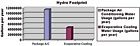


Figure 2.

NO. 3: SMALLER HYDRO FOOTPRINT

Evaporative cooling systems leave a smaller “hydro footprint” than traditional systems. One might assume that this method of cooling would use more water as it relies so heavily on the resource. However, when comparing water usage, there are more factors at play than the on-site water consumption of the cooling system.

In order to produce the added energy used by packaged air conditioning, power companies are forced to generate up to four times more electricity. In creating this electricity, power companies primarily rely on large cooling towers and water that is stored in reservoirs that will, for example, evaporate up to 7.85 gallons of water to produce 1 kWh of power in the state of Arizona (NREL TP-550-33905). When this unseen additional water usage - what we refer to as the hydro footprint - is considered, packaged air conditioning usage actually requires up to 50 percent more water than evaporative cooling systems.

Example: The weighted power plant water use for Arizona according to the National Renewable Energy Laboratory (NREL) requires 7.85 gallons of water to produce 1 kWh of electricity. Notice in Figure 2 how the overall water usage for package air conditioning compares with evaporative cooling.


NO. 4: CONSERVES BUILDING MATERIAL

The light weight of evaporative cooling systems can reduce the structural members needed for building support. This reduction of material use is significant when compared to standard package air conditioning equipment, which weighs more. One obvious and positive environmental effect of this is that if fewer materials are needed to provide structural support, then fewer materials will eventually wind up in our landfills.


NO. 5: RECYCLABLE MATERIALS

Not only do evaporative cooling systems require less material to support the units, but also they are free from environmentally harmful HCFCs. Evaporative units are also environmentally friendly in that all of the cooling media they use is a paper-based recyclable material, and the equipment is constructed from easily recyclable metals and other materials. These two factors: recyclability and the elimination of harmful HCFCs from the cooling process means that a much smaller carbon footprint is left on the environment.


NO. 6: 100 PERCENT OUTSIDE AIR

Evaporative cooling systems are true 100 percent outside air (OA) systems. It accomplishes this by moving large quantities of air that are cooled close to the entering air wet bulb temperature. Not only does this provide cooling, but it also provides air that is approximately 50 percent rh, which is the ideal level for good health. Evaporative cooling is also a very practical solution in that it exceeds the Title 24 requirements that are enforced in California.

The fact that evaporative cooling systems implement nature’s method of cooling, use up to 75 percent less power than other temperature control systems, leave a smaller hydro and carbon footprint, conserve building materials, are recyclable, and provide an effective 100 percent OA system, support the claim that an evaporative cooling system is the most environmentally friendly temperature control system. In light of these factors, any box store, warehouse, manufacturing plant, distribution center, or large industrial facility - in a hot and arid climate - that desires to be environmentally responsible must seriously consider using evaporative cooling as a means of climate control.

Publication date: 05/25/2009

Share This Story

Looking for a reprint of this article?
From high-res PDFs to custom plaques, order your copy today!


Steve Kinkel, president, and Harold Simmons (h.simmons@unitedmetal.com), special projects director, work for United Metal Products in Tempe, Ariz. For more information, visit www.unitedmetal.com.

Recommended Content

JOIN TODAY
To unlock your recommendations.

Already have an account? Sign In

  • HVAC-enrollment

    The Trades Are Back: HVACR Programs See Nearly 30% Enrollment Spike

    A new wave of future technicians is entering the pipeline.  
    Training and Education
    By: Matt Jachman
  • 2025 Top 40 Under 40

    2025 Top 40 Under 40 HVACR Professionals List

    The 11th annual Top 40 Under 40 list highlights those...
    HVAC Light Commercial Market
    By: Hannah Belloli-Oster
  • LG Ductless Mini-Split Systems

    The 9 Types of Heat Pumps

    As the U.S. moves toward electrification, heat pumps are...
    Air Source Heat Pumps
    By: Joanna R. Turpin
Subscription Center
  • Create an Account
  • Start a Subscription
  • Manage My Account
  • Sign Up for Newsletters
  • Visit Customer Service
  • Update Preferences

More Videos

Sponsored Content

Sponsored Content is a special paid section where industry companies provide high quality, objective, non-commercial content around topics of interest to The News audience. All Sponsored Content is supplied by the advertising company and any opinions expressed in this article are those of the author and not necessarily reflect the views of The News or its parent company, BNP Media. Interested in participating in our Sponsored Content section? Contact your local rep!

close
  • Piggy Bank
    Sponsored byWatercress Financial

    Energy Prices, Inflation, and HVAC: What Today’s Homeowners Care About

  • Refrigerated Food
    Sponsored bySolstice Advanced Materials

    R-455A Refrigeration: A Cold Storage Solution for the Future

  • Airex Rooftop Units
    Sponsored byAirex Manufacturing Inc

    Consolidating Roof Penetrations: A Growing Trend in Multifamily HVAC Design

Popular Stories

HVAC-Price-Increase-graphic

HVAC Price Increase List: June 2026

Trump-Section-232.jpg

Trump Reduces Section 232 Tariffs on HVAC Equipment to 15%

R410A-Refrigerant-Cylinder.jpg

Refrigerant Recovery is a Revenue Opportunity

Heat-pump-cutaway.jpg

PFAS Rules and A2L Building Codes Continue to Evolve

Kroger.jpg

Kroger to Spend $100 Million to Reduce Refrigerant Leaks

View The ACHR NEWS
Centennial Anniversary Timeline

The ACHR News Timeline Chart
Submit a Letter
Submit a letter to our editors.

Events

November 6, 2025

Next-Gen Data Center Cooling: HVAC Innovation and Real-World Solutions

On Demand As AI workloads and high-density computing push traditional cooling methods to their limits, the data center industry is accelerating the adoption of next-generation HVAC technologies.

June 9, 2026

Before You Go All In on AI: Set Up Your Business to Actually Win

In this webinar, we'll walk you through exactly what to get in place before you add AI to your business. You'll leave with a clear picture of where you stand today and a practical action plan to set yourself up for real results.

View All Submit An Event

Poll

Summer Staff

Are you fully staffed for the summer season?
View Results Poll Archive

Products

BNI Mechanical/Electrical Square Foot Costbook, 2026 Edition

BNI Mechanical/Electrical Square Foot Costbook, 2026 Edition

See More Products
A2L Refrigerants - Free Webinar - May 21, 2026

Related Articles

  • Welcome To Big Box Heating & Cooling — Maybe

    See More
  • Wasn't That Your Truck Parked at the Big Box?

    See More
  • Contractors Talk About Selling Through The ‘Big Box’

    See More

Related Products

See More Products
  • Green Tips for Building Maintenance Engineers

  • math.jpg

    Math for the Technician

See More Products

Events

View AllSubmit An Event
  • August 21, 2025

    What the Big Beautiful Bill Means for HVAC Contractors

    On Demand In this webinar, we will take a look at the elimination of the residential and commercial HVAC tax incentives and how contractors can navigate this new landscape.
View AllSubmit An Event
×

Sign Up. Stay Informed.

The #1 trusted source for the HVACR industry since 1926

SUBSCRIBE
  • RESOURCES
    • Advertise
    • Contact Us
    • Advisory Board
    • Classifieds
    • Submit a Letter
    • Directories
    • Store
  • ACCOUNT CENTER
    • Create an Account
    • Start a Subscription
    • Manage My Account
    • Sign Up for Newsletters
    • Visit Customer Service
    • Update Preferences
  • SERVICES
    • Marketing Services
    • Reprints
    • Market Research
    • List Rental
    • Survey/Respondent Access
  • STAY CONNECTED
    • LinkedIn
    • Facebook
    • Instagram
    • YouTube
    • X (Twitter)
  • PRIVACY
    • PRIVACY POLICY
    • TERMS & CONDITIONS
    • DO NOT SELL MY PERSONAL INFORMATION
    • PRIVACY REQUEST
    • ACCESSIBILITY

Copyright ©2026. All Rights Reserved BNP Media, Inc. and BNP Media II, LLC.

Design, CMS, Hosting & Web Development :: ePublishing