A Breath of Fresh Air
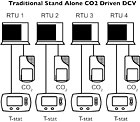
Figure 1. Existing DCV systems require the installation of one CO2 sensor for each unit.
However, implementing DCV in existing buildings can require an expensive damper retrofit or a complete HVAC unit replacement. In addition, most DCV implementations involve stand-alone control of a single rooftop unit (RTU), each with a new sensor, with no coordination across multiple units serving the same shared space.
A newer generation of intelligent DCV technology is increasingly being deployed as part of energy management systems (EMS) with above-site monitoring capabilities. Next-generation DCV systems can provide greater energy savings and improve air quality by automatically optimizing air intake across multiple RTUs. More importantly, these systems can control both new and legacy HVAC systems, eliminate the need to replace equipment or install retrofits, and provide remote monitoring of DCV performance.
DCV BACKGROUND
Maintaining IAQ in commercial buildings requires that significant outside air ventilation be supplied according to building codes and industry standards. Most retail sites have HVAC systems statically set up to serve maximum occupancy levels. As buildings are rarely fully occupied, the HVAC system wastes energy when heating, cooling, and humidifying or dehumidifying excessive amounts of outside air.In many applications the HVAC fan is programmed to run 24/7, regardless of heating or cooling needs or occupancy levels, further wasting energy.
ANSI/ASHRAE 62.1-2004 provides the source requirements for DCV that is widely adopted by government agencies. For retail sales spaces, the outside air requirement is specified at 16 cfm per person at full occupancy. Depending on the total air-moving capacity, the HVAC contractor will set the outside air dampers on each RTU at an appropriate minimum setting to ensure compliance with the 16-cfm/person requirement. A space with rated occupancy of 100 people would require 1,600 cfm of outside air to be pumped into the space.
Without an actual occupancy measurement, standard compliance is only ensured when the outside air mix is preset for 100 percent occupancy, as described earlier. In the case of unoccupied retail space, such as after store hours, the requirement for outside air is 0 percent. EMS can therefore put all RTU fans in auto mode during unoccupied hours, so that the fans run only if the system is calling for heating or cooling.
During occupied hours, existing DCV solutions provide a measure of occupancy by measuring CO2 levels at each RTU using a model defined in ANSI/ASHRAE 62.1-2004 Appendix D. This allows RTUs equipped with an economizer (or an add-on motorized damper) to close their outside damper below the aforementioned minimum down to 0 percent, yielding significant annual energy savings (up to 15 percent).
Additionally, many utilities recognize the positive impact of DCV on building energy use, so they promote the adoption of DCV by providing aggressive rebates based on delivered energy savings, further accelerating payback.

Figure 2. Intelligent DCV systems monitor CO2 globally in a shared space, and apply control algorithms to all RTUs in the shared space.
EXISTING LIMITATIONS
While the concept of DCV has significant promise, there are several operational limitations with existing DCV systems:
• They are applicable only to newer RTUs equipped with economizers or added motorized dampers.
• Failing dampers can go undetected indefinitely, impacting both air quality and energy use.
• There are no means to verify the ongoing performance of DCV from an air quality and energy use perspective.
• Each RTU operates in a stand-alone fashion, requiring installation of one CO2 sensor for each unit (Figure 1).
• Managing compliance to ever-changing health and safety standards is almost impossible.
The cost savings that go unrealized in such DCV systems can be significant:
• Fans may still run nonstop during occupied hours.
• Inefficient dehumidification and increased maintenance result from higher humidity.
• Higher RTU maintenance costs.
• They are applicable only to newer RTUs equipped with economizers or added motorized dampers.
• Failing dampers can go undetected indefinitely, impacting both air quality and energy use.
• There are no means to verify the ongoing performance of DCV from an air quality and energy use perspective.
• Each RTU operates in a stand-alone fashion, requiring installation of one CO2 sensor for each unit (Figure 1).
• Managing compliance to ever-changing health and safety standards is almost impossible.
The cost savings that go unrealized in such DCV systems can be significant:
• Fans may still run nonstop during occupied hours.
• Inefficient dehumidification and increased maintenance result from higher humidity.
• Higher RTU maintenance costs.
THE NEXT GENERATION
While still implementing DCV based on CO2 input per ASHRAE guidelines, a newer generation of intelligent DCV systems is addressing the above limitations, while capturing additional cost savings and reducing operational risks. This approach monitors CO2 globally in a shared space, and applies sophisticated control algorithms to all RTUs in the shared space, including older units built without an economizer or motorized outside air damper (Figure 2). The resulting IAQ and comfort levels are then monitored in a closed-loop fashion.For RTUs without an economizer, fans are switched between Auto and On modes to control CO2 levels in compliance with the ASHRAE standards. All RTU fans are controlled in a coordinated fashion, which reduces peak loads while still circulating air to ensure occupant comfort. Newer, economizer-equipped RTUs with dedicated CO2 and enthalpy controls are also coordinated in the control strategy.
Since the algorithm is deployed within the context of an EMS with Web capabilities, a centralized data center can be used to log and monitor all customer sites in real time. This enables the building owner’s energy and facilities managers to control all enterprise-level functions, including DCV operations. Advanced query and trending algorithms allow managers to deal with changing compliance standards rapidly and remotely, without a site visit.
Dampers, economizers, sensors, and whole HVAC systems can be troubleshot, as well as real-time verification of service contractor repairs to ensure continued cost savings of the DCV feature. For the multisite operator, managers can focus budget resources on the lowest-performing sites and address the root causes. Based on energy costs and actual building performance, the multisite operator can also remotely tune building-wide DCV to specific local or regional needs.
Implementing DCV by controlling fan run times in older rooftop equipment, and when available, also controlling economizer and damper settings in newer units, delivers superior energy performance, improved IAQ, extends useful equipment life, and lowers operational risk. Superior dehumidification is another useful outcome with intelligent DCV. Running RTUs in an alternating fashion, at their most efficient cooling capacity, results in lower building humidity levels than autonomous HVAC operation.
COST ANALYSIS
To quantify the savings, without considering the impact of compliance (or noncompliance) costs, a cost/payback analysis should consider the following:• Cost avoidance by using existing legacy RTUs.
• Fan energy savings: (300 W/ton) x (run time).
• Lower mean time between failure (MTBF) of RTUs.
• Units without economizers require no additional or complex thermostat-to-RTU wiring.
• Lower mean time to repair (MTTR) of economizers.
• Special DCV rebates are available.
• Reduced customer staff to oversee DCV.
Next-generation DCV technologies are providing a breath of fresh air for facilities management. These systems offer superior savings and ROI over current approaches through reduced installation costs, RTU capital investments, maintenance costs, customer overhead costs, and energy usage.
With integrated above-site monitoring, alerting, and alarming, performance and government agency compliance risks are also reduced.
Publication date: 09/29/2008
Looking for a reprint of this article?
From high-res PDFs to custom plaques, order your copy today!


