ACHR News
search
Ask ACHR NEWS AI
cart
facebook twitter instagram linkedin youtube
  • Sign In
  • Subscribe
  • Sign Out
  • My Account
ACHR News
  • NEWS
    • Breaking News
    • New HVAC Products
    • Featured Products
    • Manufacturer Reports
    • HVAC Data
    • Legislation
    • ACHR NEWS Centennial
  • RESIDENTIAL
    • Air Conditioners
    • Furnaces
    • Residential Heat Pumps
    • Ductless
    • Residential IAQ
    • Testing, Monitoring, Tools
    • Components & Accessories
  • COMMERCIAL
    • Air Handlers
    • Rooftop Units
    • Chillers and Cooling Towers
    • Commercial Heat Pumps
    • Boilers and Hydronics
    • VRF/Ductless
    • Commercial IAQ
  • REFRIGERATION
    • Refrigerants
    • Refrigerant Regulations
    • Leak Management
  • CONTRACTOR PRO
    • Geothermal
    • Homeowner Study
    • VRF and VRV Ductless
    • Unitary Trends
  • EDUCATION
    • Training and Education
    • Business Management
    • Service and Maintenance
    • Continuing Education
    • Market Research >
      • HVAC Brand Awareness Report
      • VRV, VRF, VRVZ Report
      • Unitary Trends Report
      • Water Heat Professionals Report
    • Webinars
    • Sponsor Insights
    • eProducts Info
    • White Papers
  • EVENTS
    • HVAC Contractor Forum
    • Industry Events and Webinars
  • MEDIA
    • Videos
    • AHR Expo 2025 Videos
    • Podcasts >
      • ACHR News Podcast
      • HARDI Podcasts
      • AHR Expo Podcasts
      • ACCA Podcasts
    • Interactive Spotlights
    • Quizzes
    • eBooks
    • HVAC Talkback
  • HVAC GROUP
    • ACHR NEWS >
      • Current Issue
      • Digital Edition
      • Subscribe
    • Distribution Trends
    • SNIPS NEWS >
      • Join SNIPS NEWS
    • Engineered Systems News >
      • Join ES News
    • HVACR Directory
    • Contests
    • Newsletters
    • Contact
    • Advertise
    • My Account

The Carbon Dioxide Equation

November 5, 2007
A supermarket chain in Denmark is using a carbon dioxide as part of a refrigeration system that has two refrigeration circuits linked by a plate heat exchanger.

[Editor’s note: Talk continues about using carbon dioxide (CO2) as a refrigerant in refrigeration systems. Among its strongest advocate is Eurammon, a joint European initiative of companies, institutions, and individuals who advocate an increased use of natural refrigerants. The following is excerpted from one of Eurammon’s most recent white papers, which clarifies a number of issues related to the refrigerant.]

At first glance it may seem strange that carbon dioxide, commonly thought of as the No. 1 greenhouse gas, is seen as an especially environmentally friendly alternative in refrigerant. However, the carbon dioxide used for refrigeration mainly comes from existing, mostly natural sources. For instance, more than 90 percent is produced in the fermentation processes commonly used in breweries. The rest is generated as a waste product in the chemical industry (e.g., in the production of carbonates and during air liquefaction.)

The amount of energy required for these processes and the quantities produced are so small compared with total industrial carbon dioxide emissions worldwide that they are, quite literally, negligible.

“Carbon dioxide has been used as a refrigerant since the 19th century, and temporarily took a back seat when synthetic refrigerants were introduced in the 1950s,” said Franz Kaltenbrunner, member of the executive board of Eurammon. “It was only rediscovered in the early 1990s, when researchers and those working in the refrigeration industry realized that, given today’s energy and environmental situation, carbon dioxide is in fact an ideal refrigerant.”

Carbon dioxide does not contribute to the destruction of the ozone layer and, with a reference value of 1, has a low direct global warming potential. Carbon dioxide is a colorless gas that can be liquefied under pressure, and it has a slightly acidic odor or flavor. It is neither toxic nor flammable, is chemically inert, and heavier than air.
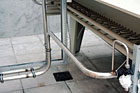
According to Eurommon’s most recent white paper, for the operational safety of a system at high pressure, thick stainless steel is used through the entire piping network.

COOLING SUPERMARKETS

Intense research and development since it was rediscovered have led to carbon dioxide now being practical for use in many different applications. One promising field of application is supermarket refrigeration, where HFCs still dominate at present.

For example, the Danish supermarket chain Super Best has installed a carbon dioxide-based cascade system at its Copenhagen branch. In Denmark, the use of more than 10 kilograms (22.04 pounds) of fluorinated gases (F-gases such as HCFCs and HFCs) in newly installed refrigeration systems has been prohibited by law since earlier this year.

Refrigeration specialists Knudsen Køling designed a refrigeration system that uses two refrigeration circuits linked by a plate heat exchanger. This allows three different temperature levels to be achieved, two for cooling and one for heat dissipation.

The first temperature level is needed in frozen food cabinets and the deep-freeze chambers in the cellar. At an evaporating temperature of -28°C (-18.4°F), the carbon dioxide is used to maintain an ambient temperature of -20°C (-4°F). The second temperature level is used for refrigerators and cold stores requiring an air temperature of a few degrees above 0°C (32°F). This is achieved by supplying the evaporators with carbon dioxide at an evaporating temperature of -10°C (14°F). The third and highest level ensures reliable heat dissipation by condensation or gas cooling, depending on the ambient temperature. Overall the cascade system has a refrigeration capacity of 150 kW.

Güntner components are used for the various temperature levels generated by the system, and the cold stores are fitted with evaporators. The heat dissipation enables an evaporator to function as a gas cooler at elevated ambient temperatures and hypercritical processing. To guarantee the operational safety of the system even at pressures of around 120 bar, Güntner used 0.7-mm-thick stainless steel for the gas cooler and the entire piping network.

Thanks to its low-noise design, the gas cooler can even be used in locations with very high noise-control requirements (e.g., residential areas). Injection to the evaporators and the cooling unit is controlled by Danfoss electrical components. There are currently 11 of these combined deep-freezing/normal refrigeration systems installed throughout Europe, as well as 100 deep freezer systems in use in supermarkets.

Two compact heat exchangers and pumping units are used for a carbon dioxide air conditioning system in the Netherlands.

PROTECTING SERVERS

Carbon dioxide is also used in air conditioning. The Dutch bank ABN Amro, for example, has used a carbon dioxide air conditioning system since 2006 to protect the powerful blade servers from overheating in the computer center at its London office. It was planned, implemented, and commissioned by Trox AITCS in cooperation with Star Refrigeration.

The system consists of two compact heat exchange and pumping units. The heat exchanger uses cold water to condense carbon dioxide gas, which has been evaporated in a heat exchanger mounted on the backs of the blade server cabinets.

A stainless steel piping system connects the carbon dioxide circuit to 15 cooling units. These units have five independently powered fans which extract the heat from the cabinets. The chilled-water circuit, at 6°C (42.8°F), condenses carbon dioxide, which is pumped out to the server cabinets by centrifugal pumps, evaporated, and returned to the condenser to begin the process again, all at a constant saturated temperature of 14°C (57.2°F).

Carbon dioxide is ideal as a refrigerant for this application because it is an electrical insulator and is thus totally safe, and in comparison to a water cooling system, the operator makes an energy saving of about 30 percent. The carbon dioxide concentration in the cabinets and in the server room is monitored continuously.

The whole system has a refrigeration capacity of 300 kilowatts or 20 kW per cooling unit. This high cooling capacity makes it possible to put more servers than usual in each cabinet, thereby reducing the space required by more than half. Trox AITCS and Star Refrigeration have installed similar systems for JP Morgan, Barclays Bank, Norwich Union and at Imperial College London. The most recent development in this application of carbon dioxide as a volatile secondary refrigerant is for close control cooling of dealer desks on the trading floors of investment banks.

ALTERNATIVES TO AUTO A/C

“Thanks to its excellent qualities as a refrigerant, carbon dioxide is being used for more and more applications,” said Kaltenbrunner. “It has long escaped the confines of the research lab, and its potential for use in series production of vehicle air conditioning systems is under discussion, to cite just one example. This is partly due to new European legislation, which is increasingly restricting the use of F-gases and forcing manufacturers to take action.”

For more information, visit www.eurammon.com.

Publication Date: 11/05/2007

Share This Story

Looking for a reprint of this article?
From high-res PDFs to custom plaques, order your copy today!


Recommended Content

JOIN TODAY
To unlock your recommendations.

Already have an account? Sign In

  • HVAC-enrollment

    The Trades Are Back: HVACR Programs See Nearly 30% Enrollment Spike

    A new wave of future technicians is entering the pipeline.  
    Training and Education
    By: Matt Jachman
  • 2025 Top 40 Under 40

    2025 Top 40 Under 40 HVACR Professionals List

    The 11th annual Top 40 Under 40 list highlights those...
    HVAC Commercial Market
    By: Hannah Belloli-Oster
  • LG Ductless Mini-Split Systems

    The 9 Types of Heat Pumps

    As the U.S. moves toward electrification, heat pumps are...
    HVAC Commercial Market
    By: Joanna R. Turpin
Subscription Center
  • Create an Account
  • Start a Subscription
  • Manage My Account
  • Sign Up for Newsletters
  • Visit Customer Service
  • Update Preferences

More Videos

Sponsored Content

Sponsored Content is a special paid section where industry companies provide high quality, objective, non-commercial content around topics of interest to The News audience. All Sponsored Content is supplied by the advertising company and any opinions expressed in this article are those of the author and not necessarily reflect the views of The News or its parent company, BNP Media. Interested in participating in our Sponsored Content section? Contact your local rep!

close
  • Piggy Bank
    Sponsored byWatercress Financial

    Energy Prices, Inflation, and HVAC: What Today’s Homeowners Care About

  • Refrigerated Food
    Sponsored bySolstice Advanced Materials

    R-455A Refrigeration: A Cold Storage Solution for the Future

  • Airex Rooftop Units
    Sponsored byAirex Manufacturing Inc

    Consolidating Roof Penetrations: A Growing Trend in Multifamily HVAC Design

Popular Stories

Refrigerants-and-gauge.jpg

HVAC Industry Warns of Counterfeit Refrigerants Entering U.S. Supply Chain

U.S. Supreme Court building

95% Furnace Efficiency Rule to Get New Hearing

Midea-training.jpg

HVAC Workforce Crisis Expands Beyond Technicians to Instructor Shortages

Data_Center_facility.jpg

HVAC Manufacturers Respond to Growing Data Center Backlash

HVAC Minute retail refrigeration system

EPA Final Rule’s Impact on R-410A Deadlines

View The ACHR NEWS
Centennial Anniversary Timeline

The ACHR News Timeline Chart
Submit a Letter
Submit a letter to our editors.

Events

November 6, 2025

Next-Gen Data Center Cooling: HVAC Innovation and Real-World Solutions

On Demand As AI workloads and high-density computing push traditional cooling methods to their limits, the data center industry is accelerating the adoption of next-generation HVAC technologies.

June 23, 2026

HVAC Duct Sealing Mastics: Why Selection Matters

In this webinar we will detail what HVAC material buyers and technicians need to know when selecting duct mastics, including matching mastic to substrate, alternatives to liquid mastic, and where UL 181 Listings fit into real world installations.

View All Submit An Event

Poll

Summer Staff

Are you fully staffed for the summer season?
View Results Poll Archive

Products

BNI Mechanical/Electrical Square Foot Costbook, 2026 Edition

BNI Mechanical/Electrical Square Foot Costbook, 2026 Edition

See More Products
HVAC Duct Sealing Mastics: Why Selection Matters - Free Webinar - 6/23/2026

Related Articles

  • Training the Carbon Dioxide Technicians

    See More
  • Digital Control Systems Inc.: Carbon Dioxide Sensor

    See More
  • GE Sensing - Telaire Products: Carbon Dioxide Transmitter

    See More

Related Products

See More Products
  • math.jpg

    Math for the Technician

  • Uncomplicating The Heat Pump: Refrigeration & Air Flow Systems DVD

See More Products

Related Directories

  • TOXALERT International Inc.

    Carbon Monoxide (CO), Carbon Dioxide (CO2), NO2 and other toxic gases, combustible gas detectors, refrigerant leak monitors and Control panels. IAQ. BACnet. Integration. Design.
  • Telaire

    As the world's first and leading manufacturer of Non-Dispersive Infrared (NDIR) Carbon Dioxide (CO2) Sensors, Telaire has been on the forefront of CO2 sensors technology for over 25 years.
×

Sign Up. Stay Informed.

The #1 trusted source for the HVACR industry since 1926

SUBSCRIBE
  • RESOURCES
    • Advertise
    • Contact Us
    • Advisory Board
    • Classifieds
    • Submit a Letter
    • Directories
    • Store
  • ACCOUNT CENTER
    • Create an Account
    • Start a Subscription
    • Manage My Account
    • Sign Up for Newsletters
    • Visit Customer Service
    • Update Preferences
  • SERVICES
    • Marketing Services
    • Reprints
    • Market Research
    • List Rental
    • Survey/Respondent Access
  • STAY CONNECTED
    • LinkedIn
    • Facebook
    • Instagram
    • YouTube
    • X (Twitter)
  • PRIVACY
    • PRIVACY POLICY
    • TERMS & CONDITIONS
    • DO NOT SELL MY PERSONAL INFORMATION
    • PRIVACY REQUEST
    • ACCESSIBILITY

Copyright ©2026. All Rights Reserved BNP Media, Inc. and BNP Media II, LLC.

Design, CMS, Hosting & Web Development :: ePublishing