European Requirements Foretell U.S. Future
NUREMBURG, Germany - This coming July 4 marks the celebration of independence in the United States. But for contractors and technicians in Europe, it will mark the beginning of a process that will probably lead to strict training and certification requirements to work on HVACR equipment, along with more detailed recordkeeping and the end of the use of disposable refrigerant cylinders.
The rules are significant for stateside contractors and technicians. While the U.S. HVACR industry continues to promote mostly voluntary testing and certification, Europe appears to be moving to make its testing and certification mandatory.
On July 4, the European Commission (EC) is supposed to set many rules and regulations for the member nations of the European Union (EU) that will:
The information comes from a presentation by an EC official, given to an audience of several-hundred HVACR industry personnel during a symposium presented by the Association of European Refrigeration Compressor and Controls Manufacturers (ASERCOM). The five hour seminar featured nine presenters and came a day before the start of the 27th annual International Trade Fair for Refrigeration, Air Conditioning, Ventilation (IKK).
The move to mandatory training and testing is designed to “contribute to meeting Kyoto objectives,” said Peter Horrocks of the European Commission, referring to the protocol calling for a curb on global warming gases.
“The focus is on containment and recovery.”
The timetable that begins July 4 is actually a multi-year one. For example, by July 1, 2008:
The certification, he said, involves required updates, new entrant training, and a willingness to develop new skills.
At its most basic level, there is a two-tier approach for personnel. Category A (for those involved in monitoring a system) involves “a person who should be able to maintain a refrigerating system safely, with due regard to environmental requirements and energy without breaking into the refrigerant circuit,” Mitchell said. Such a person watches equipment and makes adjustments, but should a problem arise, he calls in a Category B person.
Category B is for “‘refrigeration craftsmen,” those who install, service, and repair systems; recover refrigerants; and decommission a unit. Basically, these are the tech-nicians who carry manifold gauges and know how to do recovery work. By putting on the gauges or doing recovery, they are breaking into a refrigerant circuit, and therefore need more advanced training and certification than Category A.
Companies (either a contractor or end user) must commit to comply to regulations, employ at least one Category B person, have adequate tools and equipment, be willing to perform refrigerant administration and documentation, and be subject to audits at any time, said Mitchell.
Sascha Wenzler, executive manager of the German Association of Refrigeration and Air Conditioning Contractors, reviewed that material in some detail and showed how contractors can benefit from such regulations.
“There will be new tasks for operators of plants and contrac-tors today and in the future, in such areas as leakage control, emission reduction, energy efficiency, maintenance, reporting, and recording,” he said.
“Contractors could offer a full-service package for the operator’s extensive environmental tasks. This would strengthen the bonds between owners and contractors.”
improvement of energy per-formance of buildings and the convergence of building standards toward those of member states with most ambitious levels.”
The idea was to allow individual countries in the EU to work on standards, then have the highest standards adopted throughout the region. This is somewhat similar to what has happened in the United States, where California’s recent wave of tougher efficiency standards appears headed toward adoption as a U.S. energy policy.
Along the way, those involved in the project must come up with what Gronroos-Saikkala said was “a methodology for energy performance standards on buildings and the application of these standards on new and existing buildings.” This would appear to imply little willingness to grandfather in older buildings.
He noted a 2006-09 time frame for the project.
According to Chris Sherwood, commercial specialist for the U.S. mission to the EU, “Producers (i.e., manufacturers) became financially responsible on Aug. 13, 2005, for the collection and recycling of EEE, although some countries may allow different arrangements, such as customers paying.”
The Restriction of Hazardous Substance (RoHS) Directive is also a hot topic in Europe. Sherwood said this “bans mercury, cadmium, lead, hexavalent chromium,” and other substances in products as of July 1, 2006.
While primarily a European situation, WEEE and RoHS has a potential global impact. Some manufacturers headquartered in Europe have already announced they would adhere to the two directives on a company-wide, world-wide basis.
Because the situation with the directives is changing and somewhat confusing, Sherwood said a Website (www.buyusa.gov/europeanunion/weee.html) has been established to include the latest information.
In Europe, many supermarket officials proclaim single-digit and even near-zero leak rates.
Friedrich Busch, head of the European Partnership for Energy and the Environment (EPEE), told attendees in Nuremburg that shoddy workmanship and sloppy sizing in the United States is the cause of those high leak rates.
“In the United States air conditioning (sector), 75 percent of equipment is poorly installed and 50 percent is oversized,” he said, adding that there could be a 30 percent or better improvement in energy savings if such situations were prevented.
In Europe, he cited efforts to recognize energy-efficient equipment and installations. One aspect underway since mid-2005 has been “the setting of eco-design requirements for energy-using products.” He said contractors are involved in the study.
In effect, this reflects a change in attitudes in Europe over what the primary objective of a new product should be. He noted that the primary issue up until 2000 was safety, but now it has become more environmental.
“This shift took place with a tremendously high speed,” he said. “The end user is choosing the product with the smallest environmental impact based on campaigns by governmental and nongovernmental organizations, as well as by manufacturers’ promotional campaigns. They are also looking at incentives offered by governments or power supply companies.”
Publication date: 12/04/2006
The rules are significant for stateside contractors and technicians. While the U.S. HVACR industry continues to promote mostly voluntary testing and certification, Europe appears to be moving to make its testing and certification mandatory.
On July 4, the European Commission (EC) is supposed to set many rules and regulations for the member nations of the European Union (EU) that will:
- Establish “standard inspection requirements and indirect and direct leakage measurements.”
- Establish “minimum requirements for training programs and certification for companies and personnel.”
- Ensure that “companies involved in containment and recovery use qualified personnel.”
The information comes from a presentation by an EC official, given to an audience of several-hundred HVACR industry personnel during a symposium presented by the Association of European Refrigeration Compressor and Controls Manufacturers (ASERCOM). The five hour seminar featured nine presenters and came a day before the start of the 27th annual International Trade Fair for Refrigeration, Air Conditioning, Ventilation (IKK).
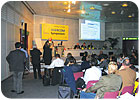
A symposium in Nuremburg, Germany, drew some 150 HVACR personnel, who heard the latest news concerning mandatory testing and certification for European technicians and contracting companies.
Stateside Significance
The EU’s standards are mini-mum requirements; individual member states can make them even stricter within their countries. And just as there were those in the United States who watched phaseouts of refrigerants in Europe and promoted similar actions, advocates in the states of mandatory testing and certification are sure to be watching the latest developments in Europe just as closely.The move to mandatory training and testing is designed to “contribute to meeting Kyoto objectives,” said Peter Horrocks of the European Commission, referring to the protocol calling for a curb on global warming gases.
“The focus is on containment and recovery.”
The timetable that begins July 4 is actually a multi-year one. For example, by July 1, 2008:
- Member states are to have penalties in place for violations.
- Operators of equipment are to ensure personnel working on the equipment are qualified.
- Operators will need to maintain detailed records of refrigerants “added and recovered, details of servicing, dates and results.”
Certification, Training
The minimum standards of training and certification are embracing installation, service, refrigerant recovery, and leak checking. Required training will affect individual HVACR personnel up to entire companies, ac-cording to Norman Mitchell of the Air-Conditioning and Refrigeration Europe Association (AREA).The certification, he said, involves required updates, new entrant training, and a willingness to develop new skills.
At its most basic level, there is a two-tier approach for personnel. Category A (for those involved in monitoring a system) involves “a person who should be able to maintain a refrigerating system safely, with due regard to environmental requirements and energy without breaking into the refrigerant circuit,” Mitchell said. Such a person watches equipment and makes adjustments, but should a problem arise, he calls in a Category B person.
Category B is for “‘refrigeration craftsmen,” those who install, service, and repair systems; recover refrigerants; and decommission a unit. Basically, these are the tech-nicians who carry manifold gauges and know how to do recovery work. By putting on the gauges or doing recovery, they are breaking into a refrigerant circuit, and therefore need more advanced training and certification than Category A.
Companies (either a contractor or end user) must commit to comply to regulations, employ at least one Category B person, have adequate tools and equipment, be willing to perform refrigerant administration and documentation, and be subject to audits at any time, said Mitchell.
Tracking Refrigerant
The industry in Europe is working to develop minimum requirements for leak checking methods on refrigeration circuits. This is part of the industry’s efforts to be proactive, so that any EU legislation is more reflective of what the industry wants and can best deal with.Sascha Wenzler, executive manager of the German Association of Refrigeration and Air Conditioning Contractors, reviewed that material in some detail and showed how contractors can benefit from such regulations.
“There will be new tasks for operators of plants and contrac-tors today and in the future, in such areas as leakage control, emission reduction, energy efficiency, maintenance, reporting, and recording,” he said.
“Contractors could offer a full-service package for the operator’s extensive environmental tasks. This would strengthen the bonds between owners and contractors.”
Building Improvements
Buildings themselves are coming under review regarding their energy efficiency. According to a report from Ismo Gronroos-Saikkala, the EC’s directorate general for energy and trans-port, “The objectives are for theimprovement of energy per-formance of buildings and the convergence of building standards toward those of member states with most ambitious levels.”
The idea was to allow individual countries in the EU to work on standards, then have the highest standards adopted throughout the region. This is somewhat similar to what has happened in the United States, where California’s recent wave of tougher efficiency standards appears headed toward adoption as a U.S. energy policy.
Along the way, those involved in the project must come up with what Gronroos-Saikkala said was “a methodology for energy performance standards on buildings and the application of these standards on new and existing buildings.” This would appear to imply little willingness to grandfather in older buildings.
He noted a 2006-09 time frame for the project.
WEEE And RoHS
Another issue that has been stirring up discussions in Europe concerns the Waste Electrical and Electronic Equipment (WEEE) Directive, designed to limit the amount of waste from electronics in landfills.According to Chris Sherwood, commercial specialist for the U.S. mission to the EU, “Producers (i.e., manufacturers) became financially responsible on Aug. 13, 2005, for the collection and recycling of EEE, although some countries may allow different arrangements, such as customers paying.”
The Restriction of Hazardous Substance (RoHS) Directive is also a hot topic in Europe. Sherwood said this “bans mercury, cadmium, lead, hexavalent chromium,” and other substances in products as of July 1, 2006.
While primarily a European situation, WEEE and RoHS has a potential global impact. Some manufacturers headquartered in Europe have already announced they would adhere to the two directives on a company-wide, world-wide basis.
Because the situation with the directives is changing and somewhat confusing, Sherwood said a Website (www.buyusa.gov/europeanunion/weee.html) has been established to include the latest information.
Tighten Up
One issue that perplexes many in Europe is the seemingly tolerant attitude U.S. regulators take concerning leak rates. The Europeans, for example, cite the U.S. Environmental Protection Agency (EPA) allowing supermarkets a 35 percent annual leak rate (although the EPA plans to impose a tougher rate in the future).In Europe, many supermarket officials proclaim single-digit and even near-zero leak rates.
Friedrich Busch, head of the European Partnership for Energy and the Environment (EPEE), told attendees in Nuremburg that shoddy workmanship and sloppy sizing in the United States is the cause of those high leak rates.
“In the United States air conditioning (sector), 75 percent of equipment is poorly installed and 50 percent is oversized,” he said, adding that there could be a 30 percent or better improvement in energy savings if such situations were prevented.
In Europe, he cited efforts to recognize energy-efficient equipment and installations. One aspect underway since mid-2005 has been “the setting of eco-design requirements for energy-using products.” He said contractors are involved in the study.
Design Directives
The principle theme of the ASERCOM Symposium was taking the directives and regulations and finding new business opportunities from them. For example, Martin Dieryckx of Daikin suggested that manufacturers and companies have a “corporate philosophy that includes social responsibility to assure sustainability or to create differentiation through leadership in environmental aspects.”In effect, this reflects a change in attitudes in Europe over what the primary objective of a new product should be. He noted that the primary issue up until 2000 was safety, but now it has become more environmental.
“This shift took place with a tremendously high speed,” he said. “The end user is choosing the product with the smallest environmental impact based on campaigns by governmental and nongovernmental organizations, as well as by manufacturers’ promotional campaigns. They are also looking at incentives offered by governments or power supply companies.”
Publication date: 12/04/2006
Looking for a reprint of this article?
From high-res PDFs to custom plaques, order your copy today!


