Using Pets as a Means to Sell More IAQ
New study shows dogs impact IAQ as much as humans
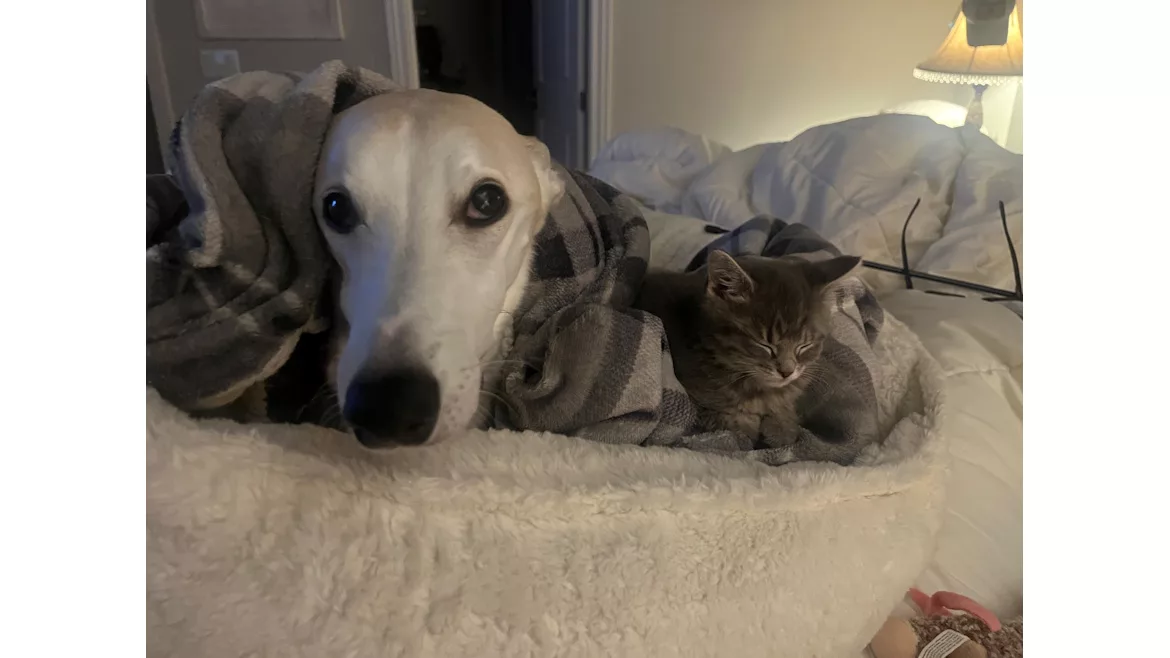
FURRY FRIENDS: Ella with her new friend, shortly after we brought Martini home.
I have a whippet named Eleanor “Ellie” Taft Wilson Harding Coolidge Roosevelt. For those of you unfamiliar with whippets, they sleep 18 hours a day and, in their heyday, run about 35 mph. At 11 years old, Ellie doesn’t run very fast anymore, but she sleeps even more, usually under a blanket. Whippets aren’t supposed to shed much, which is one of the reasons we chose the breed.
Unfortunately, Ellie has a medical condition that requires medication that causes shedding, so instead of vacuuming once a day, we vacuum … more than that.
We also have a cat — a sweet little thing we found as a two-week-old kitten and bottle-fed back to health. Now add in my husband, Joey, who is allergic to pets. Because we’ve had Martini “Tini” Fellini since she was basically born, Joey has built up a sort of tolerance to her. Ellie, however, is another story. The dog hair can get to him.
Between the dog hair, the sneezing, and the constant vacuuming and lint rolling, indoor air quality isn’t just a concept in our house — it’s something we feel.
And it turns out, science says he’s right.

TINY TREASURE: Pet parents like me are often receptive to IAQ solutions — as long as the pets aren’t framed as the problem. (Courtesy of Hannah Belloli)
A recent study published in Environmental Science & Technology by the American Chemical Society set out to measure just exactly what our beloved four-legged doggy friends contribute to indoor air quality (IAQ). What researchers found was that in some cases, pets can rival — and even exceed — the impact of the humans living in the home.
“Pets are part of our indoor environment,” said Dusan Licina, corresponding author of the study. “By quantifying what dogs add to indoor air, we can build more realistic indoor air quality and exposure models and better inform ventilation strategies — without blaming pets or discouraging pet ownership.”
Looking for quick answers on air conditioning, heating and refrigeration topics? Try Ask ACHR NEWS, our new smart AI search tool. Ask ACHR NEWS
What The Study Had To Say
To better understand how pets affect IAQ, researchers compared two groups of dogs — four small dogs (chihuahuas) and three large dogs (including a Tibetan Mastiff, a Newfoundland, and an English Mastiff). The dogs were observed in separate, controlled environments alongside one owner each. All emissions were measured separately.
Here’s the story the results told.
Both small and large dogs released more airborne particulate matter than their human counterparts, with the smaller, more active dogs producing the most. Large dogs, on the other hand, emitted carbon dioxide (CO₂) and ammonia at levels comparable to humans — and at rates much higher than smaller dogs. They also released more bacteria and fungi into the air, much of which came from outside, effectively changing the “indoor microbial composition” in ways that humans don’t, according to ACS.
POOR IAQ: All the love and cuteness in the world can’t stop your pets from negatively impacting your IAQ. But the right solutions can. (Staff photo)
All in all, dogs — especially large ones — can contribute to IAQ as much, if not more, than we do.
According to the study’s authors, these findings highlight the need to design ventilation and air quality systems for healthier indoor environments for all types of occupants in a home. In other words, “not just for humans, but for the animals that live alongside them.”
An Opportunity For HVACR Contractors
For HVACR contractors, this isn’t just interesting research or factoids. It’s a sales opportunity.
Most HVACR contractors already understand that pets impact IAQ. But that’s not the case for homeowners. Homeowners might notice pet hair on their clothes, lingering odors, worsening allergies — but many don’t realize the full extent, or that those issues are connected to their overall IAQ. Not to mention that there are solutions that only HVAC professionals can provide.
This is where data becomes a powerful asset.
Pets can offer a natural entry point into an IAQ conversation. Instead of leading with all that technical mumble jumble, contractors can start with something tangible that their homeowners with pets may be experiencing every day: shedding, smells, sneezing.
From there, it’s an easy transition to explain the things they can’t see happening in the air. According to the study, that’s increased particulate matter, microbial presence, and airborne compounds.
And let’s make something clear: What a homeowner doesn’t want to hear is that their dog is the problem. What they are open to hearing, though, are the ways that they can make their indoor environment healthier for everyone living in it — including their pets.
Because at the end of the day, most people likely aren’t investing in IAQ upgrades because of “particle counts” or “microbial data.” (Can you imagine your homeowner even saying those words to you?) They’re doing it because their house smells like pet, the air feels thick, or someone in the home — like Joey — is feeling the effects.
The science just gives HVACR contractors a better way to explain the “why.”
So, the next time you walk into a home and see a dog bed, food bowls, a scratching post, or lint rollers stationed by the front door, consider it more than just a sign of a pet-friendly, animal-loving household.
It’s an IAQ opportunity.
