AHRI, ASHRAE, US DOE partnership devotes $5.2 million to broaden knowledge
June 20, 2016
The research program is part of an ongoing global effort to phase down the use of high-GWP refrigerants and identify appropriate climate-friendly alternatives. The DOE will contribute $3 million; ASHRAE, $1.2 million; and AHRI, $1 million.
Will facilitate and accelerate the safe use of these refrigerants
June 9, 2016
The Air-Conditioning, Heating, and Refrigeration Institute (AHRI), ASHRAE, and the U.S. Department of Energy (DOE) are collaborating to fund research that will establish a more robust fact base about the properties and use of flammable refrigerants.
Topics include toxicity, flammability, and higher pressures
February 1, 2016
With the advancing worldwide phaseout of hydrochlorofluorocarbons (HCFCs), the United Nations Environmental Programme (UNEP’s) OzonAction Division of Technology has produced a series of factsheets on the safe use of the new alternative refrigerants.
Industry input is being sought into a proposal to modify portions of ASHRAE’s refrigeration safety standard to incorporate subclass 2L flammability classifications. Addendum d to ANSI/ASHRAE Standard 15-2013, Safety Standard for Refrigeration Systems, is open for public comment until Jan. 18.
Standard 15 specifies safe design, construction, installation, and operation of refrigeration systems
December 23, 2015
HVACR industry input is being sought into a proposal to modify portions of ASHRAE’s refrigeration safety standard to incorporate subclass 2L flammability classifications. Addendum d to ANSI/ASHRAE Standard 15-2013, Safety Standard for Refrigeration Systems, is open for public comment until Jan. 18, 2016.
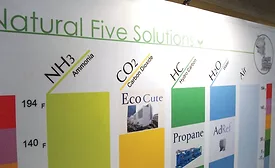
Although it’s commonly acknowledged that there is no one-size-fits-all answer, natural refrigerants, such as carbon dioxide (R-744), ammonia (R-717), and the hydrocarbon (HC) refrigerants propane (R-290) and isobutane (R-600), have been garnering attention.
In March, the EPA approved several low-GWP hydrocarbon refrigerants for use in refrigeration and air conditioning applications, subject to use conditions. The approval drew a mixture of reactions ranging from support to concern.
In the evolving world of refrigerants, the HVACR industry is preparing for the inclusion of mildly flammable or flammable refrigerants in an increasing number of applications. But the expanded use of these refrigerants won’t happen overnight, as there is a multistep approval process they must undergo to be approved for new applications.
Will Help the Industry Understand the Comparative Risk of Using 2L Refrigerants
April 13, 2015
The Research and Technology (R&T) Committee of the Air-Conditioning, Heating, and Refrigeration Institute (AHRI) has established a Flammable Refrigerants Subcommittee that will seek to develop a set of application requirements for the use of ASHRAE-designated 2L, or mildly flammable, refrigerants.
Using Such Refrigerants in an Existing Air Conditioner Poses Risk of Fire or Explosion
July 23, 2014
The U.S. Environmental Protection Agency (EPA) has issued a warning to consumers, contractors, and technicians about the safety hazards related to charging existing home and motor vehicle air conditioning systems with propane-based refrigerants.