As Northern Virginia’s data center boom strains power, water, and infrastructure, industry leaders are turning to district energy to transform waste heat into a scalable, low-carbon resource.
The Markham District Energy facility differs from standard applications because instead of relying on conventional energy sources, it captures waste heat from sewage, which enters at about 5°C and is converted into 95°C usable heat.
Since Rheem launched its sustainability initiative, A Greater Degree of Good, in 2019, the manufacturer has implemented programs to provide more environmentally sustainable solutions in North America and abroad.
Duluth is one of 11 communities in 10 states that were selected to design, with DOE financial support, geothermal district heating and cooling systems.
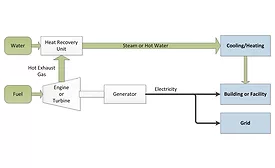
A one-paragraph, simple overview of the basic CHP approach reads like this: A building’s (or campus’) system uses fuel to make its own electricity, and then it applies the waste heat from that process toward its HVAC needs.
Increasing demand for recovering waste heat generated by various industries is one of the key factors driving the growth of the thermoelectric generators (TEG) market.
It’s a way to reduce wasted heat and increase industrial efficiency
December 19, 2016
Combined heat and power (CHP) systems are being used by a wide range of applications to reduce the overall energy intensity of industrial systems. In some cases, such as industrial furnaces, efficiency improvements resulting from waste heat recovery can improve energy efficiency 10-50 percent.
Emerging trends have a direct impact on the dynamics of the industry
December 15, 2016
The global heat exchanger market is expected to reach an estimated $21.3 billion by 2022, and it is forecast to grow at a compound annual growth rate (CAGR) of 6.1 percent from 2017 to 2022, according to a report published by Lucintel. The major drivers of growth for this market are a rise in HVACR deployments, rapid industrialization, and stringent environmental regulations.