Ductwork Leaks Are Bleeding Energy

Shoddy duct installation practices have been cited as a primary source of energy leaks in several studies. Getting ductwork sealed up properly at the most critical points - joins, boots, and transitions - was the purpose of the second DuctFair, hosted by the South Carolina Association of Heating and Air Conditioning Contractors (SCAHACC). With its southern location, the event focused on duct board and flex duct systems, but also dealt with sheet metal to a more limited degree.
Leaks in areas such as crawlspaces or attics can draw in outdoor air to the airstream, reducing the amount of heat exchange available and thus degrading system efficiency. It also affects customer comfort.
The training event gathered top technical representatives from duct, tool, and equipment manufacturers and showed technicians how to use their products properly to create quality duct systems. It was organized by Jim Herritage, CEM and president of Energy Auditors Inc., Mt. Pleasant. Participants are placed into specific groups, and each group goes from station-to-station to listen to a timed training presentation.
Energy Imperative
"We've got to save energy," stated Dan West of RCD, whose station at the event taught duct board sealing, hands on. "Two years ago, homeowners spent $5 billion/year in duct leaks." According to West, "We should be paying $1/square foot for energy consumption."The No. 1 place for wasting energy is the boot," he continued. The boot hooks the grille and register to the duct. He taught attendees how to seal two pieces of duct board together using mastic, gauze, and mastic again. He advised against using solvent-based mastic and mastic tape.
"In the 70s, I saw a problem with the energy crunch," said Bob Place of Owens-Corning Technical Services. So, he started designing "superinsulated homes" with ceiling insulation, for instance, of R-60.
Duct Construction
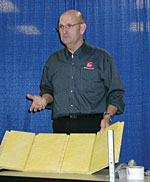
Fiberglas® duct board, Place said, can be constructed and installed quickly, but it must be done correctly to get the energy and even acoustical values customers are expecting. He said he prefers to create square duct using a tool that cuts groove for a modified shiplap. What about the V-groove cut? "I don't like it," Place said. "I won't teach it."As far as sealing it goes, "You must set the adhesives or I guarantee it'll fall off," he said.
"Don't use fiberglass upstream of a VAV box," he added. "However, it's ideal for residential systems." Ralph Koerber, of ATCO and the Air Distribution Council (ADC), demonstrated correct connection and splicing of flexible duct.
Looking for quick answers on air conditioning, heating and refrigeration topics? Try Ask ACHR NEWS, our new smart AI search tool. Ask ACHR NEWS
The connection can be made with tape or mastics, he added. "We're doing it today with tape."
To splice two pieces of flex duct together, he said, first you pull back both the barrier and insulation. Apply tape across the collar. "Bring the other piece of inner core over and secure it with two wraps."
Finish the splice with a mechanical fastener; install on the bead. Apply two wraps of tape over the vapor barrier, but "try not to get too tight," he said, as this could restrict airflow.
"Most people won't do a good job," he said, demonstrating the haphazard way many harried crews tend to create a splice.
Russ Verbruge (Hart & Cooley) and Joey Henderson (Carrier) followed up by showing how to support flex duct.
Installers must use a 1.5-inch minimum support strap, Verbruge pointed out. Supports must be spaced no more than 5 feet apart. "Install the least amount of flex to deliver the most amount of air," he said, adding, "take-offs require a bead now." He referred to Koerber's demonstration of joining a splice using two wraps of tape and mechanical clamps. "Pull the insulation up to the boot."
There are no length limitations for flex duct as long as it's installed correctly, he said. "Connectors do have limitations."
Henderson pointed out that flex should be fully extended, including the inner core, before you determine how long it is. "When you have a bunched-up core, that's where all the air restriction is.
"The goal is to make it look just like hard pipe," he said.
His pet peeve for floor boots is that they are too often installed without any insulation. "Sweating and condensation goes into duct."
David Harrison of Knauf addressed the finer points of duct wrap:
1. Thermal value.
2. Condensation control.
3. Acoustic absorption.
It's critical to figure out the thickness of the installed insulation, which expands when it is unrolled. This measurement can be next to impossible in the field. "I can't measure the thickness," he said, "but I can measure the length."
His demonstration used foil-backed insulation with a scrim pattern and Kraft paper. Product should have no more than 25 percent compression, he said.
To figure out how much to cut R-6 insulation when it's out of package to account for its expansion, Harrison offered these simple equations:
He cut a staple flap on duct board using "a $3 flea market knife." Cut through the insulation first, he said. "Insulate after you hang it." Apply insulation staples and pre-tape along the longitudinal flap. "Then I can put my tape on it. Tape has to be squeegeed down." Mastic, he said, is better than tape.
"In 48 hours the insulation will grow; the fluffier, the better."

Joins And Transitions
Tim Duncan and Sid Griffin (Alco) and John Moffit (Malco Tools) demonstrated how to make tight transitions from round ductwork. Duncan started out by showing old-style transitions that are gasket sealed. "They still need mastic," he said.Collars and takeoffs attach to rectangular or round duct, he continued. "About 15 years ago, primary supplies were rectangular-wrapped." There was a gradual evolution to round. Northern U.S. product tends to be rectangular, he said, while southern product is round.
Round-to-round transitions are now available with a gasket, Duncan said. This innovative fitting is often referred to as an "Air Tite," although that actually is a specific brand name. "A guy invented it in a garage," he said.
The beauty of the mastic on the gasket is that it allows hands-free installation. "The hole can even be off, you'll still get correct airflow," he said.
"We're on the front side of the curve of energy concerns," Duncan commented. Although 13-SEER product costs will eventually come down, prices won't adjust down to compensate for the increased labor, he said. Among other considerations, takeoff sizes will increase.
When it comes to sealing takeoffs, "We're preaching to the chorus here," said Moffit. Using a hole cutter, he demonstrated how to cut a round hole in round piece of duct. Hole cutters are available in two sizes, up to 12 inches or up to 20 inches, he said.
Tom Shiflet heads up the Department of Heating & Air Conditioning at Greenville Technical College, Greenville. He described how to connect the plenum to an air handler or furnace. "It needs to be solid, sealed, and insulated," he said. Otherwise the system may suffer from sweat, corrosion, and mold.
Bought plenums, he said, may be connected using S-locks. "S-locks with an offset, or Ls, provide a more secure, tighter fit."
Shiflet summed up his instructions in a few words: "Secure the connection, seal it, and insulate it. Even on a gasketed trunk, you still need to go in and seal it."
He recommended use of a metal trunk and takeoffs with a balancing damper.
Keith Shull and Tammy Thompson (Shurtape) discussed the UL 181 BFX Code, which addresses the use of specific types of tape to properly seal ducts. The code was adopted in 1998. "In the past, you could use whatever kind of tape you wanted on flex duct," Shull said. UL 181 outlines a baseline standard for tape. "UL tape is much thicker and has a better film," he pointed out. "It was designed to increase in strength over time."
Dave Fetters of Hart & Cooley described lab work to determine air performance on grilles and registers. "We determine square foot units for product based on air performance," he said. "Fins take away from performance. The effective area is a little bit less than the free area."
Digital airflow meters, he pointed out, measure cfm, which is fpm x free area (square inches). "You need to know the effective area."
Publication date: 12/12/2005
Looking for a reprint of this article?
From high-res PDFs to custom plaques, order your copy today!