GPS Helps Curb Gas Consumption
It's usually easier for consumers: combine errands, carpool, take the bus, etc. For business owners, it's much more complicated. Service providers such as HVAC contractors, electricians, and plumbers rely on fleets of trucks to get their technicians from one jobsite to another. Often those jobsites are spread out over a large metropolitan area, which can mean hundreds of miles put on each truck every day.
While there is no way to control the high cost of gasoline, contractors are looking for ways to compensate for high fuel prices. Implementing fuel surcharges and increasing prices are two of the methods commonly used to lessen the impact to the bottom line. Installing global positioning systems (GPS) on service trucks has become another tool that many contractors are using to decrease fuel consumption.

Monitoring Increases Fuel Efficiency
Just about everyone knows that GPS can be used to monitor where each technician's vehicle is during the course of the day, but how can that reduce fuel costs? Surprisingly enough, there are a number of ways, and when combined, the result can be a 15 percent to 20 percent reduction in fuel consumption.Dan Beatty, manager of national direct sales, FleetBoss Global Positioning Solutions Inc., Orlando, Fla., noted that GPS helps increase fuel efficiency by helping control speed, service stops, and idle time. "Those three factors all influence fuel efficiency and are the best methods to monitor in order to actively handle your fuel."
Speeding is a habitual problem for many people, but what most don't realize is that according to the U.S. Department of Energy, fuel consumption increases almost 2 percent for each mile per hour above 50, stated Beatty. "A GPS system can monitor the speed of a truck, helping the driver to better manage his speed. If more technicians consistently do the speed limit, that reduces fuel."
Since many GPS systems work in real time, it's possible for the office manager or contractor to immediately know which technicians are going the speed limit, and which are not. If they go over the speed threshold that's set in the vehicles, the GPS system can send a page or an e-mail to a cell phone or e-mail address stating that the vehicle has exceeded that threshold.
Mark Schneider, owner, Pacific Aire Inc., Ventura, Calif., installed GPS on all his service trucks, and he's been surprised by the results. "I found out that about one-third of my technicians were speeding. Now we are alerted if anyone goes over 69 mph."
GPS also helps dispatchers route technicians more efficiently. Tim Van Cleve, COO, Teletrac Inc., Garden Grove, Calif., said that one of the first questions a dispatcher asks when a technician calls in is, "Where are you?"
Looking for quick answers on air conditioning, heating and refrigeration topics? Try Ask ACHR NEWS, our new smart AI search tool. Ask ACHR NEWS
"With GPS, dispatchers have the ability to already know where the technicians are, so they're not reliant on the drivers telling them. By knowing where each technician is, the dispatcher can route technicians to jobs that are closest to them. That increases productivity and saves fuel," said Van Cleve.
Joyce Kim, vice president of marketing and products, Aligo Inc., San Francisco, added that GPS-assisted dispatching is a great benefit, particularly if an emergency job needs to be squeezed in during the day. "If there are 10 guys in the field and the dispatcher doesn't know their locations, he'd have to call around and figure out who was the closest. Or else he could end up sending John from clear across town when Joe is three blocks away."

Kim noted that when technicians know they're being tracked, they are less likely to run errands or spend their time unproductively. "With GPS, the odometer readings tell the story, and the technicians are held accountable for their time. This really reduces a lot of the side jobs and errand issues that companies face."
Mark Giebelhaus, president, Marlin Mechanical Corp., Phoenix, believes GPS has helped his company because, "We know where they are. It has eliminated those side trips home or to the store or whatever because they know we are watching them. I know it sounds like ‘big brother,' but if they were not doing those things we would not have had to track them."
Idling is another factor that can contribute significantly to increased consumption of fuel. Beatty cited an Argonne National Labs study, which found that an idling vehicle burns between 1.6 and 2.4 gallons of gas per hour. Many technicians sit in idling trucks, filling out paperwork before or after a service call. This can add up to three or four hours a day of idle time, which of course, wastes gas.
"Idling is very expensive," stated Van Cleve. "We can measure idling, though. If a vehicle is stopped and it's still running for more than 10 minutes, we can send a message to the truck that tells them to turn it off."

Paying The Bill
Of course, GPS solutions do not come free-of-charge. Contractors wanting to implement the technology will have to consider which type of system they want to use - active or passive - and what type of equipment they'll utilize - truck-mounted equipment or cell phones.In a passive system, the GPS-outfitted vehicles come back to a central location, and the information is downloaded automatically into a main system. Nothing needs to be pulled out of the system or processed, the passing of information happens automatically. The contractor or office manager can then review the data and see where the trucks went during the course of a day.
An active system, or automated vehicle location (AVL), is a system that allows the dispatcher, contractor, or other office personnel to find out what each driver is doing at a particular moment. There are immediate updates, and all data is passed in real-time. In an active scenario, some type of mechanism is needed to download the information, whether it's cellular towers or general packet radio services (GPRS), and there is a monthly fee associated with using that mechanism.
With a truck-mounted GPS system, such as the solutions offered by FleetBoss and Teletrac, an on-board engine computer provides tracking and location data gathered via GPS. There are different levels of systems available, and the service and equipment can be bundled together for a once-a-month payment. Of course, there are various ways that customers can purchase a GPS system: They may lease to own, lease only, or buy the equipment outright and pay the monthly service charge for an active system.
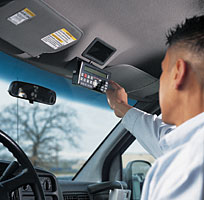
Van Cleve stated that with Teletrac, the equipment that needs to be installed includes a black box containing the GPS chip as well as an optional message display terminal. There's also software that needs to be purchased and in-stalled. "Most of our customers lease the equipment, and that's combined with the monthly service fee. The total runs about $2.50 per day per truck. Basically, the total turnkey pricing is less than a gallon of gas per day per vehicle."
Beatty noted that most of FleetBoss' customers choose the lease-to-own or buy-outright option. "It's a low enough cost that many choose to pay for the equipment outright, deduct the capital cost on their tax returns (be sure to consult your tax advisor), then have the monthly fees automatically drafted from an account. In this scenario, the average return on investment is only four to six months, then it becomes a revenue-generating item."
Aligo Inc. decided to approach GPS a little differently, by leveraging the GPS chip in the technician's cell phone. In addition to tracking the technician, the cell phone can be used to log time sheet hours and job information, as well as what tasks technicians are performing. Like a truck-mounted system, the cell phone solution can track mileage, speed, direction, and location, and the information is available real-time.
According to Kim, "We work with the cell phones that the technicians already have. We can track the cell phone with the phone number of their existing phone, or we can leverage a GPS chip that's already there. The cost to the contractor is $15 per phone per month."
Selling The Benefits
As can be expected, some technicians are less than excited when told that GPS will be installed on their trucks. Many resent the fact that the boss will know exactly where they are and what they're doing at any given point during the day. And if the technicians take the trucks home, they may not want the office to know that they're using the vehicle at night or on weekends for personal use.Jim Deiter, vice president, Deiter Bros Heating, Cooling, and Security, Bethlehem, Pa., stated that some technicians at his firm were resentful when GPS was installed on their trucks. "But overall, I believe that they understood that the benefits obtained by using the system were to their benefit. They did not like being routed from one end of our service area to the other end, only to be routed back for another call. This [GPS] made their individual efficiencies increase."
That translates into more money in their pocket, which technicians like. Consider that if a dispatcher can make more effective routing decisions based on real-time data, technicians might be able to add one or two jobs to their routes each week. Depending on their compensation structure, that can increase how much money they make.
"Like anything else, it all depends on how you position it to your employees. GPS is a tool that, if you present it properly, is positive. You can reward people for good behavior. You're not trying to catch somebody doing something wrong. You're trying to say you now have a mechanism to monitor how the company's assets are being used," noted Beatty.
A business owner may then be able to pass some of the savings along in the form of bonuses or increased pay. For example, a contractor could state that he'd like the company to cut its overall idle time by 10 percent, and if the company cuts more than that amount, he'll give them a bonus.
Kim remarked that when positioned as a benefit, employees are much more likely to embrace GPS. "We tell technicians that they'll know what their paycheck should be, because now they can check their times online. Since everything is done in real time, filling out paperwork and driving back to the office are eliminated. It's definitely a benefit to the employee in that issues with underpaying are dramatically reduced."
Another benefit for technicians and contractors is that GPS can verify if a technician is on site when he's supposed to be there. "We may have a customer claim that we were not at their site as long as we billed them for. It is a simple matter to go to the report and verify how long the vehicle was there. Only one time did one of our techs overbill for the time. The report has validated our time on site every other instance when we have been questioned," said Giebelhaus.
Most business owners and their employees seem to understand the situation, stated Van Cleve.
"Everyone knows that employees have to be effective and efficient. I've found that many times it's the top performers who embrace GPS very readily. They understand that now everyone is going to be measured in the same capacity. And for a business owner, there's just too much to lose by not implementing GPS."
And many contractors seem to agree with that sentiment.
Publication date: 11/21/2005
Looking for a reprint of this article?
From high-res PDFs to custom plaques, order your copy today!