ACHR News
search
Ask ACHR NEWS AI
cart
facebook twitter instagram linkedin youtube
  • Sign In
  • Subscribe
  • Sign Out
  • My Account
ACHR News
  • NEWS
    • Breaking News
    • New HVAC Products
    • Featured Products
    • Manufacturer Reports
    • HVAC Data
    • Legislation
    • ACHR NEWS Centennial
  • RESIDENTIAL
    • Air Conditioners
    • Furnaces
    • Residential Heat Pumps
    • Ductless
    • Residential IAQ
    • Testing, Monitoring, Tools
    • Components & Accessories
  • COMMERCIAL
    • Air Handlers
    • Rooftop Units
    • Chillers and Cooling Towers
    • Commercial Heat Pumps
    • Boilers and Hydronics
    • VRF/Ductless
    • Commercial IAQ
  • REFRIGERATION
    • Refrigerants
    • Refrigerant Regulations
    • Leak Management
  • CONTRACTOR PRO
    • Geothermal
    • Homeowner Study
    • VRF and VRV Ductless
    • Unitary Trends
  • EDUCATION
    • Training and Education
    • Business Management
    • Service and Maintenance
    • Continuing Education
    • Market Research >
      • HVAC Brand Awareness Report
      • VRV, VRF, VRVZ Report
      • Unitary Trends Report
      • Water Heat Professionals Report
    • Webinars
    • Sponsor Insights
    • eProducts Info
    • White Papers
  • EVENTS
    • HVAC Contractor Forum
    • Industry Events and Webinars
  • MEDIA
    • Videos
    • AHR Expo 2025 Videos
    • Podcasts >
      • ACHR News Podcast
      • HARDI Podcasts
      • AHR Expo Podcasts
      • ACCA Podcasts
    • Interactive Spotlights
    • Quizzes
    • eBooks
    • HVAC Talkback
  • HVAC GROUP
    • ACHR NEWS >
      • Current Issue
      • Digital Edition
      • Subscribe
    • Distribution Trends
    • SNIPS NEWS >
      • Join SNIPS NEWS
    • Engineered Systems News >
      • Join ES News
    • HVACR Directory
    • Contests
    • Newsletters
    • Contact
    • Advertise
    • My Account

Economic Forecast Looks Solid

December 16, 2004
As we end 2004 and enter 2005, the U.S. economy appears to be headed into another solid year of above-trend growth.

Total output for the country, as measured by gross domestic product (GDP), should increase by 3.6 percent in 2005. This is below the 4.4 percent growth seen in 2004, but it is still above the nation's long-term average growth rate. Recent price reports that show some upward pressure on prices will cause the Federal Reserve to continue to tighten the money supply by raising interest rates during 2005, contributing to the slowdown.

The housing market, which experienced a remarkable year in 2004, will see slightly reduced production in 2005, in part due to the higher levels of mortgage rates that will occur because of Federal Reserve policy. At the same time, the job market will continue to improve, adding strength to housing demand.

Total nonagricultural employment is expected to grow by 2 percent in 2005, as 2.6 million jobs are added to the economy.

Unfortunately, the negative effect of higher interest rates will more than offset the positive effect of stronger job growth. The result will be a decline in total housing starts of just over 4 percent in 2005.

Employment Growth Strengthens

The October employment report showed the strongest growth since March of this year. Total nonagricultural employment increased by 337,000, bringing total job gains during the first 10 months of 2004 to 2 million. Job growth is becoming more widespread, as employment increased in most major categories of employment in October.

Manufacturing, which had performed miserably during the past three years, saw employment slip again in October. Despite this, employment in manufacturing is up so far in 2004, with gains in six of the 10 months of the year. This is especially good news for the areas of the country that have lagged due to their large manufacturing sectors.
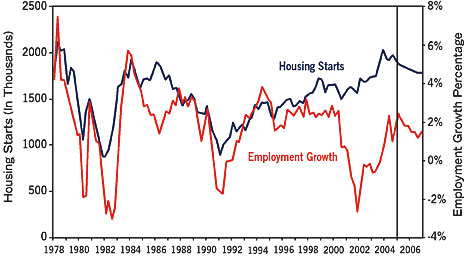
Figure 1. Housing starts vs. employment growth.

Housing To Weaken Despite Job Growth

The close tie of employment growth to housing demand has always been regarded as a "no brainer." That is, it is always assumed that strong employment growth leads to higher levels of housing demand. This occurs for a variety of reasons.

First, a more robust job market leads to rising confidence among those who already are employed. Second, a growing job market gives new entrants to the labor force opportunities to gain employment and allows them to establish their own households - rental or owner-occupied. Third, a strong job market eventually leads to stronger wage gains, and adds to a household's ability to purchase housing.

As Figure 1 shows, however, this connection appears to have broken down during the past three years, as housing starts grew despite the significant loss in jobs across the economy. In fact, the real disconnect occurred during 2000 and 2001. Despite significant job losses, total housing production climbed.

Looking for quick answers on air conditioning, heating and refrigeration topics? Try Ask ACHR NEWS, our new smart AI search tool. Ask ACHR NEWS →

As Figure 2 shows, the reason for the disconnect was significant decline in mortgage rates brought on by an aggressive Federal Re-serve policy that attempted to avoid and then cushion the recession. Since 2002, stronger job growth has been accompanied by rising housing starts.

Figure 2. Housing starts vs. mortgage rates.

Inflation Growth Concerns

The Federal Reserve has embarked on a path that will lead to higher interest rates during the next year. The federal funds rate, which had been held at just 1 percent in 2003, is expected to average 3 percent in 2005. Concern over an acceleration in the rate of inflation is motivating these actions.

Recent data from the consumer and producer price reports appear to confirm that these concerns are justified. The Federal Reserve's actions will cause mortgage rates to rise during the next two years. Fixed-rate mortgages, which averaged 5.9 percent during the third quarter of 2003, will reach 6.9 percent by the end of 2005. Adjustable-rate mortgages will move from 4.1 percent to 5.6 percent during the same period.

Figure 3. Homeownership rate.

Homeownership Limits

Although we may not like to do it, at times we must talk about the possibility of exhausting demand or running out of new consumers for housing. After all, there is a limit to how many new homes we need each year.

Part of the support for the remarkable levels of new home construction that have occurred in the past few years has been an increase in the share of households that have chosen to own rather than to rent their homes. Figure 3 shows the increase in the homeownership rate that has occurred throughout the 1990s and into the first half of the current decade.

There is a limit to how high the homeownership rate will go. Several factors contribute to this limit.

First, there are some households that voluntarily choose to rent rather than own. These households may view their current location as temporary or they may rent simply because of convenience or their current family situation.

Second, some households are unable to save the down payment and other funds that would allow them to move into homeownership. Finally, the higher interest rates forecast during the next few years will simply make housing a bit less affordable.

So, the recent increase in the homeownership rate will actually limit the number of new home purchases during the next few years.

Declining Housing Starts In 2005

With rising mortgage rates, an economy that will be moving closer to trend growth, and job growth that will be modest, total housing starts in 2005 are expected to decline by 4.3 percent in 2005. This results in total housing starts that are almost equal to their value in 2003. The mix will be slightly different, however, as single-family housing starts at 1.527 million are expected to be a larger share of the total than they were in 2003.

Stanley F. Duobinis, Ph.D., is president of Crystal Ball Economics Inc., Millersville, Md. He can be reached at 410-987-9623 or s.duobinis@att.net.

Publication date: 12/20/2004

Share This Story

Looking for a reprint of this article?
From high-res PDFs to custom plaques, order your copy today!


Recommended Content

JOIN TODAY
To unlock your recommendations.

Already have an account? Sign In

  • HVAC-enrollment

    The Trades Are Back: HVACR Programs See Nearly 30% Enrollment Spike

    A new wave of future technicians is entering the pipeline.  
    Training and Education
    By: Matt Jachman
  • 2025 Top 40 Under 40

    2025 Top 40 Under 40 HVACR Professionals List

    The 11th annual Top 40 Under 40 list highlights those...
    HVAC Commercial Market
    By: Hannah Belloli-Oster
  • LG Ductless Mini-Split Systems

    The 9 Types of Heat Pumps

    As the U.S. moves toward electrification, heat pumps are...
    HVAC Commercial Market
    By: Joanna R. Turpin
Subscription Center
  • Create an Account
  • Start a Subscription
  • Manage My Account
  • Sign Up for Newsletters
  • Visit Customer Service
  • Update Preferences

More Videos

Sponsored Content

Sponsored Content is a special paid section where industry companies provide high quality, objective, non-commercial content around topics of interest to The News audience. All Sponsored Content is supplied by the advertising company and any opinions expressed in this article are those of the author and not necessarily reflect the views of The News or its parent company, BNP Media. Interested in participating in our Sponsored Content section? Contact your local rep!

close
  • Piggy Bank
    Sponsored byWatercress Financial

    Energy Prices, Inflation, and HVAC: What Today’s Homeowners Care About

  • Refrigerated Food
    Sponsored bySolstice Advanced Materials

    R-455A Refrigeration: A Cold Storage Solution for the Future

  • Airex Rooftop Units
    Sponsored byAirex Manufacturing Inc

    Consolidating Roof Penetrations: A Growing Trend in Multifamily HVAC Design

Popular Stories

Outdoor-condensing-units.jpg

EPA Removes R-410A Installation Deadline

HVAC-Price-Increase-graphic

HVAC Price Increase List: June 2026

Trump-Section-232.jpg

Trump Reduces Section 232 Tariffs on HVAC Equipment to 15%

cooling-habits.jpg

50 Percent of Americans Have Skipped HVAC Maintenance

ACHR NEWS Editor Chris Gray Presenting HVAC Minute 5-18-2026

HVAC Manufacturers Fight Pricing Lawsuits

View The ACHR NEWS
Centennial Anniversary Timeline

The ACHR News Timeline Chart
Submit a Letter
Submit a letter to our editors.

Events

November 6, 2025

Next-Gen Data Center Cooling: HVAC Innovation and Real-World Solutions

On Demand As AI workloads and high-density computing push traditional cooling methods to their limits, the data center industry is accelerating the adoption of next-generation HVAC technologies.

June 9, 2026

Before You Go All In on AI: Set Up Your Business to Actually Win

In this webinar, we'll walk you through exactly what to get in place before you add AI to your business. You'll leave with a clear picture of where you stand today and a practical action plan to set yourself up for real results.

View All Submit An Event

Poll

Summer Staff

Are you fully staffed for the summer season?
View Results Poll Archive

Products

BNI Mechanical/Electrical Square Foot Costbook, 2026 Edition

BNI Mechanical/Electrical Square Foot Costbook, 2026 Edition

See More Products
A2L Refrigerants - Free Webinar - May 21, 2026

Related Articles

  • Construction Forecast Looks Bright

    See More
  • April 2, 2012: U.S. Economic Recovery Forecast to Continue in 2012 and 2013, Adding 5 Million Jobs

    See More
  • Johnson Controls Absorption Chiller

    Solid Growth Forecast for Absorption Chillers Market

    See More

Related Products

See More Products
  • The ACHR News - December 1, 2025

    ACHR NEWS December 1, 2025, Issue

  • The ACHR News - November 03, 2025

    ACHR NEWS November 3, 2025, Issue

See More Products

Related Directories

  • SSHC Inc. (Solid State Radiant Heating Inc.) (Manufacturer)

    ENERJOY radiant ceiling panels - the only radiant heat documented by the US D.O.E. to save 30-50% on energy. UL, CUL, TUV. Residential/commercial/ industrial applications, hot yoga, perimeter heating, task heating, animal habitats.
  • Penn Separator Corp.

    Penn Separator Corp., a certified ASME Code welding shop, has been manufacturing boiler auxiliaries and pressure vessels since 1956. Penn is a leading supplier of Blowdown and Flash Separators.
×

Sign Up. Stay Informed.

The #1 trusted source for the HVACR industry since 1926

SUBSCRIBE
  • RESOURCES
    • Advertise
    • Contact Us
    • Advisory Board
    • Classifieds
    • Submit a Letter
    • Directories
    • Store
  • ACCOUNT CENTER
    • Create an Account
    • Start a Subscription
    • Manage My Account
    • Sign Up for Newsletters
    • Visit Customer Service
    • Update Preferences
  • SERVICES
    • Marketing Services
    • Reprints
    • Market Research
    • List Rental
    • Survey/Respondent Access
  • STAY CONNECTED
    • LinkedIn
    • Facebook
    • Instagram
    • YouTube
    • X (Twitter)
  • PRIVACY
    • PRIVACY POLICY
    • TERMS & CONDITIONS
    • DO NOT SELL MY PERSONAL INFORMATION
    • PRIVACY REQUEST
    • ACCESSIBILITY

Copyright ©2026. All Rights Reserved BNP Media, Inc. and BNP Media II, LLC.

Design, CMS, Hosting & Web Development :: ePublishing