Health Care Costs Continue To Rise

The issue seems to be on the mind of most contractors. "Contracting businesses spend a lot of money on health insurance," said Paul Stalknecht, president and CEO of ACCA.
"And, it's getting worse. Premiums have been spiraling out of control over the past few years, making it harder for contractors to afford this valuable employee benefit."
Those results are borne out by ACCA's "2004 HVACR Contractor Health Insurance Benefits Analysis," which the association published in January of this year. Simply put, ACCA wanted to track the rising health care costs that the industry continues to encounter. The 2004 survey employs questions similar to those posed to members in 2002.
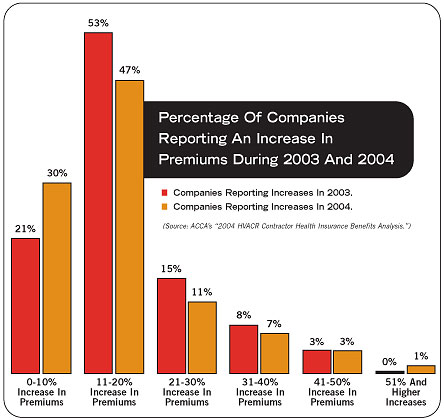
In a nutshell, 90 percent of respondents to the 2004 survey reported that they experienced an increase in health care premiums from the previous year.
When asked about the size of the increase, approximately half of the respondents (47 percent) reported an increase in premiums of between 11 percent and 20 percent in the past year, while 53 percent reported an increase in the same range in 2003.
If this pace continues, John Boyce of Airco Service Inc., Tulsa, Okla., said he's considering reducing coverage. He continually shops around for the best price, but it keeps getting harder and harder.
"We pay 100 percent of an employee's insurance and 50 percent for an employee's family," he said, noting that the company might have to drop family coverage in the future. The company is also considering increasing the cost for employees.
Looking for quick answers on air conditioning, heating and refrigeration topics? Try Ask ACHR NEWS, our new smart AI search tool. Ask ACHR NEWS
"In a competitive market for outstanding performers, we have to offer health insurance, so we will have to find a way to absorb the costs, regardless," said Ruzwa Cooper of Buzz Oates Air Conditioning Inc., Sacramento, Calif. "From a social policy perspective, I would like to see further development of the ‘consumer-driven health care' trend so that individuals are more aware and more sensitive to what they are buying and why.
"We are all much more cautious and prudent about our buying habits when it is our money, rather than the company's. We would like to find a way to help cover our families' insurance as well if the cost is reasonable, so we are very open to strategies that might allow us to do that within a finite pool of benefits dollars."
The Good, The Bad, And The Ugly
If there is a bright spot in the report, at least the soaring costs are not as dramatic in escalation as those in the span between 1999 and 2002. In that time span, ACCA respondents paid 60 percent more in health insurance premiums than they had in 1999. Still, current national averages indicate that over 98 percent of those surveyed had seen an increase in health premiums over those in 2002, according to Stalknecht."In the course of deploying this report - to further bolster our arguments on Capitol Hill in support of the Bush administration's plan for association health plans (AHPs) - we also knew that the information would be useful to the participants as benchmarking data," said Stalknecht. "With this information, contractors can see where they stand in terms of employment, health insurance costs, participation, and employee cost-sharing."
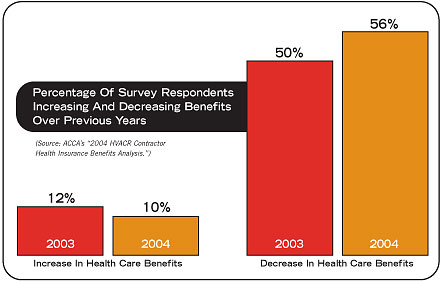
In 2003, 50 percent of respondents said they had decreased benefits over the previous year. In 2004, that figure jumped to 56 percent. This represents a marked increase compared to previous years. In 2000, 14 percent of companies reported a decrease in benefits, while 21 percent did so in 2001 and 28 percent did so in 2002.
Cooper found one way to keep costs stable was to utilize a Professional Employer Organization (PEO) to handle benefits. "At the beginning of 2004, we decided to outsource our entire human resource operation to Administaff, which is a PEO," he said. "One of the important reasons for doing this was that it allowed us to offer a richer set of benefits to our team at almost the same cost we had been paying the previous year.
"For example, because of our small size, we had been able to offer only one plan from one carrier. With Administaff, we can now offer the choice of HMO or PPO from three carriers. In addition, we have access to online health information resources, as well as a toll-free, 24-hour employee assistance plan that we would never have been able to provide on our own."
Michael Flesher, president of Arctic Air Inc., Detroit, was thankful his business is a union shop.
"I have a collective bargaining agreement with Pipefitters Local 636 in Detroit," he said. "My field people are covered under that health plan."
Increases, Decreases
Most survey respondents said they did not increase health insurance benefits for employees over the past two years. This could include providing health insurance for the first time, expanding the coverages or programs offered, decreasing percentage costs of participation, or any other move interpreted as expanding employee benefits.In 2003, only 12 percent said they increased benefits over the previous year. The number dropped to 10 percent in 2004. In previous years, respondents offering increased benefits totaled 18 percent (2002), 22 percent (2001), and 19 percent (2000).
As the ACCA report states, "The results of this survey showed that not only have contractors significantly ceased offering more benefits to employees in 2003 and 2004, but decreased health benefits no longer keep pace with increased benefits among respondents."
In other words, those companies who reported enhanced health benefits once balanced those companies at the other end of the spectrum that were trimming benefit programs, and that is no longer the case.
Has the insurance situation hit a crisis point yet? The crisis started a long time ago, answered Boyce. "Five years ago," was his assessment.
Spending Less, Getting Less
Compared to numbers presented in the 2002 survey, contractors are spending slightly less of their overall expenses toward health insurance premiums. In 2003, the average percentage of expenses spent on health insurance was 5.22 percent, dropping to 5.1 percent in 2004. (Previously, the average percentages paid from overall expenses toward health care premiums were 6 percent in 2000, 8 percent in 2001, and 7 percent in 2002.)This decrease in expense toward premiums out of the overall employers' expenses can likely be attributed to a couple of factors, including data showing that employers are decreasing the coverage options previously given to employees due to overall increased health insurance costs, as well as additional data indicating that employers are shifting more of the expense of these increased costs to their employees.
"Our health care cost from 2004 to 2005 went up approximately 8 percent, which is still outrageous in light of general inflation, but a bit easier to swallow," admitted Cooper. "We would like to offer dental and vision, but have not found a way to do that at a reasonable cost. Most options we have seen charge a healthy premium and end up paying little once you are on the dental chair."
At Buzz Oates Air Conditioning, the company does provide its team with a flexible spending account so they can use their pre-tax dollars to pay for some types of out-of-pocket expenses.
"But no one takes advantage of this because of the fear of losing the money if they don't end up using it," said Cooper. "I'd like to see that IRS regulation changed so that at least we can roll over the unused portion to the next year so there is no risk of losing it."
Shakedown By Regions
While all the contractors saw increases in premiums, some regions experienced 100-percent increases in premiums over the past two years - the Mountain (Alaska, Kansas, North Dakota, Nebraska, South Dakota) and North (Connecticut, Maine, Massachusetts, New Hampshire, New York, Rhode Island, Vermont) regions. The Western region (Arizona, Colorado, New Mexico, Oklahoma, Texas, and Utah), which recorded the highest increases in 2002, reported the lowest increase in premiums in 2003 and 2004 (79 and 83 percent, respectively).One interesting detail evident in this comparison involves the number of Western region respondents offering benefits. While a clear majority still offers health insurance to employees, only 90 percent of the Western respondents in 2003 and 87 percent in 2004 did so, compared to 97 percent to 100 percent of the respondents in the other regions surveyed.
Light At End Of Tunnel?
ACCA admitted in its newest health insurance benefits analysis report that it would not attempt to summarize or provide a total assessment of its overall results, "as that would require too many assumptions on our part of details not actually surveyed." The association stated that it would allow "the numbers to speak for themselves."Still, the report concluded that "it is clear that rising health care costs have had an impact on participants surveyed; and, while these businesses continue in their efforts to provide health care programs for their employees, the results of this survey (and the one concluded in 2002) indicate that businesses faced with rising health care costs are cutting back on health care benefits offered, and are seeing the expense of their increased health care premiums reflected in the overall total expenses of running their companies."
On thing seems certain: Contractors will be talking about their health care situation in private and among friends at ACCA's convention this week.
To purchase ACCA's "2004 HVACR Contractor Health Insurance Benefit Analysis," go to www.acca.org/biz/datatools.
Sidebar: ACCA, Others Support Small Business Health Fairness Act
The Air Conditioning Contractors of America (ACCA), the Associated Builders and Contractors (ABC), and other national trade associations of HVACR contracting businesses are in support of the bipartisan "Small Business Health Fairness Act of 2005" (H.R. 525) sponsored by Reps. Sam Johnson, R-Texas; John Boehner, R-Ohio; Nydia Velazquez, D-N.Y.; and Albert Wynn, D-Md."ACCA applauds Reps. Johnson, Boehner, Velazquez, and Wynn for introducing this legislation to help address the skyrocketing health care costs that our small community-based contractors have seen for the last several years," said ACCA president and CEO Paul Stalknecht. "ACCA's members are clamoring for federal legislation that will allow them to both lower their health insurance premiums and continue to provide their employees with access to quality health care."
The act, introduced Feb. 2 in the U.S. House of Representatives, is a measure designed to allow small businesses to join together nationwide through federally certified association health plans (AHPs). The House twice approved similar AHP legislation during the 108th Congress, with both bills passing by wide bipartisan majorities. Companion AHP legislation, S. 545, was introduced in the U.S. Senate during the 108th Congress, but the chamber never voted on the bill.
"The skyrocketing cost of health care was a central issue for the Bush-Cheney campaign in 2004," said Kirk Pickerel, ABC president and CEO. "Throughout the year, President Bush expressed his support for AHPs, repeatedly urging the Senate to consider its AHP legislation." ABC commends the president for making health care a priority issue in the 109th Congress as well.
"Now is the time for Congress to support America's small businesses and their employees by allowing AHPs. ABC continues to call on the Senate to quickly pass this important legislation and provide the nation's construction workers with the quality, affordable health care they need and deserve."
In his State of the Union address, President Bush said, "To make our economy stronger and more productive, we must make health care affordable, and give families greater access to good coverage and more control over their health decisions.
"I ask Congress to move forward on a comprehensive health care agenda with tax credits to help low-income workers buy insurance, a community health center in every poor county, improved information technology to prevent medical error and needless cost, associated health plans for small businesses and their employees, expanded health savings accounts and medical liability reform that will reduce health care costs and make sure patients have the doctors and care they need."
Stalknecht said ACCA will continue to follow the act and push for reform.
"The key to expanding access to affordable health care is more market competition and allowing small businesses to pool together across state lines, thus increasing their purchase power," he said. "Fortune 500 companies and large labor unions are already allowed to do this. Shouldn't America's small businesses have the same option?
"This bill did not pass in the last session of Congress. It's time that it did. Let's end the silly discrimination against small, community-based businesses that requires them to pay far more per employee than huge corporations. Small businesses employ more people than the Fortune 500 and deserve the same ability to compete for lower insurance rates.
"Let's work together and do something that will make a real difference to the small business owners who make America great and all of their employees, families, and communities."
Sidebar: MCAA Attacks Health Care Costs, Too
The Air Conditioning Contractors of America (ACCA) is not the only industry association examining the concern over soaring health care costs. The Mechanical Contractors Association of America (MCAA) created a Health Care Benefits Cost Control Task Force last year to address the status of health and welfare programs in the mechanical construction industry.As a tool to assist the task force in making its assessment and recommendations, local affiliates have been requested to obtain information describing their local health and welfare plan from the plan administrator. The findings of their data collection effort are described in "Health Care Benefits Cost Control," a report to MCAA prepared by the Construction Labor Research Council. It was issued in July of last year.
Findings include:
MCAA's full report can be downloaded at www.mcaa.org.
Publication date: 03/07/2005
Looking for a reprint of this article?
From high-res PDFs to custom plaques, order your copy today!


