ACHR News
search
Ask ACHR NEWS AI
cart
facebook twitter instagram linkedin youtube
  • Sign In
  • Subscribe
  • Sign Out
  • My Account
ACHR News
  • NEWS
    • Breaking News
    • New HVAC Products
    • Featured Products
    • Manufacturer Reports
    • HVAC Data
    • Legislation
    • ACHR NEWS Centennial
  • RESIDENTIAL
    • Air Conditioners
    • Furnaces
    • Residential Heat Pumps
    • Ductless
    • Residential IAQ
    • Testing, Monitoring, Tools
    • Components & Accessories
  • COMMERCIAL
    • Air Handlers
    • Rooftop Units
    • Chillers and Cooling Towers
    • Commercial Heat Pumps
    • Boilers and Hydronics
    • VRF/Ductless
    • Commercial IAQ
  • REFRIGERATION
    • Refrigerants
    • Refrigerant Regulations
    • Leak Management
  • CONTRACTOR PRO
    • Geothermal
    • Homeowner Study
    • VRF and VRV Ductless
    • Unitary Trends
  • EDUCATION
    • Training and Education
    • Business Management
    • Service and Maintenance
    • Continuing Education
    • Market Research >
      • HVAC Brand Awareness Report
      • VRV, VRF, VRVZ Report
      • Unitary Trends Report
      • Water Heat Professionals Report
    • Webinars
    • Sponsor Insights
    • eProducts Info
    • White Papers
  • EVENTS
    • HVAC Contractor Forum
    • Industry Events and Webinars
  • MEDIA
    • Videos
    • AHR Expo 2025 Videos
    • Podcasts >
      • ACHR News Podcast
      • HARDI Podcasts
      • AHR Expo Podcasts
      • ACCA Podcasts
    • Interactive Spotlights
    • Quizzes
    • eBooks
    • HVAC Talkback
  • HVAC GROUP
    • ACHR NEWS >
      • Current Issue
      • Digital Edition
      • Subscribe
    • Distribution Trends
    • SNIPS NEWS >
      • Join SNIPS NEWS
    • Engineered Systems News >
      • Join ES News
    • HVACR Directory
    • Contests
    • Newsletters
    • Contact
    • Advertise
    • My Account
HVAC ContractingTechnical

Measuring Temperature And Humidity

April 1, 2005
An HVAC technician must measure water temperatures, as well as dry bulb and wet bulb temperatures of air. For example, you may have to measure the entering and leaving temperatures for a coil - both for air and for water. Accurate temperature readings can be critical. An error of even 1 degree F can make a substantial difference when measuring temperatures and adjusting the water flow to a chilled water coil.

To measure temperature and humidity properly, the technician must be able to use all of the following instruments:

  • Thermometers: glass stem, pocket dial, digital, surface contact, and non-contact infrared.

  • Psychrometers: sling, power, and digital.

  • Temperature and humidity recorders.

    Measuring Temperatures

    Accuracy
    Catalog descriptions of thermometers usually give their accuracy. For analog instruments, accuracy is usually given as a percentage of the scale. A typical designation is "±1 percent of scale." This means that a 0 degree F to 120 degree F thermometer is accurate to within ±1.2 degrees (1 percent of 120 degrees F). In other words a reading of 70 degrees F can actually be between 68.8 degrees F and 71.2 degrees F.

    This article gives the general accuracy for a type of instrument. However, the accuracy can vary from one model to another. Check with the manufacturer for the accuracy of a particular instrument.

    Divisions
    Whenever you use a different analog thermometer, be sure to check what the divisions mean. For example, on some thermometers a single division means 1 degree. On others a division means 2 degrees.
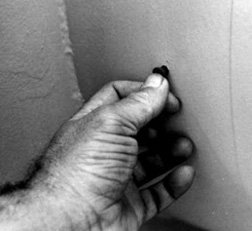
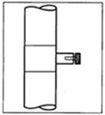
    Figure 1. Duct plugs.
    Taking Readings
  • Always give the instrument time to reach its true stable reading.

  • Take a reading more than once. Do not accept a reading until you obtain the same reading twice in a row.

  • When measuring for the temperature difference (delta T) across a device, always use the same thermometer for both readings.

  • Holes must often be made in ducts in order to take temperature readings. Never make these holes with a punch and hammer. The duct can be dented, and the hole cannot be sealed properly. Drill a 1/4-inch or a 7/16-inch hole. These can be sealed with plastic duct plugs, commonly called CaPlugs® (Figure 1).

    Figure 2. Pressure-temperature tap.
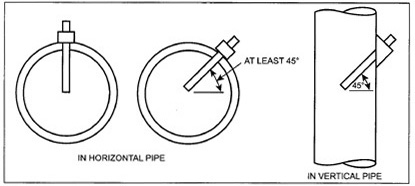
  • To measure the temperature of fluid in a hydronic system, the probe of a thermometer can be inserted into a pipe through a pressure-temperature tap (Figure 2), commonly called a PT plug or Pete's plug. This self-sealing valve installed in the piping closes by itself when the probe is removed.

  • Do not stand in front of a PT plug when inserting or removing a probe. Stand to one side to avoid getting hit by hot water if the plug fails to seal properly.

    Figure 3. Thermometer wells.
  • Thermometers or probes can also be inserted into thermometer wells (also called immersion wells) (Figure 3) installed in the piping. The well contains a heat transferring liquid (water, oil, mercury) to conduct the temperature to the thermometer.

    Thermometers

    Glass Stem Thermometer
    The portable glass stem thermometer is seldom used on the job because of the chance of breakage. However, it cannot get out of calibration and is often used to check the accuracy of other types of thermometers.

    Glass stem test thermometers are usually mercury-filled, and 14 inches to 16 inches long. They should be the partial-immersion type - that is, they must only be immersed in the liquid up to the mark on the stem. Some thermometers are alcohol-filled instead of mercury to avoid mercury contamination if the thermometer is broken.

    Thermometer subdivision marks are usually either 1-degree or 2-degree increments. Markings should be engraved on the glass, so that they do not wear off with use. Be aware of parallax if the thermometer is located where your eyes are not on a plane with the meniscus.
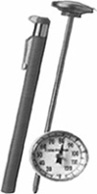
    Figure 4. Pocket dial thermometer and case. (Product photos courtesy of Davis Inotek Instruments.)
    Pocket Thermometers
    Pocket thermometers are convenient since they are about as long as a pen and can clip into a shirt pocket. Due to the small scale, accurate readings are difficult to obtain. They get out of calibration easily.

    The analog dial thermometer (Figure 4) is a bi-metal thermometer that contains a strip made of two layers of different metals. The different expansion rates of the two metals cause the strip to bend and this moves the indicator on the dial. However, they take some time for the indicator to reach the final point. Figure 4 shows a single scale thermometer with a 1-inch diameter dial.

    Pocket dial thermometers often have a lock nut at the back of the dial. Loosen this nut to twist the dial in order to calibrate it. Compare it with a glass stem thermometer or place in a glass of water and ice, which will be at 32 degrees F (0 degrees C). Because of this calibration feature, do not twist the thermometer when holding it by the dial while inserting into a PT plug.
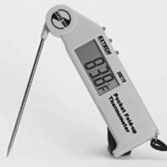
    Figure 5. Digital pocket thermometer.
    Digital pocket thermometers (Figure 5) have a larger range than analog types. A common range is -40 degrees F to 300 degrees F. Accuracy can range from ±2 degrees F to ±1 percent of the reading depending on the model. Some have hold buttons to allow measurements to be taken in awkward places, and then read in a more convenient position. They are available in either Fahrenheit (degrees F) or Celsius (degrees C), and some can be switched to either scale.

    Digital Thermometers
    Digital thermometers are battery powered. They are highly accurate and provide a choice between degrees F and degrees C scales. A variety of probes can be used for different applications such as penetration, surface, or air measurements. Most of these instruments can be calibrated in the field by placing the probe in the socket on the instrument and then zeroing the readout.

    Surface Thermometers
    It is always better to use an immersion thermometer to measure the temperature of a liquid. However, if there is no practical way to enter a hydronic system to measure the fluid directly, a surface thermometer can be used. It is held to the surface of the pipe either by a magnet or by a spring that wraps around the pipe. In some cases, they may have to be held in place by hand.

    The surface temperature of the pipe will not be the same as the temperature of the liquid in the pipe. However, if readings are taken on the same type of pipe for each point, the temperature difference (delta T) across a device can be determined. Be sure the pipe surface is clean.
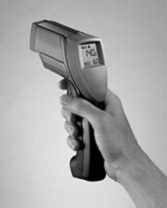
    Figure 6. Infrared thermometer.
    Non-Contact Infrared Thermometers
    A non-contact infrared thermometer (Figure 6) is used to measure temperatures in hard-to-reach places, such as the air temperature at a high supply air outlet that would otherwise require a special ladder or scaffold. Other typical uses are checking the temperature differential on each side of a steam trap, the temperature of a high voltage panel, the temperature of moving parts such as motor bearings, or hot spots on a building because of poor insulation.

    Infrared thermometers have digital displays and most can be selected for either degrees F or degrees C. They are generally accurate to ±2 degrees F (±1 degree C). Many use a laser beam to indicate the target area that is being measured. Features vary widely, depending on the model.

    In addition to the accuracy, an important feature to check is the target or spot size. The optical system varies with different models, so that the diameter of the spot being measured will vary with the distance. For example, one model specifies an 8-inch diameter spot at 60-inch distance from the target.

    Psychrometers

    Psychrometers are used to determine relative humidity by measuring dry bulb and wet bulb temperatures. The relative humidity (rh) is determined based upon the measured wet bulb and dry bulb temperatures. Relative humidity is an important factor in determining the comfort conditions of a space.

    Relative humidity is the percentage of moisture in the air as compared to the total amount of moisture that air can hold at a specific temperature, which is 100 percent humidity.

    Sling Psychrometer
    A sling psychrometer is the basic method of determining relative humidity. It consists of a dry bulb and a wet bulb thermometer. The wet bulb thermometer has a wick on the bulb that is wetted at each use. After the wick is wetted, the thermometers are whirled in the air for two minutes. Then the dry bulb and the wet bulb temperatures are read. The relative humidity is determined from these readings by use of a scale attached to the instrument or by a psychrometric chart.

    For most HVAC work, the sling psychrometer has been replaced by power psychrometers that are faster, easier to use, and more accurate.
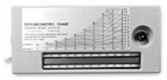
    Figure 7. Power psychrometer.
    Power Psychrometer
    A power psychrometer (Figure 7) is a battery operated, analog instrument that has accurate dry bulb and wet bulb thermometers. Some have a built-in water bottle to keep the wet bulb wick wet. A battery-powered fan maintains a constant proper velocity of air across the wick. A psychrometric chart on the instrument is used to determine rh and dew point (the temperature at which water starts condensing out of the air.)

    This instrument is more accurate than the sling psychrometer because the air velocity across the wet bulb is constant, and because the wet bulb temperature can be read as soon as it stabilizes. On the sling psychrometer, the time between stopping the whirling and reading the wet bulb temperature can be long enough for the wet bulb temperature to change significantly.

    The accuracy of the power psychrometer is generally ±1 percent of the full scale. This means that on a scale that reads from 0 degrees to 120 degrees F, the instrument is accurate to ±1.2 degrees F.

    Digital Psychrometers
    A digital psychrometer is fast and provides the dry bulb temperature within one second and the wet bulb temperature within 15 seconds. Its accuracy is generally ±2 degrees F.

    There are a variety of instruments called thermo-hygrometers or temperature/humidity/dew point indicators. These operate electronically and provide temperatures and dew points in addition to relative humidity. Many of these can be connected to a handheld printer.

    Temperature And Humidity Recorders

    A temperature recorder records variables such as temperature, humidity, and dew point with a continuous line on a replaceable circular chart or strip. A recorder is installed when a record is needed over a given period of time. Probes are placed in the location that is to be measured. The time period to be recorded can be set from a keypad and can range from 24 hours up to 31 days. Most recorders can be programmed to record two values at a time - choosing from dry bulb temperature, wet bulb temperature, dew point, or humidity. Recorders can be battery operated or key wound.

    Other Recorders

    Recorders are available for other values such as differential pressure, level of carbon dioxide, and electrical values.

    Excerpted and reprinted from Instruments For HVAC Work by Leo A. Meyer, one of the books in the Indoor Environment Technician's Library series published by LAMA Books. For over 30 years, Meyer has been writing and publishing training materials for the HVAC industry. His books cover a wide range of topics, including heating and cooling, indoor air quality, sheet metal work, electricity basics, safety, and others. For more information, visit www.lamabooks.com.

    Publication date: 04/04/2005

  • Share This Story

    Looking for a reprint of this article?
    From high-res PDFs to custom plaques, order your copy today!


    Recommended Content

    JOIN TODAY
    To unlock your recommendations.

    Already have an account? Sign In

    • HVAC-enrollment

      The Trades Are Back: HVACR Programs See Nearly 30% Enrollment Spike

      A new wave of future technicians is entering the pipeline.  
      Training and Education
      By: Matt Jachman
    • 2025 Top 40 Under 40

      2025 Top 40 Under 40 HVACR Professionals List

      The 11th annual Top 40 Under 40 list highlights those...
      HVAC Contracting
      By: Hannah Belloli-Oster
    • LG Ductless Mini-Split Systems

      The 9 Types of Heat Pumps

      As the U.S. moves toward electrification, heat pumps are...
      News
      By: Joanna R. Turpin
    Subscription Center
    • Create an Account
    • Start a Subscription
    • Manage My Account
    • Sign Up for Newsletters
    • Visit Customer Service
    • Update Preferences

    More Videos

    Sponsored Content

    Sponsored Content is a special paid section where industry companies provide high quality, objective, non-commercial content around topics of interest to The News audience. All Sponsored Content is supplied by the advertising company and any opinions expressed in this article are those of the author and not necessarily reflect the views of The News or its parent company, BNP Media. Interested in participating in our Sponsored Content section? Contact your local rep!

    close
    • Piggy Bank
      Sponsored byWatercress Financial

      Energy Prices, Inflation, and HVAC: What Today’s Homeowners Care About

    • Refrigerated Food
      Sponsored bySolstice Advanced Materials

      R-455A Refrigeration: A Cold Storage Solution for the Future

    • Airex Rooftop Units
      Sponsored byAirex Manufacturing Inc

      Consolidating Roof Penetrations: A Growing Trend in Multifamily HVAC Design

    Popular Stories

    Lennox equipment

    Platinum Equity to Sell Heat Controller to Lennox

    HVAC-tech-van.jpg

    Report: Only 65% of HVAC Technician Time is Billable Hours

    HVAC Minute retail refrigeration system

    EPA Final Rule’s Impact on R-410A Deadlines

    Lovato-refrigerant-rooftop_AC_Units_.jpg

    When Refrigerants Change, So Do the Contactors

    Dealer_Couple2_Kitchen_Estimate.jpg

    Predicting the Next Service Call

    View The ACHR NEWS
    Centennial Anniversary Timeline

    The ACHR News Timeline Chart
    Submit a Letter
    Submit a letter to our editors.

    Events

    November 6, 2025

    Next-Gen Data Center Cooling: HVAC Innovation and Real-World Solutions

    On Demand As AI workloads and high-density computing push traditional cooling methods to their limits, the data center industry is accelerating the adoption of next-generation HVAC technologies.

    July 28, 2026

    How Top Home Services Companies Turn Every Conversation Into Predictable Revenue

    In this webinar, we'll outline how top contractors are turning every conversation into predictable revenue by coaching every comfort advisor visit, not just the ones a manager rides along on.

    View All Submit An Event

    Poll

    Summer Staff

    Are you fully staffed for the summer season?
    View Results Poll Archive

    Products

    BNI Mechanical/Electrical Square Foot Costbook, 2026 Edition

    BNI Mechanical/Electrical Square Foot Costbook, 2026 Edition

    See More Products
    Designing Systems Using A2L Refrigerant - Free Webinar - 7/22/2026

    Related Articles

    • Floral Cooler

      Temperature and Humidity Play a Critical Role in Preserving Floral Arrangements

      See More
    • Full Gauge Controls: Temperature and Humidity Controller

      See More
    • Anden: Precise Control of Temperature and Humidity - ACHR

      Anden: Precise Control of Temperature and Humidity

      See More

    Related Products

    See More Products
    • 9781482255676.jpg

      Testing and Balancing HVAC Air and Water Systems, Fifth Edition

    • HVACR Troubleshooting Fundamentals  Electrical Book Cover Image.jpg

      HVACR Troubleshooting Fundamentals: Electricity and Wiring Diagrams

    • Manual B.jpg

      Manual B - Balancing and Testing Air and Hydronic Systems

    See More Products

    Related Directories

    • measureQuick®

      measureQuick is an application that technicians use to display measurements from arrayed smart tools, run equipment diagnostics, view just-in-time education and resources, generate easy-to-read homeowner-facing PDF reports and more.
    ×

    Sign Up. Stay Informed.

    The #1 trusted source for the HVACR industry since 1926

    SUBSCRIBE
    • RESOURCES
      • Advertise
      • Contact Us
      • Advisory Board
      • Classifieds
      • Submit a Letter
      • Directories
      • Store
    • ACCOUNT CENTER
      • Create an Account
      • Start a Subscription
      • Manage My Account
      • Sign Up for Newsletters
      • Visit Customer Service
      • Update Preferences
    • SERVICES
      • Marketing Services
      • Reprints
      • Market Research
      • List Rental
      • Survey/Respondent Access
    • STAY CONNECTED
      • LinkedIn
      • Facebook
      • Instagram
      • YouTube
      • X (Twitter)
    • PRIVACY
      • PRIVACY POLICY
      • TERMS & CONDITIONS
      • DO NOT SELL MY PERSONAL INFORMATION
      • PRIVACY REQUEST
      • ACCESSIBILITY

    Copyright ©2026. All Rights Reserved BNP Media, Inc. and BNP Media II, LLC.

    Design, CMS, Hosting & Web Development :: ePublishing