ACHR News
search
Ask ACHR NEWS AI
cart
facebook twitter instagram linkedin youtube
  • Sign In
  • Subscribe
  • Sign Out
  • My Account
ACHR News
  • NEWS
    • Breaking News
    • New HVAC Products
    • Featured Products
    • Manufacturer Reports
    • HVAC Data
    • Legislation
    • ACHR NEWS Centennial
  • RESIDENTIAL
    • Air Conditioners
    • Furnaces
    • Residential Heat Pumps
    • Ductless
    • Residential IAQ
    • Testing, Monitoring, Tools
    • Components & Accessories
  • COMMERCIAL
    • Air Handlers
    • Rooftop Units
    • Chillers and Cooling Towers
    • Commercial Heat Pumps
    • Boilers and Hydronics
    • VRF/Ductless
    • Commercial IAQ
  • REFRIGERATION
    • Refrigerants
    • Refrigerant Regulations
    • Leak Management
  • CONTRACTOR PRO
    • Geothermal
    • Homeowner Study
    • VRF and VRV Ductless
    • Unitary Trends
  • EDUCATION
    • Training and Education
    • Business Management
    • Service and Maintenance
    • Continuing Education
    • Market Research >
      • HVAC Brand Awareness Report
      • VRV, VRF, VRVZ Report
      • Unitary Trends Report
      • Water Heat Professionals Report
    • Webinars
    • Sponsor Insights
    • eProducts Info
    • White Papers
  • EVENTS
    • HVAC Contractor Forum
    • Industry Events and Webinars
  • MEDIA
    • Videos
    • AHR Expo 2025 Videos
    • Podcasts >
      • ACHR News Podcast
      • HARDI Podcasts
      • AHR Expo Podcasts
      • ACCA Podcasts
    • Interactive Spotlights
    • Quizzes
    • eBooks
    • HVAC Talkback
  • HVAC GROUP
    • ACHR NEWS >
      • Current Issue
      • Digital Edition
      • Subscribe
    • Distribution Trends
    • SNIPS NEWS >
      • Join SNIPS NEWS
    • Engineered Systems News >
      • Join ES News
    • HVACR Directory
    • Contests
    • Newsletters
    • Contact
    • Advertise
    • My Account

Testing, Adjusting, And Balancing Can Boost Profits For Contractors

By Barbara A. Checket-Hanks
April 21, 2005
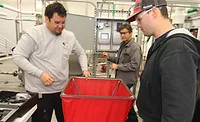
Testing, adjusting, and balancing are as important for hydronic systems as air systems. (Photos courtesy of the Testing, Adjusting and Balancing Bureau.)
Becoming TAB certified can give a major boost to a technician's career, as well as to a contractor's bottom line. TAB stands for testing, adjusting, and balancing, and its domains are commercial and industrial air and hydronic systems.

According to the Testing, Adjusting, and Balancing Bureau (TABB) of the National Energy Management Institute Committee (NEMIC), "The purpose of TAB is to ensure that an HVAC system is providing maximum occupant comfort at the lowest energy cost possible."

"HVAC contractors who don't perform TAB work misunderstand the necessity for TAB testing," said Roy Ringwood, board trustee of the Labor Management Coalition Trust (LMCT) between Orange County (Calif.) Local Sheet Metal Union 105 and Orange Empire Sheet Metal and Air Conditioning Contractors' National Association (SMACNA).

Ringwood has served on the National Test & Air Balance Technical Task Force.

"You can have an environmentally safe building without TAB, but IAQ and energy consumption can be affected by problems that TAB testing would have caught."

TAB has been around for quite some time. How has it changed? "In particular, enactment of the certification program is one of the major changes that TAB has undergone," Ringwood said.

Today's TAB certification means that the contractor, supervisor, and technician are all trained and certified. "There is a direct, comprehensive certification program for TAB. Before, a TAB-certified contractor didn't have to have a certified technician." Having certified techs, among other things, helps ensure that testing is performed accurately.

Another change in the program is that contractors have to sign a quality and integrity agreement, he pointed out. All three parties (contractor, supervisor, technician) must be recertified periodically.

Looking for quick answers on air conditioning, heating and refrigeration topics? Try Ask ACHR NEWS, our new smart AI search tool. Ask ACHR NEWS →

TAB certification of technicians is crucial for ensuring repeatability of results.

The TAB Tech

"The journeyman sheet metal worker who has achieved national certification in testing, adjusting, and balancing environmental systems is at the highest level of HVAC technical skill and knowledge," according to Sheet Metal Workers' International Association (SMWIA).

TAB procedures on a complicated HVAC system require that the TAB tech be well-trained, highly skilled, and knowledgeable.

"This person must know the fundamentals of airflow, hydronic flow, refrigeration, and electricity and be familiar with all types of HVAC temperature controls and refrigeration systems," according to the bureau.

"They must also know how to take pressure, temperature, and flow measurements and be able to perform effective troubleshooting."

James S. Barrie, owner of Rocky Mountain Balance Co., Denver, described the ideal TAB technician as a person "who likes to solve problems, who enjoys working by himself or with one or two other persons, who feels comfortable with computers, and who gets a kick out of understanding HVAC systems and almost designing them."

A TAB-certified technician will have completed a National Training Fund (NTF)-approved training program or worked at least two years as a TAB tech under supervision; be a member in good standing of SMWIA; and pass a five-hour written test and two-day hands-on performance test.

"One must work at least 600 hours per year in TAB work to maintain certification, and the certification can be revoked for failure to meet established professional standards," according to the bureau.

Some TAB jobs can be done by one person. However, many HVAC systems need a TAB team to complete the work efficiently and in a reasonable time period.

It is equally important that the other members of the TAB team be trained and knowledgeable in the basic fundamentals and procedures of TAB work. Getting one person on staff certified may be a good place to start, but it could limit the TAB jobs a contractor pursues.
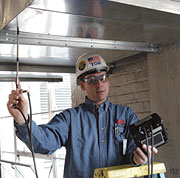
Here, a TAB-certified technician checks for leaks in ductwork.

TAB Jobs

The goal of TAB work, for any new construction or renovation project, is to verify that all HVAC water and air flows and pressures meet both the design intent and equipment manufacturer's operating requirements, the bureau explained.

"It is rare to find an HVAC system of any size that will perform completely satisfactorily without the benefit of final adjustments. This is why it is considered a ‘best practice' for the designer to specify that TAB work be part of the overall HVAC system installation."

Preplanning comes first. "Preplanning for TAB work includes making certain that all the necessary parties and individuals to conduct the work are on board," the bureau stated.

Key considerations include the type of building and systems to be tested, and "a realistic evaluation of what skills the TAB technician possesses."

Sometimes a controls specialist is needed to operate the system for the tech. In addition, OEM supply representatives may be needed as a resource, at a minimum. "For complex equipment and systems, or in a new building startup, a manufacturer's representative may be required at the site to operate the mechanical equipment," the bureau said.

The facilities manager is typically the most important team member with whom TAB technicians will work. "Facility managers have a substantial vested interest in ongoing customer satisfaction," the bureau said. "The people who work or live in the building are actual end-use customers; their satisfaction will ultimately be the key measure of success."

If a system cannot be balanced or made to perform according to the contract's design specifications regardless of the number of balancing dampers or valves that can be installed, TAB techs need to be prepared to work with the appropriate people, and together formulate recommendations for the final TAB report.

Two methods of balancing are taught: proportional and sequential. The proportional method involves starting at the low point in a system and working back toward the fan, the bureau explained. "The TAB technician balances one outlet to another; each damper is set correctly the first time."

The sequential method involves setting the outlets in sequence away from the fan. This is also called the "traverse method" because each time a branch damper is set the duct cfm is determined by a Pitot tube traverse, and then dampers reset to produce the cfm in each branch duct.

Critical Needs

Testing, adjusting, and balancing all of the HVAC systems in a new building is very important to completing the installation and making sure the system performs as the designer intended. "Contamination in new structures can include formaldehyde, off gassing from new furnishings and glue, even mold and moisture," said Ringwood.

In any building, energy management and IAQ are good reasons to repeat the test every year. "Building owners may not know how building systems affect those two areas," Ringwood said.

"I've seen strange things uncovered by technicians," he continued. "One new building, for example, was mostly occupied but some floors were unoccupied. A fire damper was left shut by the contractor." Off gassing building materials could not vent adequately, making several occupants ill.

"Testing, adjusting, and balancing of the HVAC system fine-tunes occupant comfort levels while keeping energy use to the lowest level possible," the bureau said. "This is extremely important in this era of rising energy costs."

"The International Certification Board certifies contractors and supervisors," Ringwood explained. "The International Training Institute trains technicians."

There currently are formal TAB training programs and certification test centers at these local union Joint Apprenticeship Training Committees (JATCs): Local 9, Denver; Local 19, Philadelphia; Local 73, Chicago; and Local 105, Los Angeles. Future sites will include Local 104, San Francisco; Local 80, Detroit; and Local 66, Seattle.

For more information, visit www.tabbcertified.org.

Sidebar: TAB Tools And Instruments

Certified TAB techs use an array of test instruments to gather accurate, repeatable, and reliable data. Using these tools, they examine and test each air distribution system and hydronic distribution system in a building, and set and adjust the system to design specifications. Here is a list of some of the tools and test instruments they may use, according to the Testing, Adjusting, and Balancing Bureau (TABB).

Airflow measuring instruments:

  • Manometers - Used to measure pressure drops that can be translated into flow rates. They represent the difference in pressure between two points.

  • Digital manometers - Can provide accurate readings at very low pressure differentials, such as across air filters and expansion cooling coils. They can automatically adjust for barometric pressure, store readings with recall in average or total numbers, and some can provide additional functions such as temperature measurements.

  • Anemometers - Available in several configurations (rotating vane, deflecting vane, thermal), they are used primarily to measure air velocities at registers, grilles, hoods, coils, etc.

  • Flow measuring hoods - Directly measures cfm of air distribution devices.

    Temperature measuring instruments:

  • Glass tube and dial thermometers - Used to measure air and fluid temperatures.

  • Thermocouples - Used to measure surface temperatures.

  • Psychrometers and electronic thermohygrometers - Determine relative humidity.

    - B. Checket-Hanks

    Publication date: 04/25/2005

  • Share This Story

    Looking for a reprint of this article?
    From high-res PDFs to custom plaques, order your copy today!


    Barbara Checket-Hanks is Service & Maintenance Editor. E-mail her at barbarachecket-hanks@achrnews.com.

    Recommended Content

    JOIN TODAY
    To unlock your recommendations.

    Already have an account? Sign In

    • HVAC-enrollment

      The Trades Are Back: HVACR Programs See Nearly 30% Enrollment Spike

      A new wave of future technicians is entering the pipeline.  
      Training and Education
      By: Matt Jachman
    • 2025 Top 40 Under 40

      2025 Top 40 Under 40 HVACR Professionals List

      The 11th annual Top 40 Under 40 list highlights those...
      HVAC Commercial Market
      By: Hannah Belloli-Oster
    • LG Ductless Mini-Split Systems

      The 9 Types of Heat Pumps

      As the U.S. moves toward electrification, heat pumps are...
      HVAC Commercial Market
      By: Joanna R. Turpin
    Subscription Center
    • Create an Account
    • Start a Subscription
    • Manage My Account
    • Sign Up for Newsletters
    • Visit Customer Service
    • Update Preferences

    More Videos

    Sponsored Content

    Sponsored Content is a special paid section where industry companies provide high quality, objective, non-commercial content around topics of interest to The News audience. All Sponsored Content is supplied by the advertising company and any opinions expressed in this article are those of the author and not necessarily reflect the views of The News or its parent company, BNP Media. Interested in participating in our Sponsored Content section? Contact your local rep!

    close
    • Piggy Bank
      Sponsored byWatercress Financial

      Energy Prices, Inflation, and HVAC: What Today’s Homeowners Care About

    • Refrigerated Food
      Sponsored bySolstice Advanced Materials

      R-455A Refrigeration: A Cold Storage Solution for the Future

    • Airex Rooftop Units
      Sponsored byAirex Manufacturing Inc

      Consolidating Roof Penetrations: A Growing Trend in Multifamily HVAC Design

    Popular Stories

    Lennox equipment

    Platinum Equity to Sell Heat Controller to Lennox

    HVAC-tech-van.jpg

    Report: Only 65% of HVAC Technician Time is Billable Hours

    HVAC Minute retail refrigeration system

    EPA Final Rule’s Impact on R-410A Deadlines

    Lovato-refrigerant-rooftop_AC_Units_.jpg

    When Refrigerants Change, So Do the Contactors

    Dealer_Couple2_Kitchen_Estimate.jpg

    Predicting the Next Service Call

    View The ACHR NEWS
    Centennial Anniversary Timeline

    The ACHR News Timeline Chart
    Submit a Letter
    Submit a letter to our editors.

    Events

    November 6, 2025

    Next-Gen Data Center Cooling: HVAC Innovation and Real-World Solutions

    On Demand As AI workloads and high-density computing push traditional cooling methods to their limits, the data center industry is accelerating the adoption of next-generation HVAC technologies.

    July 28, 2026

    How Top Home Services Companies Turn Every Conversation Into Predictable Revenue

    In this webinar, we'll outline how top contractors are turning every conversation into predictable revenue by coaching every comfort advisor visit, not just the ones a manager rides along on.

    View All Submit An Event

    Poll

    Summer Staff

    Are you fully staffed for the summer season?
    View Results Poll Archive

    Products

    BNI Mechanical/Electrical Square Foot Costbook, 2026 Edition

    BNI Mechanical/Electrical Square Foot Costbook, 2026 Edition

    See More Products
    Designing Systems Using A2L Refrigerant - Free Webinar - 7/22/2026

    Related Articles

    • Aug. 11, 2014: NEBB Announces Testing, Adjusting, and Balancing Review Seminar

      See More
    • TABB Hall of Fame

      Testing, Adjusting and Balancing Industry Honors Excellence at St. Louis Conference

      See More
    • HVAC System Testing, Adjusting and Balancing Bureau Receives ANSI Accreditation

      See More

    Related Products

    See More Products
    • 9781482255676.jpg

      Testing and Balancing HVAC Air and Water Systems, Fifth Edition

    • Manual B.jpg

      Manual B - Balancing and Testing Air and Hydronic Systems

    • new cover.jpg

      Profit is An Attitude: The Strategies You Need to Optimize Profits

    See More Products

    Events

    View AllSubmit An Event
    • August 21, 2025

      What the Big Beautiful Bill Means for HVAC Contractors

      On Demand In this webinar, we will take a look at the elimination of the residential and commercial HVAC tax incentives and how contractors can navigate this new landscape.
    View AllSubmit An Event

    Related Directories

    • Associated Air Balance Council

      Associated Air Balance Council (AABC) sets standards for Total System Balance, certifies independent agencies, and ensures unbiased, high-quality services with a National Performance Guaranty and rigorous Quality Assurance Program.
    ×

    Sign Up. Stay Informed.

    The #1 trusted source for the HVACR industry since 1926

    SUBSCRIBE
    • RESOURCES
      • Advertise
      • Contact Us
      • Advisory Board
      • Classifieds
      • Submit a Letter
      • Directories
      • Store
    • ACCOUNT CENTER
      • Create an Account
      • Start a Subscription
      • Manage My Account
      • Sign Up for Newsletters
      • Visit Customer Service
      • Update Preferences
    • SERVICES
      • Marketing Services
      • Reprints
      • Market Research
      • List Rental
      • Survey/Respondent Access
    • STAY CONNECTED
      • LinkedIn
      • Facebook
      • Instagram
      • YouTube
      • X (Twitter)
    • PRIVACY
      • PRIVACY POLICY
      • TERMS & CONDITIONS
      • DO NOT SELL MY PERSONAL INFORMATION
      • PRIVACY REQUEST
      • ACCESSIBILITY

    Copyright ©2026. All Rights Reserved BNP Media, Inc. and BNP Media II, LLC.

    Design, CMS, Hosting & Web Development :: ePublishing