ACHR News
search
Ask ACHR NEWS AI
cart
facebook twitter instagram linkedin youtube
  • Sign In
  • Subscribe
  • Sign Out
  • My Account
ACHR News
  • NEWS
    • Breaking News
    • New HVAC Products
    • Featured Products
    • Manufacturer Reports
    • HVAC Data
    • Legislation
    • ACHR NEWS Centennial
  • RESIDENTIAL
    • Air Conditioners
    • Furnaces
    • Residential Heat Pumps
    • Ductless
    • Residential IAQ
    • Testing, Monitoring, Tools
    • Components & Accessories
  • COMMERCIAL
    • Air Handlers
    • Rooftop Units
    • Chillers and Cooling Towers
    • Commercial Heat Pumps
    • Boilers and Hydronics
    • VRF/Ductless
    • Commercial IAQ
  • REFRIGERATION
    • Refrigerants
    • Refrigerant Regulations
    • Leak Management
  • CONTRACTOR PRO
    • Geothermal
    • Homeowner Study
    • VRF and VRV Ductless
    • Unitary Trends
  • EDUCATION
    • Training and Education
    • Business Management
    • Service and Maintenance
    • Continuing Education
    • Market Research >
      • HVAC Brand Awareness Report
      • VRV, VRF, VRVZ Report
      • Unitary Trends Report
      • Water Heat Professionals Report
    • Webinars
    • Sponsor Insights
    • eProducts Info
    • White Papers
  • EVENTS
    • HVAC Contractor Forum
    • Industry Events and Webinars
  • MEDIA
    • Videos
    • AHR Expo 2025 Videos
    • Podcasts >
      • ACHR News Podcast
      • HARDI Podcasts
      • AHR Expo Podcasts
      • ACCA Podcasts
    • Interactive Spotlights
    • Quizzes
    • eBooks
    • HVAC Talkback
  • HVAC GROUP
    • ACHR NEWS >
      • Current Issue
      • Digital Edition
      • Subscribe
    • Distribution Trends
    • SNIPS NEWS >
      • Join SNIPS NEWS
    • Engineered Systems News >
      • Join ES News
    • HVACR Directory
    • Contests
    • Newsletters
    • Contact
    • Advertise
    • My Account

Your Compressor's Worst Nightmare

February 2, 2003
Liquid floodback is liquid refrigerant returning to the compressor’s crankcase during the running cycle. Refrigerant migration is refrigerant liquid or vapor returning to the compressor during the off cycle. Migration usually happens because of a pressure difference. The compressor can be located in a cold ambient causing a lower pressure, or the oil can be attracting the refrigerant because of its lower vapor pressure. In either case, the refrigerant will migrate to the compressor because of its lower pressure.

Liquid refrigerant floodback is a compressor’s worse nightmare. Floodback will dilute the compressor’s oil with liquid refrigerant and cause foaming in the compressor’s crankcase, which causes bearing wash. Even if the compressor superheat is kept over 20 degrees F, there are times when evaporator heat loads are low, defrost periods have just ended, mechanical valves fail or are misadjusted, or a lack of system maintenance like a dirty evaporator coil can cause compressor floodback. If there is no way to prevent these unexpected periods of floodback to the compressor, a suction line accumulator is needed on the system.

Possible Causes

The causes of compressor floodback include:
  • Wrong TXV setting (low or no compressor superheat);

  • Overcharge;

  • Evaporator fan out;

  • Low load on evaporator;

  • End of cycle (lowest load);

  • Defrost clock or heater out (iced coil);

  • Dirty or blocked evaporator coil;

  • Capillary tube overfeeding;

  • Capillary tube system overcharge;

  • Expansion bulb loose on evaporator outlet;

  • Oversized expansion valve;

  • Flooding after hot gas termination;

  • Heat pump changeover; and

  • Defrost termination.

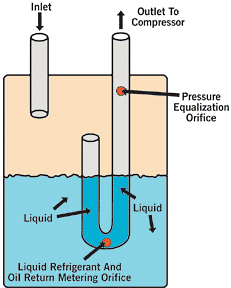
    Figure 1. During an off cycle, the accumulator may have some liquid refrigerant come to it by gravity from the evaporator and suction line. This liquid refrigerant will flow through the liquid refrigerant and oil return metering orifice and seek its own level both inside and outside the U-tube formation of the suction piping.

    Accumulators

    Suction line accumulators are designed as compressor protection devices when flooding and migration do occur. They should be installed between the evaporator and the compressor on the suction line. They are usually installed in the suction line as close to the compressor as possible. In reverse cycle systems like heat pumps, they should be installed in the suction line between the compressor and the reversing valve. Accumulators can also act as suction line mufflers to quiet compressor pulsation noises.

    Accumulators simply act as temporary reservoirs for liquid refrigerant and/or oil. They are simply vessels that collect liquids from the suction line and hold them until they evaporate and return to the compressor naturally. Their outlet tubes to the compressor are located at the highest point in the accumulator to let only refrigerant vapor enter the compressor. Hopefully, the refrigerant liquid level never reaches the highest point.

    Most accumulators are also designed to meter both the liquid refrigerant and oil back to the compressor at an acceptable rate that will not damage compressor parts or cause oil foaming in the crankcase. This is done while the compressor is running with a small metering orifice at the bottom of the outlet tube. This small orifice is mainly designed for oil return. However, liquid refrigerant can be slowly metered and vaporized through it also.

    Some accumulators use electric heaters or liquid line heat sources to evaporate liquid refrigerant in the accumulator. However, any heat source that boils off liquid refrigerant causes the refrigerant gas to be saturated. This means the gas contains no superheat as it leaves the accumulator.

    Compressors often experience high ampere draws from near saturated vapors being compressed. This density of saturated or near-saturated vapors is much greater than superheated vapors and will often cause a higher mass flow rate than the compressor can handle. The results are high amp draw and often overheating of the compressor.
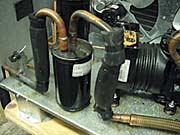
    Suction line accumulators are designed as compressor protection devices when refrigerant flooding and migration occur. They should be installed between the evaporator and the compressor on the suction line.

    Rust And Sweating

    Many indoor compressor installations have problems with suction accumulators sweating and dripping on the floors. The only way around this problem is to insulate the accumulator. The accumulator must be insulated completely and vapor-sealed to prevent condensate from forming under the insulation.

    Because accumulators are made of steel, rusting problems can result if the accumulator is exposed to moisture for any long period of time.

    Rusting of an accumulator usually happens at its seams or at the piping stubs after about 6 to 8 years of use. Even though manufacturers do supply accumulators with rust preventive paints, during the welding processes these paints can be burned off, leaving exposed metals.

    If an accumulator is repaired because of pinhole leaks (usually near the seams or piping stubs), it is recommended that after resoldering, the residual soldering flux should be washed away. The area should also be sanded clean with emery cloth or steel wool. The surfaces should then be covered with a silicone rubber or roofing tar for a waterproof seal. The suction lines connected to the accumulator should also be insulated in order to prevent sweat from forming on them and dripping onto the accumulator.

    Since compressors are extremely susceptible to liquid coming back to their crankcases or valves, accumulators add an extra safety precaution. Suction accumulators can assist in flooding and migrating conditions.

    However, if flooding or migration problems are severe, suction line accumulators have been known to flood with compressor damage still occurring. This is why the only 100-percent safe accumulator is one that can hold 100 percent of the entire system’s refrigerant charge. Also, refrigerant vapor can migrate through the accumulator on the off-cycle and still get to the compressor. So, the accumulator is not the cure-all for refrigerant migration problems.

    Pressure Equalization

    During an off cycle, the accumulator may have some liquid refrigerant come to it by gravity from the evaporator and suction line. This especially will happen when the system does not have an automatic pump-down cycle for its off cycles. This liquid refrigerant will flow through the liquid refrigerant and oil return metering orifice and seek its own level both inside and outside the U-tube formation of the suction piping of the accumulator. (See Figure 1.)

    This means that the U-tube of suction piping inside of the accumulator will have a column of liquid refrigerant in it during the off-cycle simply from liquid inside the accumulator seeking its own level.

    When the compressor starts up, this column of liquid refrigerant would be sucked out of the accumulator and into the compressor if it were not for a pressure equalization orifice at the outlet of the accumulator. This orifice at the outlet of the accumulator will equalize pressure on both sides of the liquid column when the compressor is on or off.

    In other words, the liquid column will have accumulator pressure on both sides of it because of this orifice. This will prevent the column of liquid from being sucked out of the U-tube of the accumulator and possibly damaging the compressor during the running cycle.

    The liquid column will momentarily hang in the U-tube and rapidly vaporize on a compressor startup. This is a time where the compressor could see saturated gas entering it. Once this column of liquid in the accumulator is cleared or vaporized, the compressor will again see superheated gas.

    Accumulator Selection

    Accumulators should be selected with three basic considerations in mind. Please consult with the manufacturer for specific catalog numbers and tonnage ratings.

    The accumulator should have adequate liquid holding capacity. This should not be less than 50 percent of the entire system charge.

    The accumulator should not add excessive pressure drop to the system.

    Never base the accumulator on the line size of the suction line. Many times an accumulator will not have the same line size as the suction line.

    Tomczyk is a professor of HVAC at Ferris State University, Big Rapids, Mich., and the author of Troubleshooting and Servicing Modern Air Conditioning & Refrigeration Systems, published by ESCO Press. To order, call 800-726-9696. Tomczyk can be reached at tomczykj@tucker-usa.com.

    Publication date: 02/03/2003

  • Looking for quick answers on air conditioning, heating and refrigeration topics? Try Ask ACHR NEWS, our new smart AI search tool. Ask ACHR NEWS →

    Share This Story

    Looking for a reprint of this article?
    From high-res PDFs to custom plaques, order your copy today!


    Recommended Content

    JOIN TODAY
    To unlock your recommendations.

    Already have an account? Sign In

    • HVAC-enrollment

      The Trades Are Back: HVACR Programs See Nearly 30% Enrollment Spike

      A new wave of future technicians is entering the pipeline.  
      News
      By: Matt Jachman
    • 2025 Top 40 Under 40

      2025 Top 40 Under 40 HVACR Professionals List

      The 11th annual Top 40 Under 40 list highlights those...
      HVAC Light Commercial Market
      By: Hannah Belloli-Oster
    • LG Ductless Mini-Split Systems

      The 9 Types of Heat Pumps

      As the U.S. moves toward electrification, heat pumps are...
      HVAC Residential Market
      By: Joanna R. Turpin
    Subscription Center
    • Create an Account
    • Start a Subscription
    • Manage My Account
    • Sign Up for Newsletters
    • Visit Customer Service
    • Update Preferences

    More Videos

    Sponsored Content

    Sponsored Content is a special paid section where industry companies provide high quality, objective, non-commercial content around topics of interest to The News audience. All Sponsored Content is supplied by the advertising company and any opinions expressed in this article are those of the author and not necessarily reflect the views of The News or its parent company, BNP Media. Interested in participating in our Sponsored Content section? Contact your local rep!

    close
    • Piggy Bank
      Sponsored byWatercress Financial

      Energy Prices, Inflation, and HVAC: What Today’s Homeowners Care About

    • Refrigerated Food
      Sponsored bySolstice Advanced Materials

      R-455A Refrigeration: A Cold Storage Solution for the Future

    • Airex Rooftop Units
      Sponsored byAirex Manufacturing Inc

      Consolidating Roof Penetrations: A Growing Trend in Multifamily HVAC Design

    Popular Stories

    HVAC-Price-Increase-graphic

    HVAC Price Increase List: June 2026

    Trump-Section-232.jpg

    Trump Reduces Section 232 Tariffs on HVAC Equipment to 15%

    Refrigerants-and-gauge.jpg

    HVAC Industry Warns of Counterfeit Refrigerants Entering U.S. Supply Chain

    Heat-pump-cutaway.jpg

    PFAS Rules and A2L Building Codes Continue to Evolve

    Midea-training.jpg

    HVAC Workforce Crisis Expands Beyond Technicians to Instructor Shortages

    View The ACHR NEWS
    Centennial Anniversary Timeline

    The ACHR News Timeline Chart
    Submit a Letter
    Submit a letter to our editors.

    Events

    November 6, 2025

    Next-Gen Data Center Cooling: HVAC Innovation and Real-World Solutions

    On Demand As AI workloads and high-density computing push traditional cooling methods to their limits, the data center industry is accelerating the adoption of next-generation HVAC technologies.

    June 17, 2026

    Decarbonization Without Disruption

    This webinar will explore practical HVAC decarbonization strategies that minimize disruption while maximizing long-term performance and ROI.

    View All Submit An Event

    Poll

    Summer Staff

    Are you fully staffed for the summer season?
    View Results Poll Archive

    Products

    BNI Mechanical/Electrical Square Foot Costbook, 2026 Edition

    BNI Mechanical/Electrical Square Foot Costbook, 2026 Edition

    See More Products
    Decarbonization Without Disruption - Free Webinar - 6/17/2026

    Related Articles

    • The Worst Mistakes You Can Make with Your 401(k) Plan

      See More
    • HudRoom: The Worst Customer Service, Ever

      See More
    • The Case of the Yo-Yo Motor

      See More

    Related Products

    See More Products
    • compressormotorwindingsdvd.jpg

      UNDERSTANDING COMPRESSOR MOTOR WINDINGS

    • front cover only.jpg

      How to Market Your HVAC Business

    See More Products

    Events

    View AllSubmit An Event
    • May 6, 2014

      Scroll Compressor Technology Day—INLD-STT1

      The Scroll Compressor Technology Day provides a concise overview of the applicable Copeland brand compressors and their varying applications. The course then follows up with proven troubleshooting techniques and practices.
    View AllSubmit An Event

    Related Directories

    • Carlyle Compressor

      Count on Carlyle. Carlyle compressors can be found around the world - from the first nuclear sub to your grocer's freezer to entire bus fleets.
    • Your Bargain Mart

      We are a MRCOOL Dealer and carry contractor-grade HVAC equipment, air handlers, condensers, heat pumps, gas furnaces, evaporator coils and heat pumps, gas, and electric packaged units.
    ×

    Sign Up. Stay Informed.

    The #1 trusted source for the HVACR industry since 1926

    SUBSCRIBE
    • RESOURCES
      • Advertise
      • Contact Us
      • Advisory Board
      • Classifieds
      • Submit a Letter
      • Directories
      • Store
    • ACCOUNT CENTER
      • Create an Account
      • Start a Subscription
      • Manage My Account
      • Sign Up for Newsletters
      • Visit Customer Service
      • Update Preferences
    • SERVICES
      • Marketing Services
      • Reprints
      • Market Research
      • List Rental
      • Survey/Respondent Access
    • STAY CONNECTED
      • LinkedIn
      • Facebook
      • Instagram
      • YouTube
      • X (Twitter)
    • PRIVACY
      • PRIVACY POLICY
      • TERMS & CONDITIONS
      • DO NOT SELL MY PERSONAL INFORMATION
      • PRIVACY REQUEST
      • ACCESSIBILITY

    Copyright ©2026. All Rights Reserved BNP Media, Inc. and BNP Media II, LLC.

    Design, CMS, Hosting & Web Development :: ePublishing