ACHR News
search
Ask ACHR NEWS AI
cart
facebook twitter instagram linkedin youtube
  • Sign In
  • Subscribe
  • Sign Out
  • My Account
ACHR News
  • NEWS
    • Breaking News
    • New HVAC Products
    • Featured Products
    • Manufacturer Reports
    • HVAC Data
    • Legislation
    • ACHR NEWS Centennial
  • RESIDENTIAL
    • Air Conditioners
    • Furnaces
    • Residential Heat Pumps
    • Ductless
    • Residential IAQ
    • Testing, Monitoring, Tools
    • Components & Accessories
  • COMMERCIAL
    • Air Handlers
    • Rooftop Units
    • Chillers and Cooling Towers
    • Commercial Heat Pumps
    • Boilers and Hydronics
    • VRF/Ductless
    • Commercial IAQ
  • REFRIGERATION
    • Refrigerants
    • Refrigerant Regulations
    • Leak Management
  • CONTRACTOR PRO
    • Geothermal
    • Homeowner Study
    • VRF and VRV Ductless
    • Unitary Trends
  • EDUCATION
    • Training and Education
    • Business Management
    • Service and Maintenance
    • Continuing Education
    • Market Research >
      • HVAC Brand Awareness Report
      • VRV, VRF, VRVZ Report
      • Unitary Trends Report
      • Water Heat Professionals Report
    • Webinars
    • Sponsor Insights
    • eProducts Info
    • White Papers
  • EVENTS
    • HVAC Contractor Forum
    • Industry Events and Webinars
  • MEDIA
    • Videos
    • AHR Expo 2025 Videos
    • Podcasts >
      • ACHR News Podcast
      • HARDI Podcasts
      • AHR Expo Podcasts
      • ACCA Podcasts
    • Interactive Spotlights
    • Quizzes
    • eBooks
    • HVAC Talkback
  • HVAC GROUP
    • ACHR NEWS >
      • Current Issue
      • Digital Edition
      • Subscribe
    • Distribution Trends
    • SNIPS NEWS >
      • Join SNIPS NEWS
    • Engineered Systems News >
      • Join ES News
    • HVACR Directory
    • Contests
    • Newsletters
    • Contact
    • Advertise
    • My Account
Service and MaintenanceComponents & AccessoriesCompressors

Inefficient Compressor, Bad Valves

September 28, 2004
The problem: A piston-type reciprocating compressor has had valve damage, or the valves just are not sealing for some reason. This low-temperature refrigeration system has a thermostatic expansion valve (TEV) metering device, receiver, forced-air condenser, forced-air evaporator, and R-134a refrigerant.

The result: an inefficient compressor. This is one of the most difficult service problems to diagnose because the system may still have some cooling capacity. Box temperatures will suffer, but it will depend on the severity of the valve damage.

Here are reasons why a compressor's valves may become inefficient:

  • Slugging of refrigerant and/or oil.

  • Refrigerant migration problems.

  • Refrigerant flooding problems

  • Flooded starts.

  • Overheating the compressor.

  • Acids and/or sludge in the system deteriorating parts.

  • TEV set wrong resulting in too little superheat.

  • Too low on oil.

  • Loss of lubrication.

    Service Checklist

    The following is a service checklist for an inefficient compressor with valves that are not functioning correctly.

    Measured Values

  • Compressor discharge temperature: 220 degrees F

  • Condenser outlet temperature: 75 degrees

  • Evaporator outlet temperature: 25 degrees

  • Compressor inlet temperature: 55 degrees

  • Ambient temperature: 75 degrees

  • Box temperature: 20 degrees

  • Compressor volts: 230

  • Compressor amps: low

  • Low-side (evaporating) pressure: 11.6 psig (10 degrees)

  • High-side (condensing) pressure: 95 psig (85 degrees)

    Calculated Values In Degrees F

  • Condenser split: 10 degrees

  • Condenser subcooling: 10 degrees

  • Evaporator superheat: 15 degrees

  • Compressor superheat: 45 degrees

    Symptoms
    Symptoms may include:

  • Higher-than-normal discharge temperature.

  • Low condensing (head) pressures and temperatures.

  • Normal to high condenser subcooling.

  • Normal to high superheats.

  • High evaporator (suction) pressures.

  • Low amp draw.

    A system that has bad valves will have both a high (suction) pressure along with a low condensing (head) pressure. No other situation will give a system both low head and high suction at the same time other than worn piston rings causing blowby of gases around the rings. So, any time the technician installs a gauge and has low head with high suction pressures, there has to be a valve problem.

    Higher-than-normal discharge temperature: A discharge valve that isn't seating properly because it has been damaged will cause the head pressure to be low. Refrigerant vapor will be forced out the cylinder and into the discharge line during the upstroke of the compressor. On the down stroke, this same refrigerant that is now in the discharge line and compressed will be drawn back into the cylinder because of the discharge valve not seating properly.

    This short cycling of refrigerant will cause heating of the discharge gases over and over again, causing higher-than-normal discharge temperatures. However, if the valve problem has progressed to where there is hardly any refrigerant flow rate through the system, there will be a lower discharge temperature from the low flow rate.

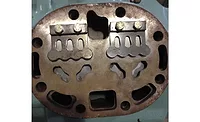
    A discharge valve that has been exposed to higher-than-normal temperatures will show carbonization of oil on the valve, valve plate, and valve backings. The iron in the valves themselves will act to speed up chemical reactions when exposed to an overheating situation. Valve leakage often occurs in these situations.

    Contaminants can also form on the valve plate due to a reaction from excessive heat. The excessive heat can actually break down the refrigeration oil. This broken down oil reacts with the system's refrigerant, forming sludge.

    Low condensing (head) pressures and temperatures: Because some of the discharge gases are being short cycled in and out of the compressor's cylinders, there will be a low refrigerant flow rate to the condenser. This will make for a reduced heat load to the condenser thus reduced condensing (head) pressures and temperatures.

    Often if a condenser is plugged causing high head pressure, valve damage can occur. High discharge pressure and temperature on a suction valve can cause visual outlines of the suction port that have been worn into the valve. This often causes valve leakage, which will eventually lead to low head pressure symptoms.

    Normal to high condenser subcooling: There will be a reduced refrigerant flow through the condenser, thus through the entire refrigeration system, because of components being in series. Most of the refrigerant will be in the condenser and receiver. This may give the condenser a bit higher subcooling.

    Normal to high superheats: Because of the reduced refrigerant flow through the system, the TEV may not be getting the refrigerant flow rate it needs. High superheats may be the result. However, the superheats may be normal if the valve problem is not real severe.

    High evaporator (suction) pressures: Refrigerant vapor will be drawn from the suction line into the compressor's cylinder during the down stroke of the compressor. However, during the upstroke, the same refrigerant may sneak back into the suction line because of the suction valve not seating properly. The result is a higher than normal suction pressure.

    Low amp draw: Low amp draw is caused from the reduced refrigerant flow rate through the compressor. During the compression stroke, some of the refrigerant will leak through the suction valve and back into the suction line reducing the refrigerant flow. During the suction stroke, some of the refrigerant will sneak through the discharge valve because it is not setting properly, and get back into the compressor's cylinder. In both situations, there is a reduced refrigerant flow rate causing the amp draw to be lowered. The low head pressure that the compressor has to pump against will also reduce the amp draw.

    If the compressor sees a slug of liquid refrigerant, broken components usually result. A slug of refrigerant can bend the valve as it tries to push the valve up through the port.

    John Tomczyk is a professor of HVACR at Ferris State University, Big Rapids, Mich., and the author of Troubleshooting and Servicing Modern Air Conditioning & Refrigeration Systems, published by ESCO Press. To order, call 800-726-9696. Tomczyk can be reached by e-mail at tomczykj@tucker-usa.com.

    Publication date: 10/04/2004

  • Looking for quick answers on air conditioning, heating and refrigeration topics? Try Ask ACHR NEWS, our new smart AI search tool. Ask ACHR NEWS →

    Share This Story

    Looking for a reprint of this article?
    From high-res PDFs to custom plaques, order your copy today!


    Recommended Content

    JOIN TODAY
    To unlock your recommendations.

    Already have an account? Sign In

    • HVAC-enrollment

      The Trades Are Back: HVACR Programs See Nearly 30% Enrollment Spike

      A new wave of future technicians is entering the pipeline.  
      News
      By: Matt Jachman
    • 2025 Top 40 Under 40

      2025 Top 40 Under 40 HVACR Professionals List

      The 11th annual Top 40 Under 40 list highlights those...
      News
      By: Hannah Belloli-Oster
    • LG Ductless Mini-Split Systems

      The 9 Types of Heat Pumps

      As the U.S. moves toward electrification, heat pumps are...
      Air Source Heat Pumps
      By: Joanna R. Turpin
    Subscription Center
    • Create an Account
    • Start a Subscription
    • Manage My Account
    • Sign Up for Newsletters
    • Visit Customer Service
    • Update Preferences

    More Videos

    Sponsored Content

    Sponsored Content is a special paid section where industry companies provide high quality, objective, non-commercial content around topics of interest to The News audience. All Sponsored Content is supplied by the advertising company and any opinions expressed in this article are those of the author and not necessarily reflect the views of The News or its parent company, BNP Media. Interested in participating in our Sponsored Content section? Contact your local rep!

    close
    • Piggy Bank
      Sponsored byWatercress Financial

      Energy Prices, Inflation, and HVAC: What Today’s Homeowners Care About

    • Refrigerated Food
      Sponsored bySolstice Advanced Materials

      R-455A Refrigeration: A Cold Storage Solution for the Future

    • Airex Rooftop Units
      Sponsored byAirex Manufacturing Inc

      Consolidating Roof Penetrations: A Growing Trend in Multifamily HVAC Design

    Popular Stories

    Refrigerants-and-gauge.jpg

    HVAC Industry Warns of Counterfeit Refrigerants Entering U.S. Supply Chain

    U.S. Supreme Court building

    95% Furnace Efficiency Rule to Get New Hearing

    Data_Center_facility.jpg

    HVAC Manufacturers Respond to Growing Data Center Backlash

    Midea-training.jpg

    HVAC Workforce Crisis Expands Beyond Technicians to Instructor Shortages

    HVAC Minute retail refrigeration system

    EPA Final Rule’s Impact on R-410A Deadlines

    View The ACHR NEWS
    Centennial Anniversary Timeline

    The ACHR News Timeline Chart
    Submit a Letter
    Submit a letter to our editors.

    Events

    November 6, 2025

    Next-Gen Data Center Cooling: HVAC Innovation and Real-World Solutions

    On Demand As AI workloads and high-density computing push traditional cooling methods to their limits, the data center industry is accelerating the adoption of next-generation HVAC technologies.

    June 23, 2026

    HVAC Duct Sealing Mastics: Why Selection Matters

    In this webinar we will detail what HVAC material buyers and technicians need to know when selecting duct mastics, including matching mastic to substrate, alternatives to liquid mastic, and where UL 181 Listings fit into real world installations.

    View All Submit An Event

    Poll

    Summer Staff

    Are you fully staffed for the summer season?
    View Results Poll Archive

    Products

    BNI Mechanical/Electrical Square Foot Costbook, 2026 Edition

    BNI Mechanical/Electrical Square Foot Costbook, 2026 Edition

    See More Products
    HVAC Duct Sealing Mastics: Why Selection Matters - Free Webinar - 6/23/2026

    Related Articles

    • The Professor: Bad Compressor Valves

      See More
    • The Professor: Diagnosing Bad HVAC Compressor Valves

      See More
    • valve plate

      Dealing With an Inefficient Refrigeration Compressor

      See More

    Related Products

    See More Products
    • compressormotorwindingsdvd.jpg

      UNDERSTANDING COMPRESSOR MOTOR WINDINGS

    • The ACHR News - September 22, 2025

      ACHR NEWS September 22, 2025, Issue

    See More Products

    Events

    View AllSubmit An Event
    • May 6, 2014

      Scroll Compressor Technology Day—INLD-STT1

      The Scroll Compressor Technology Day provides a concise overview of the applicable Copeland brand compressors and their varying applications. The course then follows up with proven troubleshooting techniques and practices.
    View AllSubmit An Event

    Related Directories

    • Carlyle Compressor

      Count on Carlyle. Carlyle compressors can be found around the world - from the first nuclear sub to your grocer's freezer to entire bus fleets.
    • Valves Only

      Valves Only is a trusted Alloy 20 Valve Manufacturers in USA, High-quality, corrosion-resistant solutions for industries dealing with acidic and corrosive environments. Our Alloy 20 valves are made to withstand harsh conditions and are intended for use in chemical and marine industries.
    • Hex Valve

      Instrumentation and gauge valves, manifold valves.
    ×

    Sign Up. Stay Informed.

    The #1 trusted source for the HVACR industry since 1926

    SUBSCRIBE
    • RESOURCES
      • Advertise
      • Contact Us
      • Advisory Board
      • Classifieds
      • Submit a Letter
      • Directories
      • Store
    • ACCOUNT CENTER
      • Create an Account
      • Start a Subscription
      • Manage My Account
      • Sign Up for Newsletters
      • Visit Customer Service
      • Update Preferences
    • SERVICES
      • Marketing Services
      • Reprints
      • Market Research
      • List Rental
      • Survey/Respondent Access
    • STAY CONNECTED
      • LinkedIn
      • Facebook
      • Instagram
      • YouTube
      • X (Twitter)
    • PRIVACY
      • PRIVACY POLICY
      • TERMS & CONDITIONS
      • DO NOT SELL MY PERSONAL INFORMATION
      • PRIVACY REQUEST
      • ACCESSIBILITY

    Copyright ©2026. All Rights Reserved BNP Media, Inc. and BNP Media II, LLC.

    Design, CMS, Hosting & Web Development :: ePublishing