ACHR News
search
Ask ACHR NEWS AI
cart
facebook twitter instagram linkedin youtube
  • Sign In
  • Subscribe
  • Sign Out
  • My Account
ACHR News
  • NEWS
    • Breaking News
    • New HVAC Products
    • Featured Products
    • Manufacturer Reports
    • HVAC Data
    • Legislation
    • ACHR NEWS Centennial
  • RESIDENTIAL
    • Air Conditioners
    • Furnaces
    • Residential Heat Pumps
    • Ductless
    • Residential IAQ
    • Testing, Monitoring, Tools
    • Components & Accessories
  • COMMERCIAL
    • Air Handlers
    • Rooftop Units
    • Chillers and Cooling Towers
    • Commercial Heat Pumps
    • Boilers and Hydronics
    • VRF/Ductless
    • Commercial IAQ
  • REFRIGERATION
    • Refrigerants
    • Refrigerant Regulations
    • Leak Management
  • CONTRACTOR PRO
    • Geothermal
    • Homeowner Study
    • VRF and VRV Ductless
    • Unitary Trends
  • EDUCATION
    • Training and Education
    • Business Management
    • Service and Maintenance
    • Continuing Education
    • Market Research >
      • HVAC Brand Awareness Report
      • VRV, VRF, VRVZ Report
      • Unitary Trends Report
      • Water Heat Professionals Report
    • Webinars
    • Sponsor Insights
    • eProducts Info
    • White Papers
  • EVENTS
    • HVAC Contractor Forum
    • Industry Events and Webinars
  • MEDIA
    • Videos
    • AHR Expo 2025 Videos
    • Podcasts >
      • ACHR News Podcast
      • HARDI Podcasts
      • AHR Expo Podcasts
      • ACCA Podcasts
    • Interactive Spotlights
    • Quizzes
    • eBooks
    • HVAC Talkback
  • HVAC GROUP
    • ACHR NEWS >
      • Current Issue
      • Digital Edition
      • Subscribe
    • Distribution Trends
    • SNIPS NEWS >
      • Join SNIPS NEWS
    • Engineered Systems News >
      • Join ES News
    • HVACR Directory
    • Contests
    • Newsletters
    • Contact
    • Advertise
    • My Account

Troubleshooting Electrical Motor and Compressor Problems

June 19, 2006
A good digital multimeter (DMM) is key to diagnosing compressor problems in general. For instance, in a previous article (May 15 issue of The NEWS) we discussed using the DMM to read suction and discharge pressure, discharge line temperatures, overnight temperatures, and valve performance. A clamp meter, on the other hand, is a great tool for troubleshooting electrical motor and compressor problems.

Meters designed to accurately measure both AC voltage and AC current are especially useful. They let you measure current without breaking into the electrical circuit.
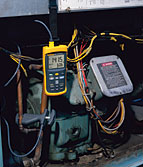
Meters designed to accurately measure both AC voltage and current allow service technicians to measure current without breaking into the electrical circuit.

COMPRESSOR ELECTRICALS

To check the compressor for electrical problems, remove the electrical terminal cover and check the following external connections.

1. Check line voltage at the load center with the compressor off. Low line voltage causes the motor to draw more current than normal and may result in overheating and premature failure. Line voltage that is too high will cause excessive inrush current at motor start, again leading to premature failure.

2. Check line voltage at the motor terminals with the compressor running. The voltage should be within 10 percent of the motor rating.

3. Check running current. The readings should not exceed the manufacturers' full-load rated amps during heavy load periods. Low amps are normal during low-load conditions. Excessive high current may be due to shorted or grounded windings, a bad capacitor, a faulty start relay, or an indication of excessive bearing fatigue.

Caution: When performing electrical measurements on compressors with internal thermal motor protection devices that have been running extremely hot, be sure to give the compressor time to cool down prior to the electrical test. This will allow the device to reset to its normal position.

MOTOR FAILURES CAUSED BY REFRIGERATION SYSTEM

Sometimes a service tech might misdiagnose what is actually a defective compressor with electrical winding failures, as being caused by an electrical system problem. Mechanical system failure or inferior installation and service practices are often the true cause of compressor electrical problems. These problems include:

  • Poor piping practices resulting in oil not adequately returning to the compressor during the run cycle.

  • High discharge temperatures creating acids in the oil.

  • Insufficient airflow across the evaporator and condenser coils.

  • Extremely low suction pressures.

  • Liquid refrigerant flooding back into the compressor.

    Here are some simple procedures to diagnose these refrigeration problems using DMMs, clamp meters, digital thermometers, pipe clamps, infrared (IR) thermometers, and pressure/vacuum modules.

    The problem: compressor bearing failure or lockup. This may be caused by poor piping practices, which lead to oil clogging in the system and result in insufficient oil return to the compressor. If the bearings don't lock up and continue to wear during these conditions, the rotor will lower into the stator housing, shorting out the windings.

    Diagnose it:

    1. Measure the compressor amps. They should not exceed the manufacturer's full-load ratings. Worn bearings will cause higher-than-normal amp readings.

    2. Inspect the oil level via the compressor sight glass. If there is no sight glass, use your IR thermometer to measure the sump of the compressor housing. The oil level can be detected with a temperature probe. The sump temperature will be different on the compressor housing at the oil level.

    Caution: Whenever an oil problem exists due to poor piping practices, the correct remedy is to fix the piping. Do not to continue to add more oil to the system.

    The problem: high discharge temperatures. These may be caused by high head pressures or high superheat.

    Diagnose it:

    1. Measure the compressor discharge line using an IR thermometer on a dull section of pipe.

    2. Measure the discharge pressure using a pressure/vacuum module.

    3. Convert the refrigerant pressure to temperature and compare it to the ambient air temperature. If the temperature difference is greater than 20° to 30°F (11° to 17°C), either noncondensible gases are in the system or airflow is restricted across the condenser.

    Note: Temperature differences will vary due to original manufacturer's design and efficiencies.

    Is there enough airflow across the evaporator? Using a digital thermometer, record the temperature difference on the air conditioning unit to find out.
    The problem: insufficient airflow across the evaporator.

    Diagnose it:

    1. Using a digital thermometer, place a bead thermocouple on the discharge side and the return side of the coil.

    2. Record the temperature difference on the air conditioning unit. Expect about 18° to 22°F (10° to 12°C) temperature difference. On refrigeration units, you would expect about 10° to 15°F (5° to 8.5°C) temperature difference.

    Note: Temperature differences may vary depending upon initial design and humidity requirements.

    The problem: extremely low suction pressures.

    Diagnose it:

    1. Install the pressure/vacuum module and your DMM at the compressor.

    2. Record the suction pressure. Convert the refrigerant pressure to temperature using a pressure-temperature (PT) chart.

    3. Measure the return air temperature before the evaporator. Compare the refrigerant temperature to the desired evaporator return air temperature.

    On air conditioning units, expect about 35° to 40°F (19° to 22°C) temperature difference and refrigeration units expect about 10° to 20°F (5° to 11°C) temperature difference.

    The problem: liquid refrigerant is flooding back to the compressor.

    Diagnose it: Determine the superheat using your pressure/vacuum module, pipe clamp, and your DMM.

    1. Check suction pressure and convert the refrigerant pressure to temperature, using your PT chart.

    2. Measure the suction line pipe temperature.

    3. Compare the difference of the two temperatures. If there is no temperature difference, you are bringing liquid back to the compressor. If there is a temperature difference between 10° to 20°F (5° to 11°C), you have normal superheat and you are not slugging the compressor with unwanted liquid.

    SUMMARY

    Troubleshooting and servicing refrigeration, air conditioning, and heat pump systems is a challenge for any technician, entry level or experienced.

    Regardless of the size or location of the system, it is vital that you understand the principles and tools needed to perform proper troubleshooting efficiently.

    Duane Smith is a Fluke specialist on digital multimeters. A 30-year veteran, Smith trains test tool users, troubleshoots field applications, and helps develop new DMMs and electrical testers. He may be contacted at 425-446-5681; duane.smith@fluke.com.

    Publication date: 06/19/2006

  • Looking for quick answers on air conditioning, heating and refrigeration topics? Try Ask ACHR NEWS, our new smart AI search tool. Ask ACHR NEWS →

    Share This Story

    Looking for a reprint of this article?
    From high-res PDFs to custom plaques, order your copy today!


    Recommended Content

    JOIN TODAY
    To unlock your recommendations.

    Already have an account? Sign In

    • HVAC-enrollment

      The Trades Are Back: HVACR Programs See Nearly 30% Enrollment Spike

      A new wave of future technicians is entering the pipeline.  
      News
      By: Matt Jachman
    • 2025 Top 40 Under 40

      2025 Top 40 Under 40 HVACR Professionals List

      The 11th annual Top 40 Under 40 list highlights those...
      HVAC Light Commercial Market
      By: Hannah Belloli-Oster
    • LG Ductless Mini-Split Systems

      The 9 Types of Heat Pumps

      As the U.S. moves toward electrification, heat pumps are...
      HVAC Commercial Market
      By: Joanna R. Turpin
    Subscription Center
    • Create an Account
    • Start a Subscription
    • Manage My Account
    • Sign Up for Newsletters
    • Visit Customer Service
    • Update Preferences

    More Videos

    Sponsored Content

    Sponsored Content is a special paid section where industry companies provide high quality, objective, non-commercial content around topics of interest to The News audience. All Sponsored Content is supplied by the advertising company and any opinions expressed in this article are those of the author and not necessarily reflect the views of The News or its parent company, BNP Media. Interested in participating in our Sponsored Content section? Contact your local rep!

    close
    • Piggy Bank
      Sponsored byWatercress Financial

      Energy Prices, Inflation, and HVAC: What Today’s Homeowners Care About

    • Refrigerated Food
      Sponsored bySolstice Advanced Materials

      R-455A Refrigeration: A Cold Storage Solution for the Future

    • Airex Rooftop Units
      Sponsored byAirex Manufacturing Inc

      Consolidating Roof Penetrations: A Growing Trend in Multifamily HVAC Design

    Popular Stories

    Outdoor-condensing-units.jpg

    EPA Removes R-410A Installation Deadline

    HVAC-Price-Increase-graphic

    HVAC Price Increase List: June 2026

    Trump-Section-232.jpg

    Trump Reduces Section 232 Tariffs on HVAC Equipment to 15%

    cooling-habits.jpg

    50 Percent of Americans Have Skipped HVAC Maintenance

    ACHR NEWS Editor Chris Gray Presenting HVAC Minute 5-18-2026

    HVAC Manufacturers Fight Pricing Lawsuits

    View The ACHR NEWS
    Centennial Anniversary Timeline

    The ACHR News Timeline Chart
    Submit a Letter
    Submit a letter to our editors.

    Events

    November 6, 2025

    Next-Gen Data Center Cooling: HVAC Innovation and Real-World Solutions

    On Demand As AI workloads and high-density computing push traditional cooling methods to their limits, the data center industry is accelerating the adoption of next-generation HVAC technologies.

    June 9, 2026

    Before You Go All In on AI: Set Up Your Business to Actually Win

    In this webinar, we'll walk you through exactly what to get in place before you add AI to your business. You'll leave with a clear picture of where you stand today and a practical action plan to set yourself up for real results.

    View All Submit An Event

    Poll

    EPA Decision

    Are you happy the EPA decided contractors can continue to install R-410A equipment?
    View Results Poll Archive

    Products

    BNI Mechanical/Electrical Square Foot Costbook, 2026 Edition

    BNI Mechanical/Electrical Square Foot Costbook, 2026 Edition

    See More Products
    A2L Refrigerants - Free Webinar - May 21, 2026

    Related Articles

    • Q&A: Compressor Problems and Solutions

      See More
    • Know your refrigerant blends to prevent condenser, compressor problems

      See More
    • Electrical Motor Repair Co./Emerson Motor Technologies

      See More

    Related Products

    See More Products
    • HVAC/R Electrical Troubleshooting: Component Testing Training Kit

    • HVAC/R Electrical Troubleshooting: Deciding where to begin DVD

    • HVACR Electrical Troubleshooting: Deciding Where To Begin Training Kit

    See More Products
    ×

    Sign Up. Stay Informed.

    The #1 trusted source for the HVACR industry since 1926

    SUBSCRIBE
    • RESOURCES
      • Advertise
      • Contact Us
      • Advisory Board
      • Classifieds
      • Submit a Letter
      • Directories
      • Store
    • ACCOUNT CENTER
      • Create an Account
      • Start a Subscription
      • Manage My Account
      • Sign Up for Newsletters
      • Visit Customer Service
      • Update Preferences
    • SERVICES
      • Marketing Services
      • Reprints
      • Market Research
      • List Rental
      • Survey/Respondent Access
    • STAY CONNECTED
      • LinkedIn
      • Facebook
      • Instagram
      • YouTube
      • X (Twitter)
    • PRIVACY
      • PRIVACY POLICY
      • TERMS & CONDITIONS
      • DO NOT SELL MY PERSONAL INFORMATION
      • PRIVACY REQUEST
      • ACCESSIBILITY

    Copyright ©2026. All Rights Reserved BNP Media, Inc. and BNP Media II, LLC.

    Design, CMS, Hosting & Web Development :: ePublishing