ACHR News
search
Ask ACHR NEWS AI
cart
facebook twitter instagram linkedin youtube
  • Sign In
  • Subscribe
  • Sign Out
  • My Account
ACHR News
  • NEWS
    • Breaking News
    • New HVAC Products
    • Featured Products
    • Manufacturer Reports
    • HVAC Data
    • Legislation
    • ACHR NEWS Centennial
  • RESIDENTIAL
    • Air Conditioners
    • Furnaces
    • Residential Heat Pumps
    • Ductless
    • Residential IAQ
    • Testing, Monitoring, Tools
    • Components & Accessories
  • COMMERCIAL
    • Air Handlers
    • Rooftop Units
    • Chillers and Cooling Towers
    • Commercial Heat Pumps
    • Boilers and Hydronics
    • VRF/Ductless
    • Commercial IAQ
  • REFRIGERATION
    • Refrigerants
    • Refrigerant Regulations
    • Leak Management
  • CONTRACTOR PRO
    • Geothermal
    • Homeowner Study
    • VRF and VRV Ductless
    • Unitary Trends
  • EDUCATION
    • Training and Education
    • Business Management
    • Service and Maintenance
    • Continuing Education
    • Market Research >
      • HVAC Brand Awareness Report
      • VRV, VRF, VRVZ Report
      • Unitary Trends Report
      • Water Heat Professionals Report
    • Webinars
    • Sponsor Insights
    • eProducts Info
    • White Papers
  • EVENTS
    • HVAC Contractor Forum
    • Industry Events and Webinars
  • MEDIA
    • Videos
    • AHR Expo 2025 Videos
    • Podcasts >
      • ACHR News Podcast
      • HARDI Podcasts
      • AHR Expo Podcasts
      • ACCA Podcasts
    • Interactive Spotlights
    • Quizzes
    • eBooks
    • HVAC Talkback
  • HVAC GROUP
    • ACHR NEWS >
      • Current Issue
      • Digital Edition
      • Subscribe
    • Distribution Trends
    • SNIPS NEWS >
      • Join SNIPS NEWS
    • Engineered Systems News >
      • Join ES News
    • HVACR Directory
    • Contests
    • Newsletters
    • Contact
    • Advertise
    • My Account

Hidden Problems Can Cause Carbon Monoxide
October 11, 2001
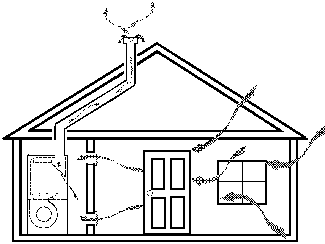
Figure 1. Drawing of a home with a nondedicated combustion air inlet system.
Safe and efficient combustion in a furnace requires a proper air-to-gas ratio. This, in turn, is dependent on the availability of air (combustion inlet) and the ability to discharge oxygen-depleted air (flue gas venting).

Whenever there is a malfunction of either the inlet or outlet system, there is a potential for incomplete combustion, which can result in carbon monoxide (CO) gases.

This article addresses residential gas heating systems with nondedicated combustion air inlets: Those furnaces that are inside the living space without direct communication to the outside air.

(Note: This article is meant to provide a general overview. For more information on testing for CO, read the supplement “Technical Background For Residential Carbon Monoxide Responders” in the National Fuel Gas Code. Also, there are many sites on the Web that have valuable information. And be sure to check with the combustion equipment manufacturers for their specific guidelines.)

Many older homes have furnaces that draw air for combustion from the occupied space. As the furnace pulls this air from the space, it is replenished by air infiltrating the house through windows, doors, and other not-so-obvious openings — at least that was the original intention. This can create a potentially dangerous situation.

Modifications done to the structure can inadvertently inhibit this flow of combustion air, causing the furnace or any other gas appliance to malfunction. Other problems in the house can turn an improperly vented furnace into a CO-generating machine.


Some Fundamentals

Most residential furnaces use natural draft to drive the combustion process. Even 80%-AFUE furnaces with combustion blowers are natural-draft furnaces. The combustion blower in an 80% furnace assists the combustion gases, but the flue still operates like a natural-draft furnace: The natural pressure differential created by heating the combustion gases in the furnace is what pushes the flue gases up and out of the flue.

As combustion gases are heated, they expand. This makes them less dense than the colder air entering the furnace, so they weigh less. They also exist at a lower pressure than the colder inlet air.

Since the combustion gases are at a lower pressure, the higher-pressure inlet gases displace them, pushing them up and out the flue (the same way that heavier, higher-pressure beer pushes the lighter, lower-pressure CO2 bubbles up to the top of a glass). For the flue to operate properly, the inlet air must always be at a higher pressure than the combustion gases so that this pressure differential can be maintained.

Looking for quick answers on air conditioning, heating and refrigeration topics? Try Ask ACHR NEWS, our new smart AI search tool. Ask ACHR NEWS →

When this pressure differential is diminished by the flue pressure becoming too positive or the combustion air inlet becoming too negative, air stops drafting through the furnace. That’s when CO is created. And if the furnace is not drafting, the CO ends up staying in the residence.

Depending on the outdoor temperature, the pressure differential needed to drive the flue gases up and out of the furnace is somewhere between 1 and 5 Pascals (0.004 to 0.020 in. of water column, wc). What this means is, as the flue gases leave the furnace, they must be at -1 to -5 Pascals relative to atmospheric pressure. A Pascal is about the weight of a Post-it® note. So you can see that the pressure differential needed to be maintained between the inlet and outlet of the furnace’s combustion air system is very delicate and can be easily disturbed. Anything that will raise the pressure in the flue or lower the pressure in the combustion air inlet system can interrupt the flow of air through the furnace and create carbon monoxide.


Combustion Air Infiltration

When a structure has a properly designed combustion air inlet system, the furnace enclosure has two dedicated vents communicating with the outside air, eliminating the need to obtain combustion inlet air from or through the living space.

Residences with a nondedicated combustion air inlet system are the homes that are at risk (see Figure 1). These homes may have worked fine since they were built, but can develop problems as a result of modernization, such as new high-efficiency windows, weather stripping, and general sealing of the structure. Anything that disturbs the pressure in the space can affect the operation of the furnace.

If a house is tightened up for energy conservation, the infiltration rate may be diminished; the house pressure drops as the furnace draws combustion air from the space. Eventually the house pressure can drop enough to reduce the combustion air inlet pressure to a point that the flue will quit drafting. Usually tightening the house alone will not cause a furnace to malfunction, but it can restrict the combustion air inlet to a point where anything that affects house pressure can inhibit furnace venting.

Some other things that can reduce combustion inlet air pressure include:

  • Furnace blower return air drawing from the furnace enclosure; furnace enclosures should always be well sealed.
  • Ductwork supply leaks causing negative pressure in the structure; if the duct system pulls more air out of the house than it returns due to supply leaks, house pressure will drop. Closing doors to rooms that have no dedicated return air grille can aggravate supply duct leaks.
  • Exhaust fans drawing on the house; this includes clothes dryers, range hoods, bathroom fans, other gas appliances, fireplaces, and whole-house fans.
  • Blockage (intentional or unintentional) of furnace enclosure vents; customers sometimes block furnace door vents to reduce noise.


  • Field Solutions

    So many variables determine how CO affects the occupants of a home. That’s why CO testing standards and processes differ from one municipality to another. I strongly recommend that you contact your local fire department or gas utility to acquaint yourself with local practices.

    Much of the information included in this article comes from the Carbon Monoxide Safety Awareness Advisory Council, and may or may not be used in your area.

    There are two general issues that have to be addressed when testing for CO:

    1. What is the net indoor ambient CO level in the house when you arrive, and are any gas appliances generating excessive CO during your routine test?

    2. Could any latent problems in the home produce CO at another time?

    If you work on furnaces, you should have a quality CO tester available. That way, before you enter a house, you can routinely take a CO reading outside to establish a baseline level. Take a CO reading inside the house just as you enter the front door. Subtract the outside CO level from the inside level to obtain the net inside level. If the net CO level in the occupied space is below 9 parts per million (ppm), the space is considered safe.

    A CO level of 10 to 35 ppm is considered a marginal health hazard. If I were to discover such a situation, I would immediately call the appropriate emergency response agency (fire department or gas utility) to make sure I was handling the situation per local practices. Check with your company’s management to find out what your CO action policy is.

    For any reading above 35 ppm, occupants should exit the building immediately.


    Furnace Testing

    To test a nonpower-ventilated furnace for CO, place your instrument probe in the outlet of each heat exchanger upstream of the flue diverter box. To test a power-ventilated, 80%- to 90%-plus-AFUE furnace, take your readings in the vent connector 12 to 18 in. from the furnace outlet.

    The test should be performed for 5 min. CO levels should not exceed 99 ppm. If they do, shut down the furnace and locate the problem. Don’t forget that the cause could be in the furnace (such as a cracked heat exchanger), in the venting system, or in the combustion air inlet system.

    To test a house for latent problems that could cause CO production, you must set up a worst-case scenario to attempt to drop the pressure in the house. This is a test you could use to check a house that did not have properly designed combustion air inlet.

    (Note: The following is a summary only, meant to provide an overview of the testing concept. This test should not be performed by inadequately trained personnel or those without a properly operating CO meter.)

    1. Turn off all gas appliances such as furnaces, water heaters, ovens, stoves, and any other fossil fuel-burning devices; leave the pilots on.

    2. Close all exterior openings in the house, such as doors, windows, attic access, and fireplace dampers.

    3. Close all doors to rooms that have a supply register but no return register, except those rooms that have exhaust fans.

    4. Close the furnace and hot water heater enclosure door, if any.

    5. Turn on furnace blower(s).

    6. Turn all exhaust fans on high, including the clothes dryer. Now the house has been set up for maximum possibility for negative pressure.

    7. Light and test the gas appliances one at a time for CO production. Since vented gas appliances also draw air from the house, leave them on after testing as the other appliances are tested to maintain a worst-case scenario.

    8. If one of the gas appliances begins to create CO or its flue begins to back draft, there is a hazard potential. The best solution is to install an AGA-approved combustion air inlet system.

    Here are some other tips to help you spot potentially hazardous situations:

  • If the gas water heater is in the house, check the paint around the opening where the gas manifold enters the water heater. If it is discolored due to overheating, the furnace has been back drafting or rolling out.
  • Look for signs of excessive moisture collecting on the flue diverter box or flue pipe. This usually manifests itself as rust, corrosion, or a whitish-colored crusty material.
  • Look for “bathtub rings” of rust where water has settled at the bottom inside of the heat exchanger below the burners.
  • Ask the occupants if they have unusually frequent head-aches or nausea, especially in the morning.
  • Remember that a house with negative pressure can also draw air from the garage. If a homeowner leaves his/her car running to warm up, the exhaust CO can be drawn into the occupied space.
  • Howard Leonard is president of Total Tech HVACR Training, Phoenix, AZ. His firm specializes in service, installation, and application training for service technicians. He can be reached at 602-943-2517.

    Publication date:10/15/2001

    Share This Story

    Looking for a reprint of this article?
    From high-res PDFs to custom plaques, order your copy today!


    Recommended Content

    JOIN TODAY
    To unlock your recommendations.

    Already have an account? Sign In

    • HVAC-enrollment

      The Trades Are Back: HVACR Programs See Nearly 30% Enrollment Spike

      A new wave of future technicians is entering the pipeline.  
      News
      By: Matt Jachman
    • 2025 Top 40 Under 40

      2025 Top 40 Under 40 HVACR Professionals List

      The 11th annual Top 40 Under 40 list highlights those...
      HVAC Contracting
      By: Hannah Belloli-Oster
    • LG Ductless Mini-Split Systems

      The 9 Types of Heat Pumps

      As the U.S. moves toward electrification, heat pumps are...
      Air Source Heat Pumps
      By: Joanna R. Turpin
    Subscription Center
    • Create an Account
    • Start a Subscription
    • Manage My Account
    • Sign Up for Newsletters
    • Visit Customer Service
    • Update Preferences

    More Videos

    Sponsored Content

    Sponsored Content is a special paid section where industry companies provide high quality, objective, non-commercial content around topics of interest to The News audience. All Sponsored Content is supplied by the advertising company and any opinions expressed in this article are those of the author and not necessarily reflect the views of The News or its parent company, BNP Media. Interested in participating in our Sponsored Content section? Contact your local rep!

    close
    • Piggy Bank
      Sponsored byWatercress Financial

      Energy Prices, Inflation, and HVAC: What Today’s Homeowners Care About

    • Refrigerated Food
      Sponsored bySolstice Advanced Materials

      R-455A Refrigeration: A Cold Storage Solution for the Future

    • Airex Rooftop Units
      Sponsored byAirex Manufacturing Inc

      Consolidating Roof Penetrations: A Growing Trend in Multifamily HVAC Design

    Popular Stories

    Outdoor-condensing-units.jpg

    EPA Removes R-410A Installation Deadline

    Trump-Section-232.jpg

    Trump Reduces Section 232 Tariffs on HVAC Equipment to 15%

    HVAC-Price-Increase-graphic

    HVAC Price Increase List: June 2026

    cooling-habits.jpg

    50 Percent of Americans Have Skipped HVAC Maintenance

    ACHR NEWS Editor Chris Gray Presenting HVAC Minute 5-18-2026

    HVAC Manufacturers Fight Pricing Lawsuits

    View The ACHR NEWS
    Centennial Anniversary Timeline

    The ACHR News Timeline Chart
    Submit a Letter
    Submit a letter to our editors.

    Events

    November 6, 2025

    Next-Gen Data Center Cooling: HVAC Innovation and Real-World Solutions

    On Demand As AI workloads and high-density computing push traditional cooling methods to their limits, the data center industry is accelerating the adoption of next-generation HVAC technologies.

    June 9, 2026

    Before You Go All In on AI: Set Up Your Business to Actually Win

    In this webinar, we'll walk you through exactly what to get in place before you add AI to your business. You'll leave with a clear picture of where you stand today and a practical action plan to set yourself up for real results.

    View All Submit An Event

    Poll

    EPA Decision

    Are you happy the EPA decided contractors can continue to install R-410A equipment?
    View Results Poll Archive

    Products

    BNI Mechanical/Electrical Square Foot Costbook, 2026 Edition

    BNI Mechanical/Electrical Square Foot Costbook, 2026 Edition

    See More Products
    A2L Refrigerants - Free Webinar - May 21, 2026

    Related Articles

    • Respiro CO-PRO Safety Switch

      Carbon Monoxide Detectors Serve Multiple Purposes

      See More
    • Carbon Monoxide and the HVAC Contractor

      See More
    • Survey Shows Many Homeowners Unclear on Carbon Monoxide Safety

      See More

    Related Products

    See More Products
    • Evaluating-and-Troubleshooting-Refrigeration-Systems-Video-Cover-210x300.jpg

      Evaluating Refrigeration Systems Troubleshooting & Identifying Problems CONTINUED

    See More Products

    Related Directories

    • TOXALERT International Inc.

      Carbon Monoxide (CO), Carbon Dioxide (CO2), NO2 and other toxic gases, combustible gas detectors, refrigerant leak monitors and Control panels. IAQ. BACnet. Integration. Design.
    • Respiro

      The CO/PRO from Respiro is a carbon monoxide shutoff-switch that monitors and turns off furnaces & water heaters to stop CO production at the source!
    ×

    Sign Up. Stay Informed.

    The #1 trusted source for the HVACR industry since 1926

    SUBSCRIBE
    • RESOURCES
      • Advertise
      • Contact Us
      • Advisory Board
      • Classifieds
      • Submit a Letter
      • Directories
      • Store
    • ACCOUNT CENTER
      • Create an Account
      • Start a Subscription
      • Manage My Account
      • Sign Up for Newsletters
      • Visit Customer Service
      • Update Preferences
    • SERVICES
      • Marketing Services
      • Reprints
      • Market Research
      • List Rental
      • Survey/Respondent Access
    • STAY CONNECTED
      • LinkedIn
      • Facebook
      • Instagram
      • YouTube
      • X (Twitter)
    • PRIVACY
      • PRIVACY POLICY
      • TERMS & CONDITIONS
      • DO NOT SELL MY PERSONAL INFORMATION
      • PRIVACY REQUEST
      • ACCESSIBILITY

    Copyright ©2026. All Rights Reserved BNP Media, Inc. and BNP Media II, LLC.

    Design, CMS, Hosting & Web Development :: ePublishing