How to clean and leak test chiller barrel
In summer’s hottest months, reduced performance is one of the last things you and your customers need from a chiller. Therefore, it is crucial to maintain water quality and keep scale and sediment from accumulating in the unit.
This installment of our chiller barrel series provides guidelines on how to keep the unit clean and how to clean the unit once it is dirty. The accompanying sidebar article (page 12) deals with water-quality issues.
Tube leak check procedure
If you suspect you have a leaking tube(s) in a chiller, you need to verify it.Electronic leak detectors can be used to sense the presence of a leak, but you need to pinpoint its location. To do this, you can use the following procedure.
1. Remove heads.
2. Shut off water to chiller and drain the water side of vessel. Close the valves and go to step 3. If there are no valves, you will have to split the flanges and install blank flanges.
3. Pressurize the shell with nitrogen to 150 psig.
Note: You must verify that every part of the system exposed to pressure is rated to safely handle that pressure, including the chiller, piping, valves, blank flanges, relief valves, air bleeds, etc.
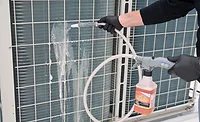
Start by leak checking the tube-to-tube sheet joints by spraying or brushing a leak-detecting soap solution on the tube sheet. Let the bubbles that form when applying pop, then look for a thick, white froth around the outside diameter of each tube; this indicates a leak.
Looking for quick answers on air conditioning, heating and refrigeration topics? Try Ask ACHR NEWS, our new smart AI search tool. Ask ACHR NEWS
After an hour, verify that you still have 150 psig. Reapply soap and recheck. If no leaks are found, go to step 4.
4. There are three methods for checking leaks inside of the tubes. All of these should be done while the pressure applied in step 3 is still on the shell.
Method A — For this method you will need a “bubbler.” This is easily made by drilling a hole in an appropriate-size rubber plug, inserting a tube through the hole, and inserting the other end into a clear glass jar half filled with water. Plug the tubes at one end with rubber plugs and insert the bubbler into each tube at the other end individually and observe the jar for bubbles for 20 to 30 sec on each tube. A leaking tube will produce bubbles in the jar. This is the best method.
Method B — Plug the tubes at one end with rubber plugs and form bubbles at the other end using a liquid leak detector. Watch for bubbles that rapidly expand and pop. It is best to leave the unit open for several hours, since refrigerant laden oil will give false indications as the refrigerant boils.
Method C — Plug both ends of the tubes and let the unit sit for 12 hrs. Leaking tubes will pop one of the plugs out.
5. If leaks are found, you must repair, replace, or plug leaking tubes. You must also take corrective action to eliminate the conditions that caused the failure.
Bulges or blisters on the inside of tubes are caused by ice that forms when the suction pressure drops below the freezing point of the fluid.
Field chiller barrel gasket leak tests
If you suspect that you have leaking chiller gaskets, this must be verified by testing the unit. The steps to check for cross-circuit or external gasket leaks are listed here.Before starting: The liquid and suction lines must be sealed to isolate the chiller barrel. The liquid line solenoids will seal the liquid lines.
1. Close the suction valves at the compressor.
2. Install 1/4-in. SAE fittings (without cores) into the 1/4-in. pipe thread couplings on the suction fittings. This allows you to use your gauge manifold.
3. Pressurize all circuits to 150 psig with nitrogen or carbon dioxide. Using a leak reactant, brush or spray a liberal amount over the entire outside of the gasket and check for indications of a leak. You are done if no leaks are found and you are working on a single circuit of a unit. If you are working on a multicircuit unit, move onto the next step.
If a leak is found, move on to Step 5.
4. On multicircuit units, you can now check for cross-circuit leaks. Pressurize the first circuit to 150 psig. Place a hose over the flare fitting on the second circuit (two-circuit unit) and place the other end into a small jar of water. Watch the jar for bubbles for 2 min.
Note: If you cannot find a hose and a jar, you can form a soap bubble on the opening of the fittings and see if it grows and pops. If it is not leaking, the bubble will collapse or it will not grow. Be careful not to get an excessive amount of soap in the fitting.
If you are working on a two-circuit model and no bubbles appear, there are no leaks and you may put the unit into service. On three- and four-circuit units, you must pressurize each circuit and check adjacent circuits. In other words, on a four-circuit unit, you would pressurize circuit one and check circuit two. Pressurize circuit two and check circuits one and three. Pressurize circuit three and check circuits two and four.
Do this until each circuit has been pressurized. If no leaks are found, you may put the unit back into service. If you do find a leak, go to Step 5.
Note: Refrigerant-laden oil can give a false leak indication as the unit warms and the refrigerant boils and expands. If the unit is used, you may want to let it sit for 24 hrs or until the residual refrigerant boils off. If no leaks are found, you may put the unit into service. If you are confident that you have a leak, see step 5.
5. If you verify a leak, retorque the bolts to the correct torques and retest. If this does not stop the leak, you can raise the torque by 10 ft/lb and retest.
If you still have a leak, you must replace the gaskets. Make sure the gaskets match the recommendations of the chiller manufacturer.
Tube plugging procedure
If you must plug a tube in a chiller or condenser, follow the steps below to ensure that the repair is permanent.Note: Never plug more than 10% of the tubes in any one refrigerant or water pass.
1. There are different methods for chillers and condensers:
Chiller — If the tube has a blister in it due to a freeze-up, you must work it down before installing the plug. This can be done using a large line-up punch. Drive the tapered punch into the tube using light hammer taps until the punch bottoms in the hole. Work the punch around the inside of the tube and remove it.
Condenser — Remove all scale, deposits, and excess epoxy. A tube-cleaning brush on a drill works well.
2. Select a plug of the proper size and material. If you are not sure which is the correct size, contact a supplier. Plugs can be ordered in one or two pieces; either will work. Measure the inside diameter (ID) of the tube after cleaning, before you call.
If you are making your own plugs, measure the ID of the tube to be plugged. The plug should be 3 in. long and taper 0.010 in. per in. The ID you measured will be the diameter in the center of the plug; add 0.015 in. to determine the size of the large end; subtract 0.015 in. to find the size of the small end.
The material must be compatible with the tube being plugged. Copper and cupro-nickel tubes should be plugged with brass, carbon steel with carbon, and stainless steel should be plugged with stainless.
3. After you have the plug ready, clean the hole. This can be done using a manufacturer-approved solvent or acetone. Thoroughly clean the inside of the hole and the plug, allowing the solvent to evaporate.
4. Apply a thick ring of Loctite 277 to the plug and the ID of the tube. On two-piece plugs, also put Loctite on the inner hole of the plug and on the drive pin.
5. Insert the plug into the hole and drive it in using a 2- to 3-lb hammer. Strike the plug squarely (glancing blows will bend the plug). Three to five firm blows should seal the plug. Apply pressure and check for leaks. If leaks are found, strike again.
Note: Do not drive the plug in any further than necessary to seal the plug; excessive force can cause leaks in adjacent tubes. Let the sealant cure 1 hr (no cheating).
6. Cut off the excess plug only if it will interfere with the installation of the head.
Water can be torture
Water quality is a complex issue that is best handled by a professional who specializes in water treatment. Poor-quality water can cause corrosion on the inside of the tube sheets, shell, or the baffles.Corrosion on the tube sheets can lead to leaks through the tube joints. It can also corrode the shell, perforating it in extreme cases. When the baffles are attacked they no longer direct the water flow and allow it to pass through the unit too quickly, resulting in a serious loss of performance.
This damage is not reversible. It may require replacement of the unit and is not considered as being under warranty. Poor-quality water can also lead to tube failure and subsequent system damage.
Scale: Excessive hard scale that forms on the tubes will inhibit heat transfer, reducing performance and increasing utility costs. This is caused by hard water with high mineral content. Some scale buildup is normal and actually helps protect the tubes.
The only way to remove hard scale is to run acid through the unit. We do not recommend this.
Sediment: Sediment can cause a loss of performance and freeze-ups when it builds up and restricts water flow through the tube bundle.
The way to prevent this is to install a strainer with a #20 screen element or filter the inlet of the chiller barrel. If the water is exposed to airborne particulates, heavy rust, or any other source of sediment, you must clean the screen or filter as needed to ensure full water flow through the barrel.
To remove accumulated sediment, back flush the unit by reversing the water flow through the unit. To improve the results of this procedure, inject low-pressure air (25 to 50 psig) through a nozzle into the 3/4-in. NPTF coupling on the flange that the water is being pumped through. This will help agitate the sediment.
Flow switches and water velocity: It is crucial that a flow switch be installed on the chiller water outlet, and that the switch is inspected for function on a regular basis.
It is also important that water velocity through the chiller remains below 5 fps, since higher velocities can result in tube failure. The velocity can be calculated if the flow through the barrel (in gpm) is known.
Links
Looking for a reprint of this article?
From high-res PDFs to custom plaques, order your copy today!