ACHR News
search
Ask ACHR NEWS AI
cart
facebook twitter instagram linkedin youtube
  • Sign In
  • Subscribe
  • Sign Out
  • My Account
ACHR News
  • NEWS
    • Breaking News
    • New HVAC Products
    • Featured Products
    • Manufacturer Reports
    • HVAC Data
    • Legislation
    • ACHR NEWS Centennial
  • RESIDENTIAL
    • Air Conditioners
    • Furnaces
    • Residential Heat Pumps
    • Ductless
    • Residential IAQ
    • Testing, Monitoring, Tools
    • Components & Accessories
  • COMMERCIAL
    • Air Handlers
    • Rooftop Units
    • Chillers and Cooling Towers
    • Commercial Heat Pumps
    • Boilers and Hydronics
    • VRF/Ductless
    • Commercial IAQ
  • REFRIGERATION
    • Refrigerants
    • Refrigerant Regulations
    • Leak Management
  • CONTRACTOR PRO
    • Geothermal
    • Homeowner Study
    • VRF and VRV Ductless
    • Unitary Trends
  • EDUCATION
    • Training and Education
    • Business Management
    • Service and Maintenance
    • Continuing Education
    • Market Research >
      • HVAC Brand Awareness Report
      • VRV, VRF, VRVZ Report
      • Unitary Trends Report
      • Water Heat Professionals Report
    • Webinars
    • Sponsor Insights
    • eProducts Info
    • White Papers
  • EVENTS
    • HVAC Contractor Forum
    • Industry Events and Webinars
  • MEDIA
    • Videos
    • AHR Expo 2025 Videos
    • Podcasts >
      • ACHR News Podcast
      • HARDI Podcasts
      • AHR Expo Podcasts
      • ACCA Podcasts
    • Interactive Spotlights
    • Quizzes
    • eBooks
    • HVAC Talkback
  • HVAC GROUP
    • ACHR NEWS >
      • Current Issue
      • Digital Edition
      • Subscribe
    • Distribution Trends
    • SNIPS NEWS >
      • Join SNIPS NEWS
    • Engineered Systems News >
      • Join ES News
    • HVACR Directory
    • Contests
    • Newsletters
    • Contact
    • Advertise
    • My Account

TS Technology Yields Interesting Field Results

May 12, 2000
The top chart shows a two-day span of a TS system at work in the heat of summer. The compressor kicks into the two-cylinder mode only at the hottest times of day. The two bottom charts are comparisons of humidity (right) and indoor blower noises (left).
BRISTOL, VA — Now that TS (twin-single) technology has been in the marketplace for a while and consumer response is being combined with field test data, something unusual is being found. People actually feel the difference with a TS system in place.

To recap, Bristol Compressors introduced the TS technology compressor, which uses a special crankshaft design featuring a portable lobe that positions itself to allow operation of two pistons in the forward direction of the rotation.

When the compressor is reversed, the lobe repositions itself at the center axis of the shaft and one of the pistons remains idle. The motor reverses direction by employing inexpensive controls and by using the start winding of the piston as the run winding, and run winding as the start winding.

“We were surprised with the number of comments we’ve had from homeowners who say they’ve noticed increased comfort after a TS system is installed,” said Bristol vice president of business development, Dennis Custance. “That’s exciting, because that’s the ultimate benefit of any hvac system.”

Why would people sense the difference in one hvac system vs. another? After looking at data gathered from testing, there seem to be several factors involved. All of them seem to make a contribution to system performance.
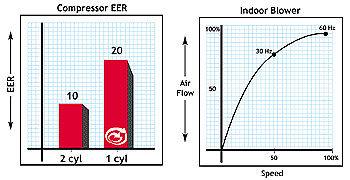
(Left)A two-cylinder compressor has an EER around 11. (Right) By using a 20-Hz controller to match blower speed to a single-cylinder compressor capacity, the TS system properly extracts humidity from the air.

Making Comfort Possible

Hvac system design is a balancing act. You have to size an a/c system so it can handle demand on the hottest days. That can make it too large for most cooling loads. At the same time, the installer has to be careful not to undersize the heat pump so it can provide sufficient heat on colder days.

“Too often you can be faced with a system built on compromises, which results in uneven indoor temperatures, lower energy efficiency, excessive on-off cycling, and less reliable operation,” said Custance.

But TS technology can change this, because it makes it easier to cost-effectively size a system for both hot and cold temperature extremes.

Since the technology lets a single compressor provide two capacities, it can be set up so the system operates most of the time at lower capacity. On extreme days, the extra power kicks in to provide the cooling or heating required. The extreme days, naturally, are when people are more sensitive to changes in indoor conditions.

Looking for quick answers on air conditioning, heating and refrigeration topics? Try Ask ACHR NEWS, our new smart AI search tool. Ask ACHR NEWS →

TS operates mostly on one cylinder (lower capacity), which reduces sound levels and makes it quieter than many systems. It is also possible to reduce indoor blower speeds by half, using a variable-speed motor or a simple 30-Hz inverter control. That further reduces overall sound, indoors and outdoors.

And when the blower motor is reduced, there’s another benefit: The system extracts more humidity (up to 10% more), again enhancing indoor comfort. This may be why TS systems get particular praise in very humid climates.

Since the compressor runs with longer cycles on lower capacity, there are fewer temperature spikes indoors.
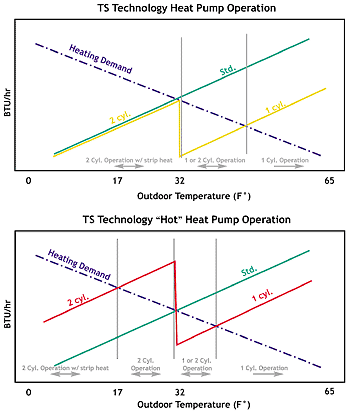
Compared to a standard heat pump (green), the same-size TS heat pump (yellow) provides an equal performance in cold weather and operates more efficiently in wamer weather. A "hot" TS heat pump (red) is sized so it has enough capacity to operate at much lower temperatures without electric strip heat.

The ‘Hot’ Heat Pump

Heat pump selection is based on both a/c and heating demand requirements, which presents a compromise that often limits heating capacity (hence customer complaints that heat pumps are “cold”).

Supplemental electric strip heat is often needed. Compressor capacity is reduced as outdoor temperatures decrease. Typically, at about 32°F, supplemental electric strip heat is required to meet heating loads.

A TS heat pump system operates on one cylinder until heating loads demand two-cylinder operation. This reduces unnecessary on-off cycling at higher temperatures and allows the system to increase capacity when temperatures go down.

A “hot” TS heat pump can be sized to handle temperatures lower than 32° without strip heat. That improves comfort when the weather is cold, and makes the system operate better even when heating demands are high.

Most of a TS system’s operating time is in one cylinder mode, where compressor efficiency is up to twice as high. During one-cylinder operation, system balance conditions are lightly loaded, which creates a more efficient operating condition.

Compressor EERs can be twice as high as a non-TS system. Not only is the compressor operating more efficiently, the indoor blower is using much less energy when running at a reduced speed.

TS technology can be applied to any hvac system efficiency level, from 10 to 16-plus SEER. In fact, the simple components and dual capacity of a TS compressor make it easy to incorporate into existing designs, often enabling them to reach new efficiency levels.

Links

  • Bristol Compressors

Share This Story

Looking for a reprint of this article?
From high-res PDFs to custom plaques, order your copy today!


Recommended Content

JOIN TODAY
To unlock your recommendations.

Already have an account? Sign In

  • HVAC-enrollment

    The Trades Are Back: HVACR Programs See Nearly 30% Enrollment Spike

    A new wave of future technicians is entering the pipeline.  
    News
    By: Matt Jachman
  • 2025 Top 40 Under 40

    2025 Top 40 Under 40 HVACR Professionals List

    The 11th annual Top 40 Under 40 list highlights those...
    HVAC Light Commercial Market
    By: Hannah Belloli-Oster
  • LG Ductless Mini-Split Systems

    The 9 Types of Heat Pumps

    As the U.S. moves toward electrification, heat pumps are...
    HVAC Commercial Market
    By: Joanna R. Turpin
Subscription Center
  • Create an Account
  • Start a Subscription
  • Manage My Account
  • Sign Up for Newsletters
  • Visit Customer Service
  • Update Preferences

More Videos

Sponsored Content

Sponsored Content is a special paid section where industry companies provide high quality, objective, non-commercial content around topics of interest to The News audience. All Sponsored Content is supplied by the advertising company and any opinions expressed in this article are those of the author and not necessarily reflect the views of The News or its parent company, BNP Media. Interested in participating in our Sponsored Content section? Contact your local rep!

close
  • Piggy Bank
    Sponsored byWatercress Financial

    Energy Prices, Inflation, and HVAC: What Today’s Homeowners Care About

  • Refrigerated Food
    Sponsored bySolstice Advanced Materials

    R-455A Refrigeration: A Cold Storage Solution for the Future

  • Airex Rooftop Units
    Sponsored byAirex Manufacturing Inc

    Consolidating Roof Penetrations: A Growing Trend in Multifamily HVAC Design

Popular Stories

HVAC-Price-Increase-graphic

HVAC Price Increase List: June 2026

Trump-Section-232.jpg

Trump Reduces Section 232 Tariffs on HVAC Equipment to 15%

Refrigerants-and-gauge.jpg

HVAC Industry Warns of Counterfeit Refrigerants Entering U.S. Supply Chain

U.S. Supreme Court building

95% Furnace Efficiency Rule to Get New Hearing

Midea-training.jpg

HVAC Workforce Crisis Expands Beyond Technicians to Instructor Shortages

View The ACHR NEWS
Centennial Anniversary Timeline

The ACHR News Timeline Chart
Submit a Letter
Submit a letter to our editors.

Events

November 6, 2025

Next-Gen Data Center Cooling: HVAC Innovation and Real-World Solutions

On Demand As AI workloads and high-density computing push traditional cooling methods to their limits, the data center industry is accelerating the adoption of next-generation HVAC technologies.

June 23, 2026

HVAC Duct Sealing Mastics: Why Selection Matters

In this webinar we will detail what HVAC material buyers and technicians need to know when selecting duct mastics, including matching mastic to substrate, alternatives to liquid mastic, and where UL 181 Listings fit into real world installations.

View All Submit An Event

Poll

Summer Staff

Are you fully staffed for the summer season?
View Results Poll Archive

Products

BNI Mechanical/Electrical Square Foot Costbook, 2026 Edition

BNI Mechanical/Electrical Square Foot Costbook, 2026 Edition

See More Products
HVAC Duct Sealing Mastics: Why Selection Matters - Free Webinar - 6/23/2026

Related Articles

  • deionized water

    Iowa State Laboratory Humidification Yields Results

    See More
  • From $19.97 to $131.21, Survey Draws Interesting Results

    See More
  • TS compressors advance heat pump system operation beyond ‘stop’ and ‘go’

    See More

Related Products

See More Products
  • The ACHR News - January 19, 2026

    ACHR NEWS January 19, 2026, Issue

See More Products

Events

View AllSubmit An Event
  • December 11, 2025

    HVAC Unitary Market Study Results

    On Demand In this webinar, we will do a deep dive into the trends that emerged from the 2025 HVAC Unitary Market Study.  
View AllSubmit An Event
×

Sign Up. Stay Informed.

The #1 trusted source for the HVACR industry since 1926

SUBSCRIBE
  • RESOURCES
    • Advertise
    • Contact Us
    • Advisory Board
    • Classifieds
    • Submit a Letter
    • Directories
    • Store
  • ACCOUNT CENTER
    • Create an Account
    • Start a Subscription
    • Manage My Account
    • Sign Up for Newsletters
    • Visit Customer Service
    • Update Preferences
  • SERVICES
    • Marketing Services
    • Reprints
    • Market Research
    • List Rental
    • Survey/Respondent Access
  • STAY CONNECTED
    • LinkedIn
    • Facebook
    • Instagram
    • YouTube
    • X (Twitter)
  • PRIVACY
    • PRIVACY POLICY
    • TERMS & CONDITIONS
    • DO NOT SELL MY PERSONAL INFORMATION
    • PRIVACY REQUEST
    • ACCESSIBILITY

Copyright ©2026. All Rights Reserved BNP Media, Inc. and BNP Media II, LLC.

Design, CMS, Hosting & Web Development :: ePublishing