Beyond Technical Know-How, Dual Fuel Starts with the Customer
Success begins with understanding both the homeowner’s expectations and the home
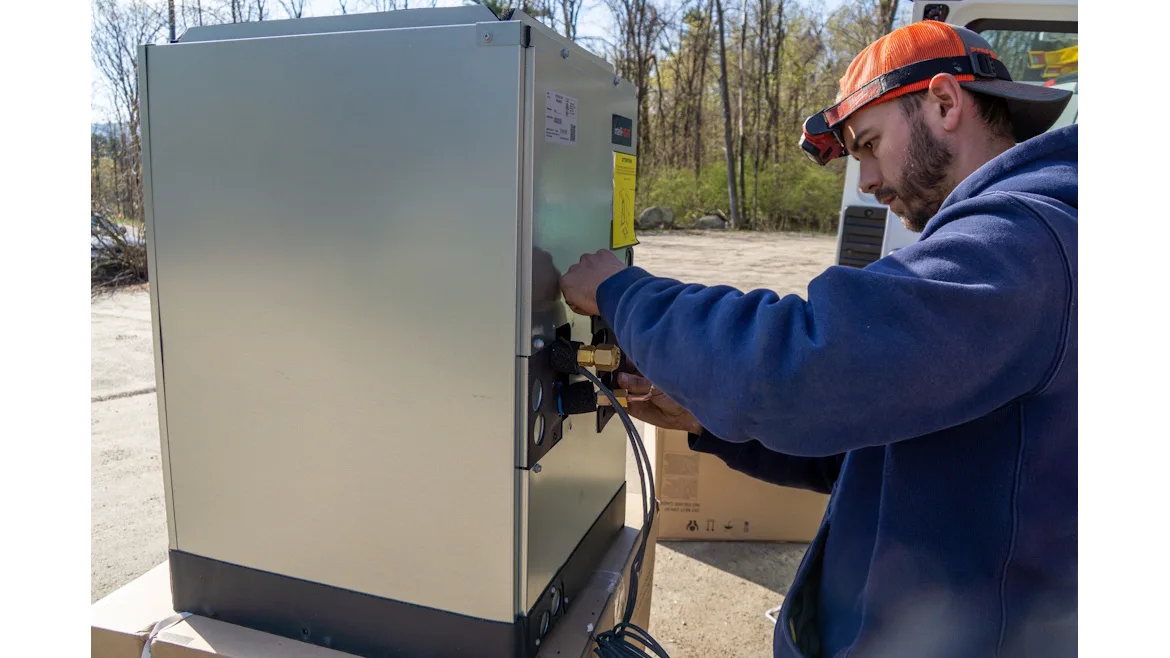
DOING DUAL-FUEL RIGHT]: A technician from Bergeron Mechanical Systems onsite during a Mitsubishi Electric intelli-Heat installation at a local dental practice in Antrim, New Hampshire.
As rebates evolve and the economics of home heating continue to change, HVAC contractors are increasingly viewing dual-fuel systems as a practical way to balance homeowner preferences, equipment costs, and energy efficiency.
The post-rebate market may favor dual-fuel systems not because they represent a compromise between gas and electrification, but because they give contractors greater flexibility to tailor heating and cooling solutions to each home’s needs.
Contractors caution, however, that installing a dual-fuel system isn’t simply a matter of pairing a heat pump with a gas furnace. Successful projects begin with understanding both homeowner expectations and whether the home itself is a good candidate for the technology.
Evaluating the Right Candidate
Butch Welsch, owner of Welsch Heating and Cooling in St. Louis, Missouri, said inexpensive natural gas still shapes many purchasing decisions in his market.
He said one of the biggest hurdles isn’t equipment performance at all; it’s homeowners’ perceptions of comfort. Homeowners accustomed to gas heat often expect warm supply air, making customer education an important part of the process.
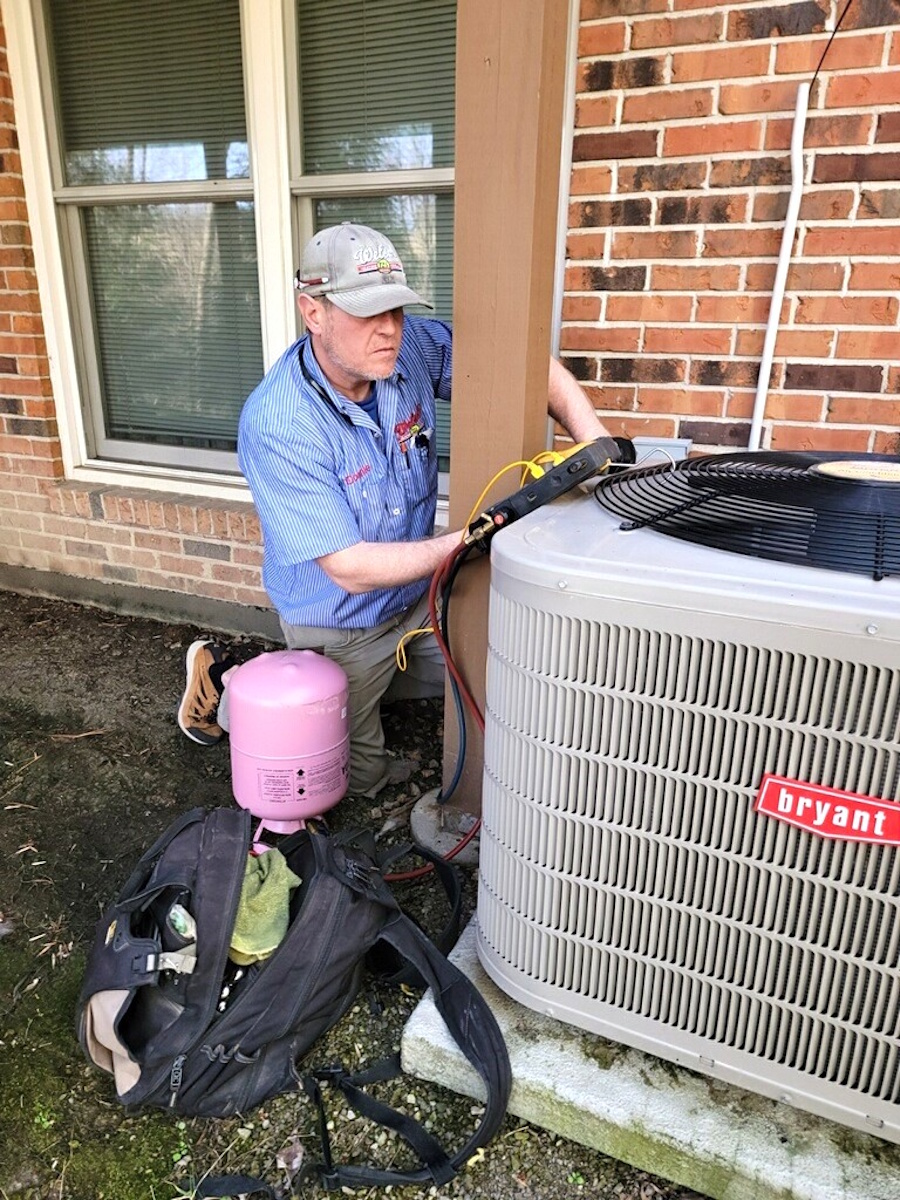
CALCULATED EFFORT: Welsch Heating and Cooling’s Donnie Nelson carefully weighs in refrigerant. (Courtesy of Welsch Heating and Cooling)
“The biggest issue with dual-fuel or electric heat pump systems is the outlet temperature,” Welsch said. “Our homeowners who have traditionally had gas heat are often not comfortable with the temperatures from other systems.”
Heat pumps generally deliver cooler supply air than traditional gas furnaces, even while maintaining indoor comfort.
Looking for quick answers on air conditioning, heating and refrigeration topics? Try Ask ACHR NEWS, our new smart AI search tool. Ask ACHR NEWS
Kim Bergeron, CEO of Bergeron Mechanical in Keene, New Hampshire, said the best candidates for dual-fuel systems are homes already equipped with ducted, gas-fired forced-air furnaces.
“Especially homes built between 1980-2000, where most fossil fuel systems were grossly oversized for the application,” Bergeron said.
Bergeron said dual-fuel systems can also help reduce upfront replacement costs when an existing gas-fired forced-air furnace designed for central air conditioning can remain in place. Compatibility becomes more challenging with oil-fired equipment or homes requiring extensive ductwork modifications.
Proper Design Starts With Manual J
Adding a second heat source doesn’t change the importance of proper system design.
Before selecting equipment, contractors say every dual-fuel installation should begin with a Manual J heat-loss calculation to determine the home's actual heating and cooling requirements.
“The Manual J calculations and airflow needs are just as important with a single-fuel system as with a dual-fuel system,” Welsch said.
Bergeron said one of the biggest mistakes contractors make is failing to perform a Manual J heat-loss calculation.
“Guessing what capacity system the home needs instead of performing a Manual J heat-loss calculation often leads to oversized equipment, poor comfort, and unnecessary energy consumption,” he said.
According to Bergeron, proper sizing, duct design, and airflow are critical to system functionality, essential for maximizing efficiency, and necessary to avoid short cycling while improving indoor comfort.
He noted that many homes built during the 1980s and 1990s were equipped with oversized furnaces, creating an opportunity for today’s inverter-driven heat pumps to handle a much greater portion of the heating season.
Proper Controls Determine Performance
Once equipment is selected, proper controls become critical to system performance.
Welsch emphasized that thermostats and controls are every bit as important as the equipment itself.
“The thermostat and other controls must work in conjunction with the equipment,” Welsch said. “They are not more important, but just as important.”
Bergeron agreed, adding that communicating controls supplied by the equipment manufacturer are essential for variable-speed hybrid systems.
“It is very important to use the hybrid system manufacturer's controls as they were used to certify the efficiency of the system,” Bergeron said. “Using third-party controls often significantly reduces efficiency and occupant comfort because they may not support the manufacturer’s communication protocols or fully utilize the inverter-driven compressor's variable-capacity operation.”
Welsch said the balance point in his area typically falls between 25 and 30 degrees, allowing the heat pump to operate efficiently before the gas furnace takes over.
“The balance point is typically determined by the equipment,” he said. “When the heat pump can no longer provide sufficient heat to satisfy the thermostat, then the gas will come on.”
Contractors distinguish between the thermal balance point, where the heat pump can no longer satisfy the home's heating demand, and the economic balance point, where fuel costs make switching to the furnace the more economical choice.
Bergeron noted that while equipment capabilities establish the operating limits, the economic balance point should also reflect local utility costs.
Contractors can compare local electricity and natural gas rates, along with equipment performance data, to determine the most economical outdoor temperature at which the system should switch from heat pump operation to the furnace. Because utility rates vary significantly by region, the ideal balance point in Missouri may differ substantially from one in New England or other parts of the country.
Homeowner Education Prevents Callbacks
Contractors also need to prepare homeowners for differences in airflow and supply-air temperatures compared with traditional gas furnaces.
“The amount and direction of the air flow on heat pump systems requires some getting used to on the part of the homeowner,” Welsch said.
Even correctly installed dual-fuel systems can generate callbacks if homeowners don't understand how inverter-driven heat pumps operate.
Bergeron said one of the most common service calls involves homeowners using large temperature setbacks as they did with conventional fossil-fuel systems.
Variable-speed heat pumps achieve their highest efficiency by operating continuously at low capacity while maintaining the thermostat set point. Many homeowners mistakenly believe turning the thermostat down or shutting the system off will save energy, when the opposite is often true.
“In fact, if they never shut off, they would last longer and use the least amount of energy while providing the maximum comfort,” Bergeron said.
He added that educating homeowners about how hybrid systems operate is just as important as installing the equipment correctly.
The Economics of Dual-Fuel Adoption
While inverter-driven heat pumps have expanded operating ranges, Welsch said economics still dictate whether homeowners embrace dual-fuel systems.
“The affordable price of natural gas makes heat pumps a difficult sell in our area,” he said.
Likewise, rebates have not been large enough in his market to offset the added cost of dual-fuel systems.
Bergeron said inverter technology has nevertheless changed how his company approaches hybrid installations.
“Inverter-driven heat pumps have allowed us to lower the dual-fuel balance point while significantly increasing indoor comfort,” he said.
He also believes hybrid systems could become an increasingly attractive replacement strategy for existing furnace-and-air-conditioning homes as utilities seek ways to manage growing electrical demand.
“As we continue to add load to the grid with electrification and mega data centers, utility companies will incentivize any chance they can to reduce peak demand,” Bergeron said.
He said that some utility demand-response programs already allow homeowners to receive incentives in exchange for permitting utilities to temporarily reduce HVAC output during periods of peak demand, often with little noticeable impact on indoor comfort.
Regardless of the equipment selected or the dollars-and-cents behind the purchase, contractors say proper commissioning ultimately determines whether the system performs as intended.
Commissioning Completes the Installation
Even a properly designed dual-fuel system won’t perform as intended if commissioning is rushed or skipped.
Bergeron said several startup procedures are mandatory before contractors leave the jobsite. Those include calculating and verifying the proper refrigerant charge, confirming all installer settings have been correctly programmed for the specific application, starting the system to verify airflow and temperature split (delta T), and documenting the startup results for both the homeowner and the contractor’s records.
According to Bergeron, the most common commissioning mistake isn't mechanical — it’s improper programming.
“The No. 1 thing we see is improper system settings,” he said. “Not programming the system for the exact application." He added that installers who have not received factory training can become confused by communicating control settings or fail to carefully follow the installation manual, resulting in reduced efficiency and homeowner comfort complaints.
For contractors, he said, proper commissioning verifies the system is operating as designed before the homeowner ever adjusts the thermostat.
Execution is the Differentiator
While manufacturers provide product-specific installation requirements, recognized industry standards also establish best practices for quality HVAC installations. Standards such as ANSI/ACCA 5 QI-2023 HVAC Quality Installation Specification, along with ANSI/ACCA 2 Manual J, ANSI/ACCA 3 Manual S, and ANSI/ACCA 1 Manual D, emphasize proper load calculations, equipment selection, duct design, controls, commissioning, and documentation.
Both experts agree that realizing the promised comfort, efficiency, and operating-cost benefits comes down to proper sizing, airflow, refrigerant charge, controls programming, balance-point settings, commissioning, and homeowner education.
As incentives evolve and replacement decisions become increasingly driven by long-term operating costs rather than rebates alone, dual-fuel systems could become an increasingly attractive option. Whether they deliver on that promise will depend less on the equipment itself than on the quality of the design, installation, and commissioning.
Looking for a reprint of this article?
From high-res PDFs to custom plaques, order your copy today!