Guest Column
4 Myths About Getting Into HVAC
An HVAC technician explains why some of the industry's most common assumptions are wrong
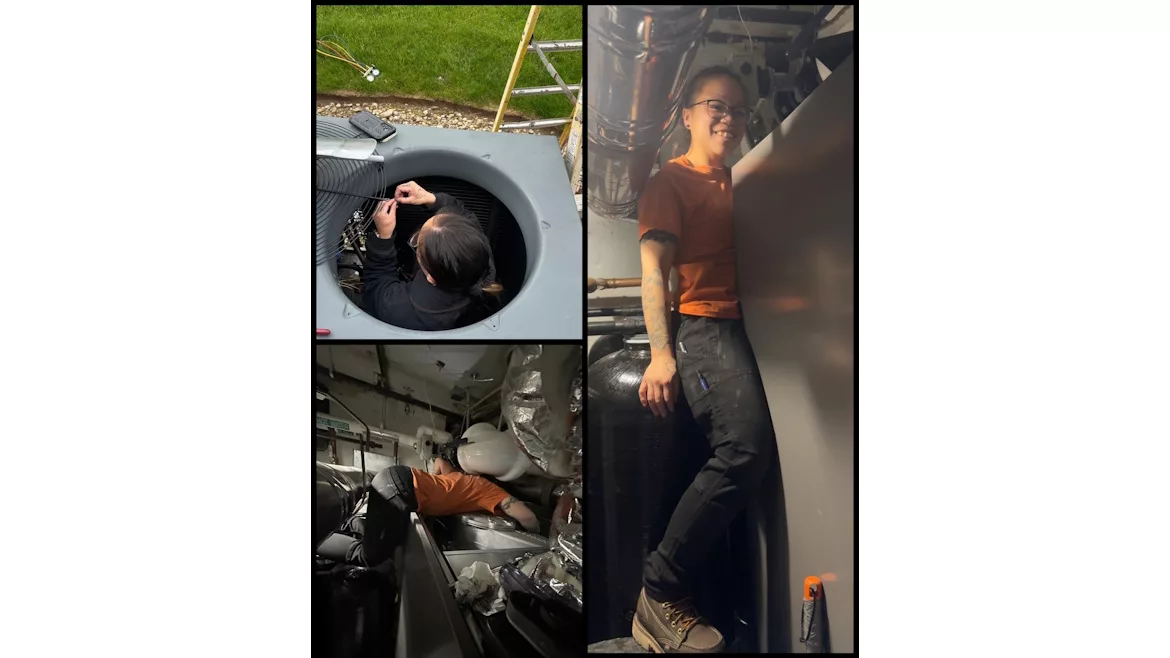
MYTH BUSTED: A common technician trope is that the HVAC industry is harder for smaller, or shorter, people. The opposite can be true, especially when it comes to working in confined areas or anywhere with tight clearances.
While the job description of HVAC technician is generally straightforward — someone who troubleshoots, repairs, and maintains HVAC equipment — there are many unspoken soft skills required to sustainably perform the role. One skill that isn’t talked about enough is the ability to manage the mental and emotional stress from day to day.
When it comes to getting into HVAC, there are mental barriers that other people create for us, which I believe discourages very capable people from ever trying it in the first place. Some of this comes from believing false narratives about what happened to the equipment, and some from simply misunderstanding how HVAC and troubleshooting works. The following are some common beliefs I hear from customers and coworkers about the job of an HVAC technician that I wish new and prospective technicians would realize are mostly false or misguided. I hope this list provides some insight into the reality of being a technician and the subtle pressures we work under.
1) It is either the customer’s fault or the technician’s fault.
This mentality is a major source of resentment, anger, and stress between the technician and the customer. Sometimes it is truly nobody’s fault. Machines are imperfect and made with degradable parts. There is no manufacturer that makes indestructible equipment or equipment that comes off the assembly line perfect every time. HVAC equipment often just breaks on its own, even after good-faith efforts to quality-check at the factory and then properly maintain the equipment in its environment. Nature is constantly trying to turn everything on this Earth into dust. Parts break all the time. That is why the job of the technician exists in the first place: to determine exactly which part broke.
2) The job is harder for smaller or shorter people.
As a 5-foot, 120-pound female service technician, I can say that this is verifiably false. In fact, I would argue this job is easier for people of my weight and stature. Shorter, leaner technicians can fit in tight-clearance spaces, crawl through ductwork or on top of joists, maneuver themselves and materials through attics and crawl spaces, sit inside of a packaged unit to perform repairs, and just use their size to an innumerable amount of advantages. There are also ways to compensate for everyday tasks. For example, my van is equipped with a ladder rack that drops down, allowing me to safely access my 32-foot extension ladder. There are also various types of hoisting equipment, such as duct jacks or the chain fall and gantry, to assist in lifting and moving heavy objects. Technicians of all sizes are useful, and it is never fair to assume someone’s size will disadvantage them in this field.
3) It is embarrassing to not know how to do something.
Because there are so many types of HVAC equipment and specialties within and adjacent to this industry, no single person who works in HVAC truly knows it all. It is a widely accepted fact that you can go to a reputable trade school, work a full-time career in the field, earn a college degree, maybe turn out to be an engineer, or simply work an entire lifetime in HVAC and still not know how to do everything. This is because the industry is so diverse and dynamic. It is always changing, always innovating, highly dependent on climate, and includes so many other trades within the trade. Younger technicians may never gain enough experience on the old equipment, and older technicians may not be up to speed with new technology. Service technicians are usually less familiar with installation and pipefitting techniques. Installers are usually less familiar with troubleshooting. It is impossible to know every nook and cranny of this field. Some advice I received early on from older technicians when I first got into a van was to not let the infinite expanse of unknown experiences in HVAC overwhelm you. One way to create value for yourself in this industry is to specialize in a few sub-categories of the field — areas of HVAC that you like and are good at — and then ask for help on the things you don’t know. It does not need to be embarrassing because none of us actually know how to do it all.
4) The job is better performed by older people.
Because HVAC technology is constantly changing and innovating, being a competent technician takes a certain amount of humility and openness to learning new things, and that is what distinguishes them — not the color of their hair. The subtle agism that exists in this trade often causes customers to feel uneasy about younger technicians and sometimes overly trusting of older technicians. As with height, age does not determine character or someone’s ability to fix a broken HVAC system. Arguably, younger people are more likely to understand today’s HVAC as they are increasingly more computer-literate and fluent in software and programming languages.
Looking for quick answers on air conditioning, heating and refrigeration topics? Try Ask ACHR NEWS, our new smart AI search tool. Ask ACHR NEWS
Looking for a reprint of this article?
From high-res PDFs to custom plaques, order your copy today!