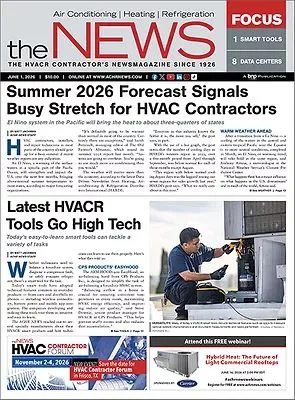
2026 Summer Weather Outlook: Warmer-Than-Normal Summer Predicted for Much of U.S.
El Niño system in the Pacific will bring the heat to about three-quarters of states

GETTING WARMER: An El Niño system in part of the Equatorial Pacific is expected to bring warm temperatures to much of the U.S. this summer, meaning it could be a busy season for air-conditioning installers and technicians.
HVAC contractors, installers, and repair technicians in most parts of the country should gear up for a busy summer if recent weather reports are any indication.
An El Niño, a warming of the surface waters in a specific part of the Pacific Ocean, will strengthen and impact the U.S. over the next few months, bringing above-normal summer temperatures to most states, according to major forecasting organizations.

PRECIPITATION: Orange shading indicates where rainfall is most likely to be below normal over the next three months, while green shading highlights areas where rainfall is most likely to be above normal. The deeper the shading, the higher the likelihood of either below-normal or above-normal precipitation. The white areas of the map show where equal chances of either above-normal or below-normal rainfall are predicted. (Courtesy of the National Weather Service)
“It’s definitely going to be warmer than normal in most of the country. Certainly, there are exceptions,” said Sarah Perreault, managing editor of The Old Farmer’s Almanac, which issued its summer 2026 report last month. “Systems are going to overheat. You’re going to use much more air conditioning than you would.”
The weather will matter more than the economy, according to the latest Data Driven Newsletter from Heating, Air-conditioning & Refrigeration Distributors International (HARDI).
“Everyone in this industry knows the hotter it is, the more you sell,” the post says, in part.
With the use of a bar graph, the post notes that the number of cooling days in HARDI’s western region in 2025, over a five-month period from April through September, was below normal for each of those months except August.
“This region with below normal cooling degree days was the laggard among our seven regions for sales growth last year,” HARDI’s post says. “What we really care about is this year.”
Looking for quick answers on air conditioning, heating and refrigeration topics? Try Ask ACHR NEWS, our new smart AI search tool. Ask ACHR NEWS
Warm Weather Ahead
After a transition from a La Niña — a cooling of the waters in the central and eastern tropical Pacific near the Equator — to more neutral conditions, completed in March, an El Niño, or warming trend, will take hold in the same region, said Anthony Artusa, a meteorologist at the National Weather Service’s Climate Prediction Center.
“What happens there has a major influence on what happens in the U.S. downstream,” and in much of the world, Artusa said.
“We expect the El Nino to become stronger and more impactful later in the summer and on into the fall,” and to last into the winter, Artusa added.

TEMPERATURES: Orange shading indicates where temperatures are most likely to be above normal over the next three months; the deeper the shading, the higher the probability of warm weather. The white parts of the map indicate where the chances of temperatures being either above or below normal are equal. (Courtesy of the National Weather Service)
The El Niño will mean warm summer weather in about three-quarters of the states, Artusa said, with the highest likelihood for hotter-than-normal temperatures predicted for the northern and central intermountain West and the Rocky Mountain area. That’s a region from Idaho and the western two-thirds of Montana, southeasterly to parts of Kansas, Oklahoma, and Texas, and from parts of Washington, Oregon, and California eastward through most of Colorado and into a corner of western Nebraska.
Most other states — in the West, Pacific Northwest, Plains, Mid-South and Deep South, the Appalachian region, and along the Atlantic coast from Florida to Maine — are also likely to see above-normal temperatures, though that probability is less than in the Rockies and intermountain area, according to the National Weather Service.
AccuWeather Inc. predicts that the number of 90°F-plus days in several major cities, including Boston, New York, Philadelphia, Portland, and Phoenix, will be near or above the 15-year average. In Portland, between 22 and 30 days of 90°-plus temperatures are forecast; the average is 20 days. In Phoenix, up to 190 days of 90°F-plus temps are forecast; the average is 180.
An area of the country centered in the northern Midwest — Minnesota, Wisconsin, Iowa, Indiana, and Michigan, most of Illinois, western Ohio, plus parts of the Dakotas, part of Missouri, and a sliver of northern Kentucky — could escape the highest temperatures, as data indicate that temperatures there are just as likely to be below normal as they are to be above normal, according to the weather service.
Temperatures in Hawaii are likely to be above normal, as are temperatures in Alaska, except for the northern part of that state, where above- or below-normal temperatures have equal chances, the weather service says.
Precipitation Outlook
El Niño will also influence precipitation patterns this summer.
An area along the Atlantic that includes most of Delaware and Maryland southward through Virginia, the Carolinas, and part of Georgia, plus most of West Virginia and the eastern parts of Kentucky and Tennessee, is likely to see above-normal rainfall, according to the weather service, though the Atlantic hurricane season is expected to be mild, Artusa said.
Most of Arizona, western New Mexico, southeastern Utah, and far southwestern Colorado are also likely to see above-normal rainfall.
In the northwest, in a region that includes all of Washington state plus northern Oregon and northern Idaho, signs point toward drier-than-normal conditions, according to the weather service. In a larger swath east of the Rockies, from southern South Dakota through most of Nebraska, Kansas, Oklahoma, and much of Texas, chances of below-normal precipitation are high.
In most of the rest of the country, there are equal chances of above- or below-normal rainfall.
AccuWeather is looking at rainfall through a different lens, warning of the possibility of flash flooding in the Texas hill country as well as in other regions.
“Flash flood events are expected in parts of the Plains, Mississippi Valley, and Ohio Valley on a higher frequency this summer,” said long-range meteorologist Paul Pastelok in AccuWeather’s summer forecast.
Here’s a temperature and precipitation outlook roundup for June, July, and August for all 50 states, based on the National Weather Service forecast:
Alaska
High chances of above-normal temperatures, except at the top of the state, where above- or below-normal temperatures have equal chances. Chances are higher for above-normal precipitation in the western part of the state; equal chances of above- or below-normal precipitation in northeastern Alaska and the Panhandle.
Pacific Northwest (Washington, Oregon)
Probability of above-normal temperatures throughout, with the highest likelihood in the eastern two-thirds of both. Below-normal rainfall likely for all of Washington and northern Oregon; equal chances of above- or below-normal rainfall in the rest of Oregon.
California
Probability of above-normal temperatures across the Golden State, and with chances higher in an eastern sliver. Equal chances of above- or below-normal rainfall for nearly the entire state.
Mountain West (Idaho, Montana, Wyoming, Nevada, Utah, Colorado)
Probability of above-normal temperatures across all states, with the highest likelihood throughout Idaho, most of Nevada, Utah, Wyoming, and Colorado, and the western two-thirds of Montana. Chances are high for below-normal rainfall in northern Idaho and western Montana. Equal chances of above- or below-normal rainfall in most of the rest of the region; southeastern Utah and a corner of southwestern Colorado are more likely to see above-normal rain levels, and a small part of eastern Colorado is in a region where drier weather is expected.
Southwest (Arizona, New Mexico, Texas)
Above-normal temperatures expected, with the highest likelihood seen in northern parts of Arizona and New Mexico and a swath of north-central Texas. Chances are high for above-normal rainfall in much of Arizona and western New Mexico. Equal chances of above- or below-normal rainfall in far western and far eastern Texas; the probability is high for most of the rest of the state to be drier.
High Plains (the Dakotas, Nebraska, Kansas, Oklahoma)
Above-normal temperatures likely in the western Dakotas, Kansas, Oklahoma, and most of Nebraska. Equal chances of below- and above-normal temperatures in the eastern Dakotas and the northeastern corner of Nebraska. Equal chances of above- or below-normal rainfall in North Dakota and most of southern South Dakota; nearly all of Nebraska, Kansas, and Oklahoma are part of a region where the probability of lower-than-normal rainfall is elevated.
Upper Midwest (Minnesota, Iowa, Missouri)
Equal chances of above- or below-normal temperatures, except in southern and western Missouri, where warmer temperatures are more likely. Equal chances of above- or below-normal rainfall in all three states, but for a tiny sliver of western Iowa next to Nebraska, which is more likely to be drier.
Great Lakes (Wisconsin, Illinois, Indiana, Michigan, Ohio)
Equal chances of above- or below-normal temperatures, except for the southernmost tip of Illinois and eastern Ohio, where above-normal temperatures are more likely. Equal chances of above- or below-normal rainfall throughout the region, but for a small part of Ohio near West Virginia, where chances of above-normal rainfall are higher.
South (Arkansas, Louisiana, Mississippi, Alabama, Florida, Georgia, Tennessee, Carolinas)
Above-normal temperatures likely, with the highest probability in Louisiana and parts of Arkansas, Mississippi, Alabama, and the Florida Panhandle. Equal chances of above- or below-normal rainfall in Arkansas, Mississippi, Louisiana, Alabama, Florida, the western two-thirds of Tennessee, and southern and northwestern Georgia. Above-normal rainfall is more likely in eastern Tennessee, most of northern and eastern Georgia, and the Carolinas.
Kentucky and West Virginia
Above-normal temperatures expected, except for parts of northern Kentucky, where equal chances of above- or below-normal temperatures are seen. Chances of above-normal rainfall are highest in eastern Kentucky and most of West Virginia; equal chances of above- or below-normal rainfall in far northern West Virginia and the western two-thirds of Kentucky.
Mid-Atlantic (Pennsylvania, New York, New Jersey, Delaware, Maryland, Virginia, Washington, D.C.)
Higher-than-normal temperatures expected throughout. Elevated chances of above-normal precipitation in Virginia, Washington, D.C., and most of Maryland and Delaware. Equal chances of above- or below-normal precipitation in Pennsylvania, New York, New Jersey, and the northern parts of Maryland and Delaware.
New England (Maine, New Hampshire, Vermont, Massachusetts, Rhode Island, Connecticut)
Elevated chances of higher-than-normal temperatures throughout. Equal chances of above- or below-normal rainfall throughout.
Hawaii
Warmer-than-normal temperatures, with a tendency toward above-normal rainfall.
Looking for a reprint of this article?
From high-res PDFs to custom plaques, order your copy today!