Can Cool Roofs Benefit HVAC Work?
In theory, yes, but the real answer is more complicated

COOL ROOFS: Cool roofs can lead to energy savings and reduced strain on HVAC equipment, but contractors need to approach them thoughtfully.
With temperatures predicted to rise across the globe and energy prices continuing to rise, HVAC contractors will want to find effective solutions to help their customers save on heating and cooling costs.
One potential solution? Cool roofs.
Normally, HVAC contractors aren’t concerned about a building’s roof unless they’re installing or maintaining rooftop units or other equipment. But if the roof can aid them in providing an energy-efficient solution, it’s worth investigating, and can transform both residential and commercial contractors into high-level problem solvers for customers.
First, the basics: Generally, a dark-colored roof will absorb more heat, raising the temperature of buildings and the surrounding air. Cool roofs do the opposite, typically with light-colored, reflective materials. This makes buildings cooler by reducing heat flow from the roof into the building.
In theory, a cool roof can reduce the strain on HVAC systems and extend their lifespan. By not having to work as hard to cool a building, systems require less maintenance or replacement.
In practice, though, the issue is complicated.
Do Cool Roofs Help HVAC?
The Cool Roof Rating Council, a nonprofit organization focused on objective, scientific information related to cool roofs, notes that multiple factors go into how much a cool roof reflects heat, but in general, the surface temperature is broadly 50°F cooler than other roofs.
Looking for quick answers on air conditioning, heating and refrigeration topics? Try Ask ACHR NEWS, our new smart AI search tool. Ask ACHR NEWS
“The surface staying cooler in the sun, that is going to translate to cooler internal temperatures for the building, which reduces demand for a/c, particularly peak cooling demand,” said Audrey McGarrell, communications manager for the Cool Roof Ratings Council.
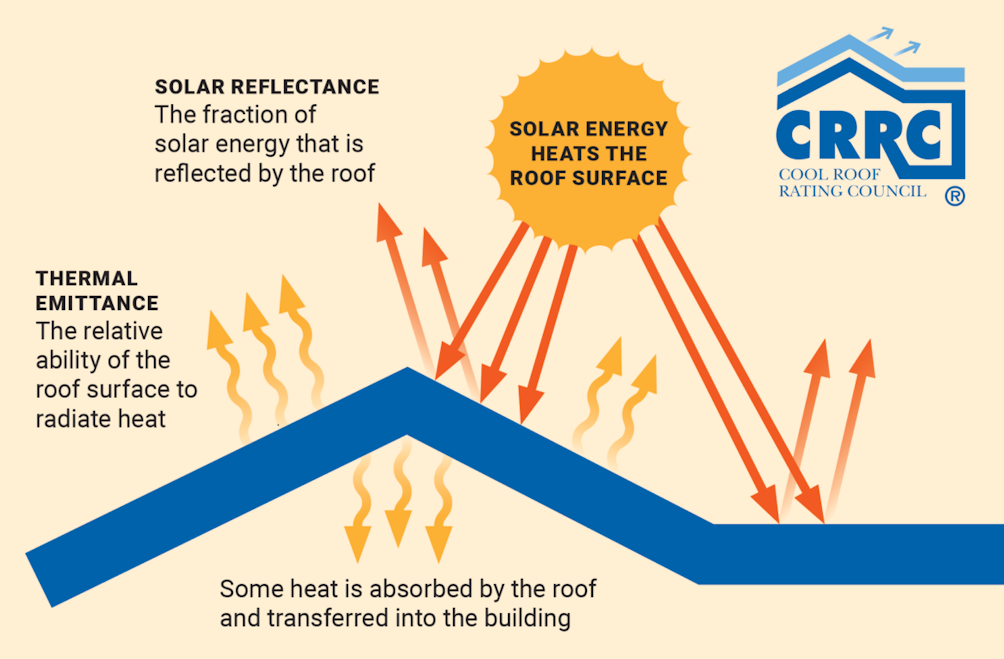
REFLECTIVE ROOFS: This illustration describes the flow of radiant energy as heat between the sun, roof surface, building interior, and surroundings. The higher the solar reflectance, the more solar energy is reflected away from the roof surface. Some of the solar energy is absorbed by the roof as heat. The higher the thermal emittance, the more of this absorbed heat is radiated away from the roof surface. (Courtesy of the Cool Roof Rating Council)
McGarrell said this can also result in buildings equipped with smaller units that can keep up with a larger space than if a conventional roof is installed.
“It can be useful for downsizing a unit or … if you’re working with an older unit that’s needing maintenance again, extending the life of that a little bit more,” she said.
The American Society of Heating, Refrigerating and Air-Conditioning Engineers recommends reflective roofs on commercial buildings in the hottest U.S. climate zones labeled 1, 2, and 3.
Most discussions about cool roofs focus on commercial buildings, but there are cool roof options for steep-slope structures. The Cool Roof Rating Council’s database has 820 products for steep roofs.
Here’s what different studies have shown:
- A 2023 paper reviewed the annual average HVAC peak power demand savings for buildings with cool roofs in climate zones 1 to 4. For medium-sized office buildings constructed before 1980, the savings are 1.1 to 3.9 watts per square meter, and 0.5 to 1.9 watts per square meter for buildings constructed between 2004 and 2013.
- A 2024 study monitored cool roof performances in six cities around the world, including Sao Paulo and Los Angeles. In most cases, cool roofs achieved an annual cooling energy reduction from 67% to 87%.
- A 2020 study shows that air temperatures measured directly at the inlets of rooftop HVAC equipment pull air several degrees higher than what weather services report, about 3.5° to 7°F. This can reduce cooling efficiency, increase compressor time, and raise energy costs.
- The same 2020 study states that in cases where cooling equipment and ventilation air inlet temperatures were modified using the above-roof temperature model, the estimated electricity savings from cool roofs were anywhere from 59% to 1,295%, averaging 311%.
It should be noted that the 2020 study was limited to large, low-angled roofs with few nearby obstructions. The findings best apply to facilities like large commercial buildings, warehouses, and data centers, and less to steep-slope residential roofs or dense high-rise environments.
Another study examined how roof reflectivity, known as albedo, affects the temperature of a roof’s surface and the air above the roof. It shows reflective roof materials consistently stay cooler than low-albedo materials both on the surface and air temperatures, meaning reflective roofs could impact unit condenser performance.
“The conclusions point to the need to carefully consider the consequences of roof system choice on placement of mechanical and electrical equipment on or adjacent to roofs,” the study says.
A Chilling Effect
The downside to cool roofs is the region in which they’re installed. Since they reflect sunlight and reduce solar heat, they have the side effect of increasing energy usage in the winter in colder climates found in Zones 5-8. This increase can be negated through energy savings realized in summer months, but again, it depends on the region.

COORDINATED EFFORTS: Working with roofing contractors and general contractors is the first step toward creating energy-efficient solutions for customers. (Courtesy of Jason Wilen)
“As you move further north, that winter heating penalty does become more significant,” McGarrell said. “It becomes a little bit more of a dance where you really want to look at the specific characteristics of the building to determine whether there will be a neutral or net positive or negative impact on energy use.”
The previously mentioned 2024 study indicates as much, saying in colder climates, cool roofs reflect heat that might otherwise reduce heating costs, with heating energy increases of up to 22% in some cities.
The study focusing on high-albedo materials providing cooling effects can also be used to show that buildings in cooler climates may want darker roofs to offset heating bills.
Mandated Cool Roofs
Obviously, HVAC contractors aren’t the ones installing a cool roof. That’s up to roofing contractors, or potentially the general contractor. But working together with subcontractors or the GC is paramount.
“Industries being able to talk about this, even if it's not directly related to the work that they're doing, \[HVAC contractors] being able to say, ‘If you install a cool roof, that could have positive implications for HVAC and for saving money for people and just keeping their homes safer and more resilient,’” said McGarrell.
In some cases, HVAC and roofing contractors may not have a choice about what type of roof is installed.
Cool roof requirements have been adopted into building and energy standards by at least 15 states and the District of Columbia, according to the Cool Roof Rating Council. There are at least seven voluntary programs for cool roofs offered by international, national, and state agencies and organizations.
Ellen Thorp, president of the Coalition for Sustainable Roofing, said much of the data initially used to justify cool roof regulations is old or outdated, so contractors should work together to determine the best solutions on a case-by-case basis.
“When we are thinking about energy efficiency and operational carbon, that's something that we want to look at: Is HVAC equipment more or less efficient when it sucks in hot air versus warm air in the summer?” said Thorp.
How Can HVAC Contractors Request Cool Roofs?
So what’s an HVAC contractor to do? As Thorp suggested, work together with general contractors and roofing contractors on projects to create energy-efficient systems.
When done right, Thorp said coordinated efforts between subcontractors can result in lower costs, lower embodied carbon, potentially lower operational carbon, and a decreased risk of issues happening down the road.
“The HVAC contractor is going to have a better experience with increased customer satisfaction if they make sure that there's that early coordination meeting, if they make sure that they can talk to the roof system designer and say, ‘Hey, new colleague, here's what we need,’” she said.
Planning needs to start from the beginning, whether it’s new construction or a retrofit. It’s not enough to have a general contractor meeting with the owner. The general contractor needs to meet with all the subcontractors, and the subcontractors should all meet and communicate.
“Have everything that goes on the rooftop designed together at the same time, especially during this period where some buildings at least have amenity spaces on the roof deck,” Thorp said. “The benefit of having that early design and coordination is that it's more efficient and it's a more sustainable project.”
An example of this could be mounting HVAC equipment on a racking system so it can be changed more easily, as opposed to being mounted directly to the rooftop. HVAC contractors can mention roof inspection or cleaning for the area around RTUs, as dirty roofs kill the efficiency of cool roofs.
“Even if it’s a reroof, we would also want to see a holistic perspective,” Thorp said. “So the HVAC equipment, the roof assembly, and the attachment systems … they must be designed together to achieve the long-term building performance.”
Looking for a reprint of this article?
From high-res PDFs to custom plaques, order your copy today!


