The Quiet Electric Shift: What 15 Years of AHRI Data Is Telling Us
On current trends, heat pumps will outsell a/cs in 2027. Will the trend hold?

SURPRISE: A deep review of AHRI shipment data from 2010 through 2025 turned up one especially unexpected result.
I pulled 15 years of monthly AHRI shipment data into a spreadsheet: 192 data points covering heat pumps, air conditioners, furnaces, and water heaters from 2010 through 2025, compiled from AHRI’s own PDF reports. I was looking for patterns. I found two I didn’t expect, and one I’m still trying to explain.
The Water Heater Nobody Was Watching
The one that surprised me most had nothing to do with heat pumps.
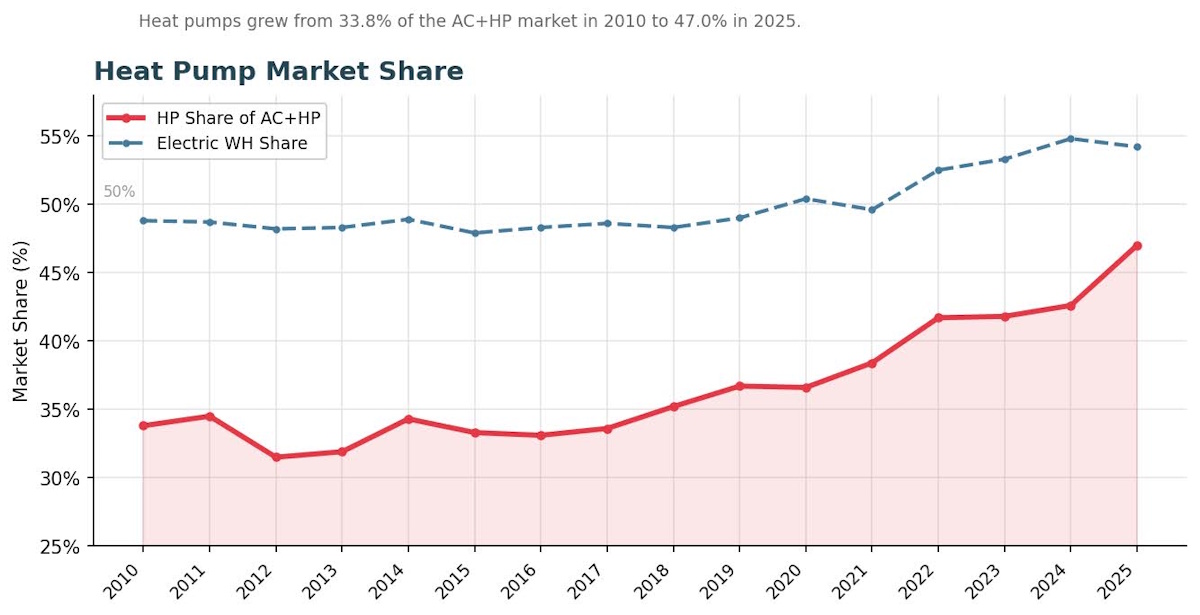
For most of the 2010s, residential electric and gas water heaters were locked in a near-even split — hovering just below 50/50, with gas holding a slim lead. Then in 2020, electric DHW crossed 50% for the first time. By 2024, electric was at 54.8%. It’s held above the crossover ever since.

Courtesy of Nate Adams
Nobody was talking about this. No culture war, no contractor Facebook drama, no op-eds. Just consumers quietly choosing electric water heaters, year after year.
Here’s what I don’t know: How much of that shift is heat pump water heaters specifically, which got a strong incentive through the Inflation Reduction Act? The AHRI data doesn’t break that out. But the crossover started in 2020, before IRA rebates were widely available — so whatever caused it, it wasn’t only the incentive. That’s worth keeping an eye on.
The Heat Pump Crossover Is Coming
Heat pumps went from 33.8% of the combined a/c and heat pump market in 2010 to 47% in 2025. In the last few months of 2025, heat pumps actually outsold straight a/cs monthly for the first time.
Courtesy of Nate Adams
I keep turning over two competing explanations for the recent acceleration, and I’m not sure how they are interacting.
Looking for quick answers on air conditioning, heating and refrigeration topics? Try Ask ACHR NEWS, our new smart AI search tool. Ask ACHR NEWS
The first is IRA rebates and incentives. The program made high-end heat pumps significantly cheaper for many homeowners, and the market responded. But if that’s the main driver, what happens now that those incentives have been cut? The momentum could slow.
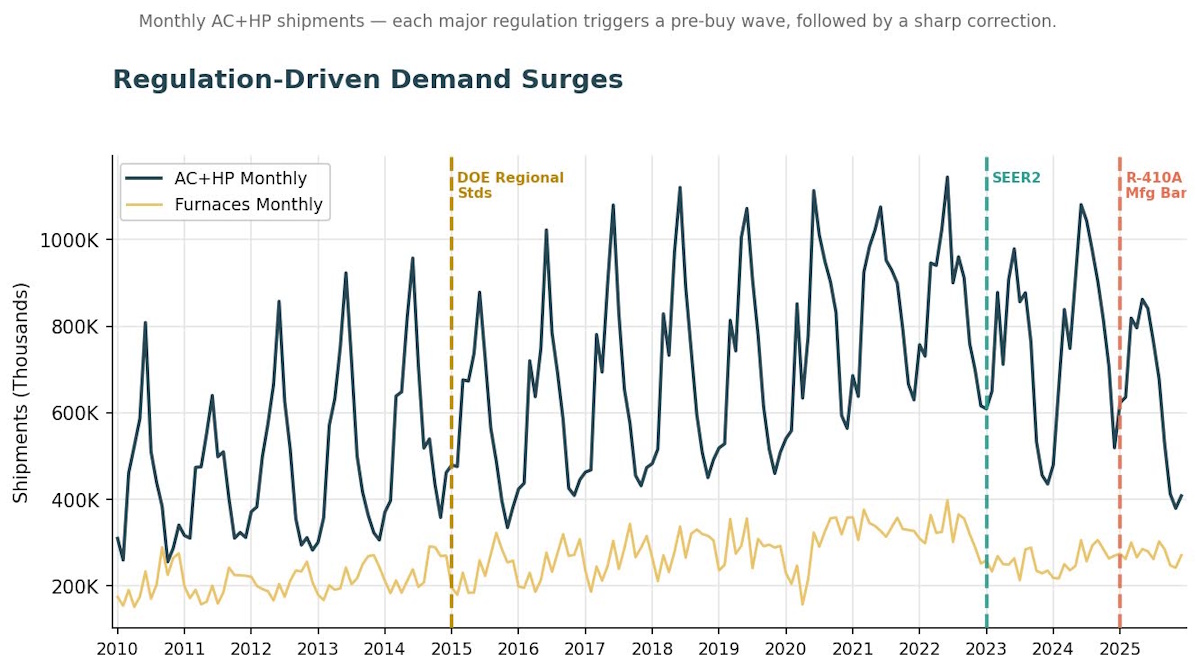
The second possible explanation is the R-410A manufacturing ban that took effect on Jan. 1, 2025. Before that deadline, distributors were loading up on R-410A equipment to get ahead of the transition to R-454B and R-32. That pre-buy surge inflated 2024 heat pump numbers — and when I look at the regulation-driven peaks and valleys across the full 15-year dataset, that pattern is unmistakable.
Courtesy of Nate Adams
Every major regulatory deadline creates a wave of channel stocking, followed by a correction. The 2015 DOE regional efficiency standards did it. The SEER2 transition pre-buy plus the COVID rush in 2021-2022 was followed by a 17% drop in 2023. The R-410A transition looks similar. Which means some of 2025’s heat pump share gains may be a last-gasp R-410A inventory flush rather than pure organic demand.
The honest answer is probably both things at once. The direction towards electrification is clear. The pace is genuinely uncertain.
The A/C Replacement Is the Moment
The leverage point I keep coming back to, for my clients and in my own work, isn’t the furnace. It’s the air conditioner.
A/cs and heat pumps are basically the same machine; the reversing valve is the main difference (and, of course, defrost sensors and a second metering device).
For a marginal extra cost, consumers can get a machine that runs every month of the year, not just part of it. They get better comfort (especially with variable-speed heat pumps), they have backup heat should the furnace die, and they can use whichever heating fuel is cheaper that year.
The comfort thing was mind-blowing to me (and often to my clients). Equipment that runs most of the time, trickling a little heat into the house, warms up all the building materials and furniture, so the house feels more even, and most things are within 2-3 degrees of what the thermostat says. My friend Cameron Taylor, who runs several large buildings on the University of Texas Arlington campus, said one of my projects had “womb-like comfort.”
My clients with hybrids consistently say they prefer the heat from the heat pump to the heat from the furnace — even my super skeptic friend Jim Bergmann of MeasureQuick.
So, the move from one-way a/cs to two-way a/cs (as I call them) is a good thing!
Heat Pumps Have Dusted Furnaces
Courtesy of Nate Adams
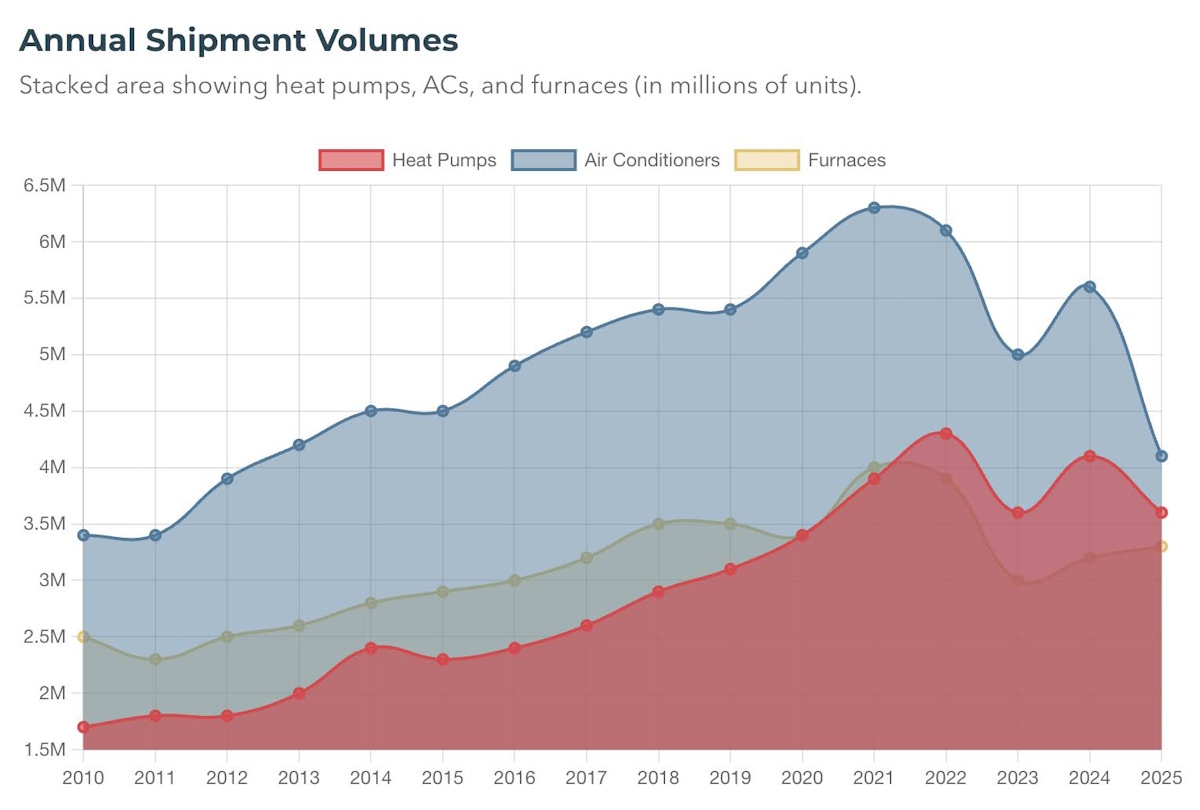
Heat pump sales left furnace sales behind in 2022. While I am critical of the heat pump-versus-furnace debate because furnaces pair just fine with heat pumps in a hybrid/dual-fuel system, that one tide appears to have turned.
Again, though, I wonder if it’s because furnaces often outlast a/cs and heat pumps in my experience. After all, they can handle poor installs better.
What I wasn’t expecting was how quickly a/c sales and heat pump sales have reached parity. On current trends, heat pumps will outsell a/cs in 2027. Will that trend hold? I think the trend will, but I’m not sure about the speed.
What I’m Updating
I’ve been skeptical of policy-driven market transformation for most of my career. I’ve watched incentive programs create boom-bust cycles. I’ve written about the structural problems where downstream rebates can’t reach the 85% of HVAC purchases that happen in emergencies.
That skepticism isn’t gone. But this data makes me think I could be wrong this time.
The water heater shift is the thing I can’t explain away with policy. It moved without fanfare, without subsidy wars, before the IRA was a household term in the trades. Cold-climate heat pumps in 2025 are genuinely better than they were in 2015 — I’ve put in enough of them to know this isn’t marketing.
I was probably overweighting my skepticism and underweighting organic technology improvement this time. I’d rather say that plainly than keep defending a position the data doesn’t support.
The Open Question
The direction in this data is clear enough that you don’t need to be a statistician to see it. The real question is whether this pace of change continues once incentives wind down — or whether the last few years of acceleration were partly a policy-and-refrigerant-transition moment that won’t repeat.
I don’t know the answer to that. But I’m watching the numbers.
Looking for a reprint of this article?
From high-res PDFs to custom plaques, order your copy today!