End of Section 25D Tax Credit Could Cut Residential Geothermal Shipments by 50%
The loss of a tax incentive will hurt the market, but experts see plenty of positives
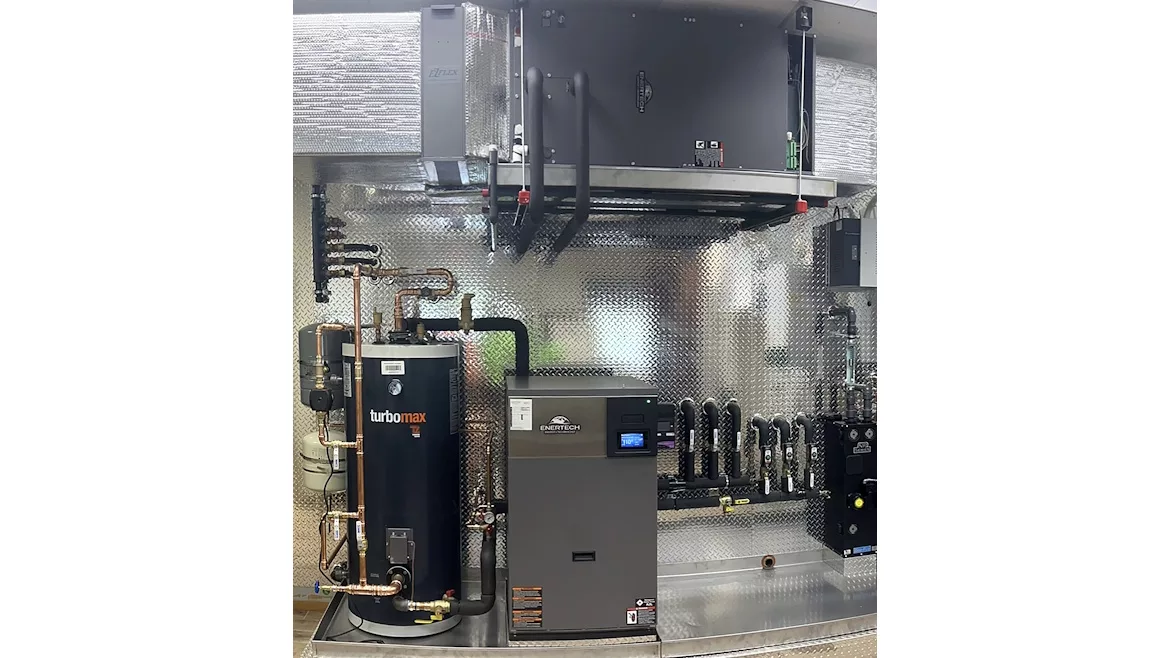
HYDRONIC WAY: An Enertech WV variable-speed water-to-water heat pump in an installation that includes an Enertech hydronic air handler and a TurboMax water heater, which is made by Thermo 2000 Inc.
The loss of a federal tax incentive for residential geothermal projects is a blow to the industry, but new approaches to cost barriers and system ownership, plus the potential in commercial geothermal, are keeping those in the business optimistic.
The Residential Clean Energy Credit — commonly known as the Section 25D credit — offered homeowners a 30% tax credit for geothermal projects. The incentive had been scheduled to sunset after 2034, but last year’s One Big, Beautiful Bill Act fast-forwarded its expiration to the end of last year.
Incomplete Internal Revenue Service (IRS) figures show that at least 80,730 households took advantage of the credit for a geothermal system in 2023. The average credit was just over $12,000.
Residential Falloff Forecast
Joe Parsons, founder of Resonant Energy Strategies, a clean energy consulting firm, predicts a drop-off this year of between 40% and 50% in shipments of residential ground-source heat pumps. He bases that forecast on the decline seen when Section 25D lapsed a few years back. (The credit was restored and made retroactive for the lapse period.)
“The current situation is even more damaging because today’s installed costs are higher, interest rates are higher, and consumers are more payment-sensitive than they were a decade ago,” Parsons said. Small and mid-sized contractors whose business models were built around the 25D credit will be the hardest hit, Parsons said.
“The sunset of the 25D tax credit will certainly impact the short-term momentum of the residential geothermal market, but we see the opportunities in residential multifamily gaining popularity,” said Rob Derksen, director of business development at Enertech, a geothermal equipment manufacturer.
Residential geothermal, Parsons said, “will feel like two different markets” this year. The loss of 25D, higher borrowing costs, and a backlog of projects from 2025 will drive “a painful contraction,” he said.
Looking for quick answers on air conditioning, heating and refrigeration topics? Try Ask ACHR NEWS, our new smart AI search tool. Ask ACHR NEWS
“On the other hand, there will be pockets of real growth in states, utilities, and developers that lean into alternative financing, on-bill (rebate) structures, and shared-loop designs that take the place of the tax credit,” Parsons added.
Experts say new ownership models that reduce homeowners’ upfront costs — the digging and installation of a ground loop is by far the most expensive part of a project — are important for advancing the residential market.
“Lower the first-cost barrier and change how the customer experiences that cost,” said Parsons. “That means moving away from a ‘buy-a-piece-of-equipment’ paradigm and toward long-term service, infrastructure, and utility-style models that match how people already pay for comfort and hot water.”
Geothermal leasing, in which a utility or another third party pays initial costs and owns the system, recouping its investment by charging a monthly fee, has a lot of potential, said Tim Litton, director of marketing and communications at geothermal manufacturer WaterFurnace.
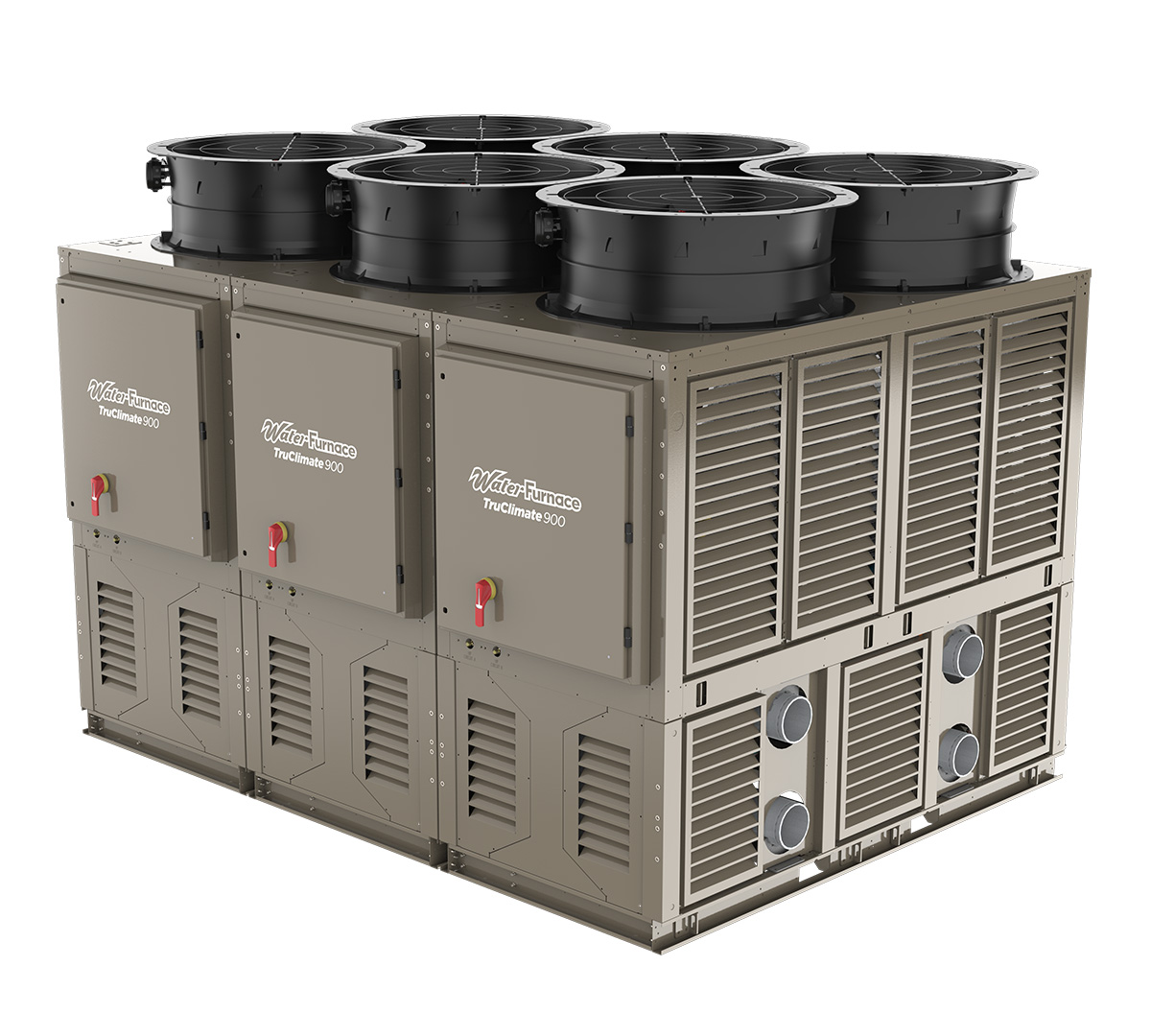
HOT WATER SOLUTION: A WaterFurnace TruClimate 900 heat pump chiller. When equipped with WaterFurnace’s OptiHeat technology, the TruClimate 900 can deliver water at a temperature as high as 140°F. (Courtesy of WaterFurnace)
“With geothermal leasing, homeowners can enjoy all the long-term benefits that geothermal provides with predictable monthly payments and no large upfront costs,” Litton said.
“This shift expands consumer access to the efficiency and durability of geothermal systems, reducing energy burden while supporting long-term, sustainable home energy solutions,” said Derksen.
Shared underground geothermal loops, Litton said, also have promise. In Framingham, Massachusetts, the New England energy company Eversource launched the country’s first networked geothermal loop for heating and cooling, which serves about three dozen buildings, both homes and commercial properties.
“Eversource’s project has piqued the interest of the utilities who are exploring their own programs, and we’re optimistic you’ll see more of this type of model in the future,” Litton said.
State and utility financial incentives are still important, though. Some state and utility geothermal rebate programs, Parsons said, are performance-based, and some of those rebates are paid in installments rather than with one-time, big-dollar checks.
“Programs that allow the payment to be structured as a line item on the utility bill, sized to be offset by energy and demand savings, have consistently performed better than ‘mail-in rebate’ approaches because they speak the language of cash flow,” he said.
Parsons urges the industry to employ several newer approaches to residential geothermal in order to boost the market.
“The most effective programs share a few common traits,” Parsons said. “They provide long‑term policy certainty, they integrate financing with the monthly energy bill, and they recognize geothermal as a grid and community asset rather than a luxury product for individual high-income homeowners.”
Commercial Picture
The commercial geothermal market, Parsons, Litton, and Derksen said, won’t have as many headwinds this year as the residential market.
“The ITC remains intact for commercial projects, and this sector was already moving in an upward trajectory,” said Derksen, referring to the investment tax credit, Section 48, for commercial clean energy projects.
Parsons said larger geothermal projects, such as for schools, mixed-use developments, and district systems, have “more tools to work with” when it comes to ownership models and cost control. Those tools, he said, include long-term power and service contracts, utility cost recovery, investors who view commercial systems as infrastructure, and an increasing focus on thermal energy networks as a path to decarbonization.
“Those projects are less dependent on any single federal incentive and more driven by fundamentals: lifecycle cost, carbon performance, resilience, and the ability to support building-electrification and grid-flexibility goals simultaneously,” he said.
New Technology, System Designs
Litton, at WaterFurnace, and Derksen, at Enertech, say their companies have products made for today’s geothermal market.
“With the growth of the multi-family market and through strategic relationships, we are pioneering new methods, procedures, and products that (are) ideally suited for this growing sector,” said Derksen.
At Enertech, hydronic delivery is seen as the “way of the future,” Derksen added, and the company has invested in producing variable-speed heat pumps for geothermal and air-to-water systems. The WV variable-speed water-to-water heat pump, available in capacities of between 0.5 ton and 5 tons, can be used at the center of a hydronic system.
At WaterFurnace, OptiHeat, a trademarked vapor-injection technology, in products like the TruClimate 900 heat pump chiller, provides water at temperatures of up to 140°F. The TruClimate 900 has a capacity of 30 tons, and up to 10 units can be banked together for a total capacity of 300 tons.
“We’re looking at leveraging OptiHeat in more products going forward,” Litton said. WaterFurnace also offers its Symphony cloud-based control platform, which, Litton said, brings “intelligence, visibility, and optimization to both homes and commercial buildings, making geothermal easier to manage and more powerful.”
Parsons said the most important geothermal technology right now is not in equipment, but in new ways of designing systems: Shared networks and borefields, energy storage, and heat-exchange piping that’s incorporated into foundations or building pilings in new construction, can “fundamentally change the economics and scalability of geothermal,” he said.
In addition, Parsons said, next-generation water-to-water and water-to-air heat pumps are being designed to not only exchange energy between buildings and the ground, but from one building to another.
“When coupled with intelligent controls and building automation, these systems can shift and shave electric peaks in a way that is very hard for air‑source equipment to match,” he said.
Looking for a reprint of this article?
From high-res PDFs to custom plaques, order your copy today!