Contractor Pro Ductless Series
Contractors VRF Priorities: Reliability and Support
October 13, 2025
Contractor Pro Ductless Series
Contractors VRF Priorities: Reliability and Support
October 13, 2025HISTORIC DESIGN: Hitachi VRF systems helped the Graduate Hotel meet strict energy codes while preserving its historic design. (Courtesy of Hitachi)


A study conducted by The ACHR NEWS and myCLEARopinion Insights Hub shows that contractors still recommend variable refrigerant flow (VRF) systems for the same core reasons they always have — reliability, quality, efficiency, and ease of maintenance. But the weight of those priorities is shifting.
When surveyed, 90% of respondents said reliability was the most important factor in VRF system selection, while 88% cited quality. By contrast, just 76% said operating efficiency was most important — a notable decline from 2022. Ease of maintenance and the ability to customize building needs followed closely behind at 73% each.
For contractors, the message is clear: Efficiency is assumed, but reliability and long-term support now drive decision-making.
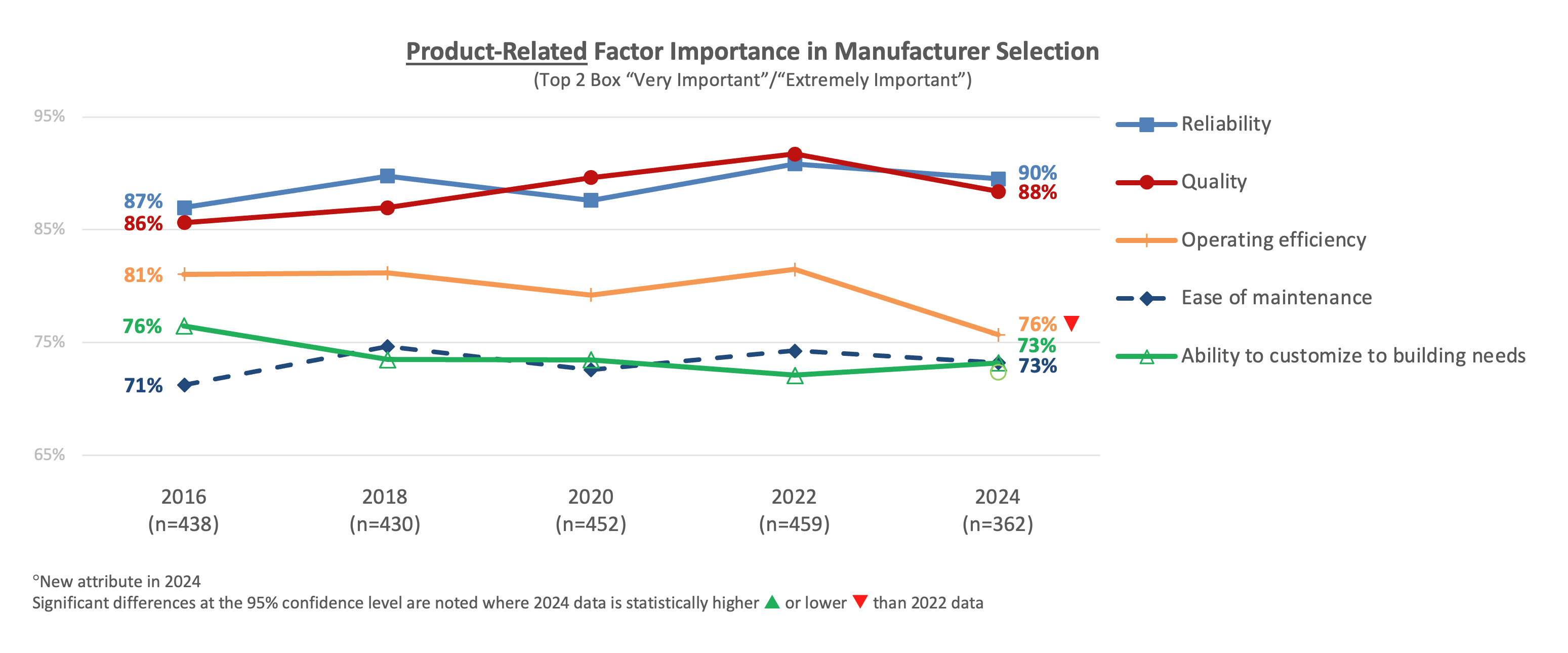
Click chart to enlarge
RELIABILITY: What VRF factors matter most to today’s contractors? Data shows it’s reliability, closely followed by quality. (Courtesy myCLEARopinion Insights Hub)
VRF sales manager
Lennox Commercial
Reliability & Quality: Non-Negotiables
The survey shows that reliability and quality are two non-negotiables in VRF. But, for manufacturers, that requires more than just strong components.
“Reliability and product quality are at the core of Trane/Mitsubishi Electric VRF solutions,” said Laura Michel, VRF product manager, Commercial HVAC Americas, Trane Technologies. “From our perspective, a truly high-quality, reliable VRF system starts with superior manufacturing but is ultimately validated through consistent performance in the field.”
Aaron Mason, VRF sales manager, Lennox Commercial, said the reliability and quality of a VRF system is built on three things: system design, component durability, and support infrastructure — but equally important is designing systems that perform consistently across diverse climates and applications.
“You must understand that reliability isn’t just about the equipment — it’s about the support that comes with it,” said Mason. “That’s why Lennox invests in training for contractors, building strong technical resources, and nationwide service coverage.”
Innovation also contributes to reliability. Hitachi, for example, was among the first to leverage both scroll and inverter compressor technology in VRF systems.
Looking for quick answers on air conditioning, heating and refrigeration topics? Try Ask ACHR NEWS, our new smart AI search tool. Ask ACHR NEWS
Looking for a reprint of this article?
From high-res PDFs to custom plaques, order your copy today!
“Because these compressors modulate speed based on real-time load demands, they’re able to deliver reliable and precise thermal comfort and excellent part-load efficiency — which translates to greater energy savings,” said Steven Southers, senior technical support and post-sales manager, Ductless Systems North America, Bosch Home Comfort Group.
Efficiency: The Baseline
While efficiency remains a core VRF quality, it no longer defines the category. Contractors now seemingly see it as a baseline feature rather than a differentiator.
“Contractors and building owners are weighing other factors more heavily today,” said Mason. Like cost, maintenance, and reliability. “This shift may reflect recent economic pressures, higher construction costs, and the fact that baseline efficiency levels in VRF are already strong.”
So, efficiency isn’t any less valuable — it’s just something contractors already assume they are getting with VRF.
“High efficiency is expected. … Our R-32 systems provide even greater energy savings and lower environmental impact,” said Michel. “We recognize that what truly matters to our customers is the entire experience; reliable system performance, ease of installation and maintenance, and responsive support throughout the product lifecycle.”
But the efficiency story still matters, especially since VRF systems have proven that they can cut energy and, ultimately, costs.
“In commercial buildings with varied heating and cooling needs, such as hotels, offices, and mixed-use properties, heat recovery VRF systems can provide as much as 30-45% energy savings compared to traditional ducted systems, which can translate into considerable reductions in operational expenditures,” said Southers.

PERSONAL COMFORT: The hotel was equipped with top-flow VRF systems with heat recovery. In turn, each guestroom’s temperature control could be individually operated while remaining energy efficient. (Courtesy of Hitachi)
Ease Of Maintenance And Customization
Beyond performance, contractors value how easily a system can be maintained and tailored to meet specific building needs. Simplifying installation and service often starts with the right training and tools.
“Our Ductless Technical Specialists provide dedicated, one-on-one local field support, ensuring contractors have expert guidance and troubleshooting assistance throughout the entire installation process,” said Michel.
Most VRF manufacturers now back their systems with a combination of hands-on training centers, online troubleshooting tools, and readily accessible technical resources. Contractors can tap into everything from installation and service manuals to engineering guides and submittals, helping them resolve issues quickly and maintain systems with confidence. Local technical support and field specialists further streamline commissioning and service, giving technicians the guidance they need on the job.
“Each VRF application is different, so there is not a one-size-fits-all approach that can be applied,” said Southers. “However, VRF systems are very flexible and can meet most building requirements and goals.”
Beyond troubleshooting tools and training, manufacturers are working to simplify commissioning and long-term upkeep — making reliability and ease of maintenance a design priority, not just an afterthought.
“When speaking to our contractors, they consistently tell us that ease of service makes or breaks their experience with a brand,” said Mason. “To address this, Lennox has worked to simplify system commissioning through intuitive controls and diagnostic tools. With our LVSS software, we’ve designed features that allow easier access to service points, streamlined piping and wiring configurations, and enhanced error code visibility.”
Tools like Hitachi’s airCloud Tap mobile app were designed to speed up commissioning.
“Using the app, HVAC professionals can connect to Hitachi VRF systems and read and configure settings using a step-by-step guide,” Southers said. “For systems with multiple units, settings can easily be copied and duplicated to save time. Data is digitally saved, and reports can be instantly generated directly from the app.”
Customization is also critical.
“Every building project is unique, whether it's a retrofit squeezed into an existing building, a mixed-use facility with diverse comfort and/or load needs, or a new state-of-the-art building with ambitious performance goals,” said Michel.
Ease of service is only part of the equation. Contractors also want systems that can flex to the unique demands of each project — from retrofits to large-scale new construction.
“Whether it’s the space constraints of a retrofit, the design complexity of a mixed-use property, or the scale of new construction,” Mason said. “We emphasize modularity in our system design, offering solutions that can be tailored to zoning, capacity, and installation requirements.”
Keeping adaptability in mind, Hitachi’s Heat Recovery VRF systems feature an integrated heating and cooling change-over box that connects the outdoor and indoor units — available as a single-port type or multi-port type ranging from four, eight, and 16 ports.
“A selection of single-and multi-port options makes it easier for contractors and technicians to tailor each project to the specifics of the building’s architecture and layout,” Southers said. “It can also result in fewer installation components and less impact on interior aesthetics.”

COMPACT DESIGN: Compact rooftop units freed up space for a rooftop bar, while discreet indoor cassettes provided comfort without impacting aesthetics. (Courtesy of David Mitchell)
One example is the nearly 100-year-old Graduate Hotel in Palo Alto. Hitachi VRF systems helped the property meet strict energy codes while preserving its historic design. Compact rooftop units freed up space for a rooftop bar, while discreet indoor cassettes provided comfort without impacting aesthetics. In total, 13 VRF systems were installed.
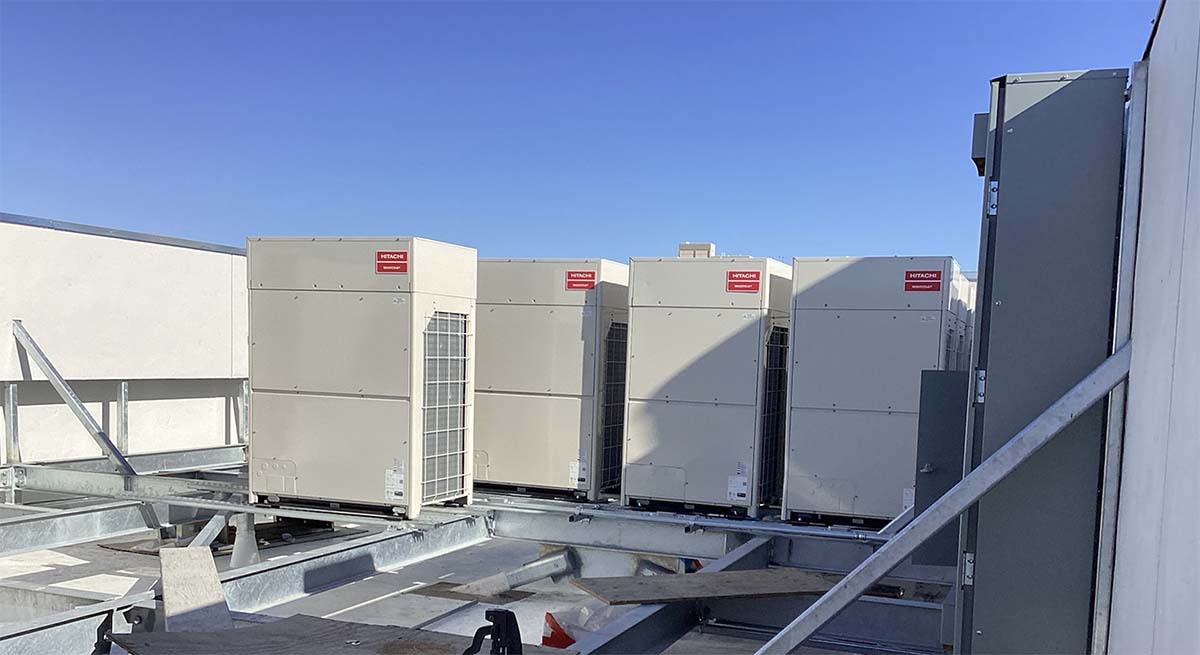
VRF HOTEL: In total, 13 VRF systems were installed in the Graduate Hotel with all outdoor equipment placed on the roof. (Courtesy of Hitachi)
senior technical support and post sales manager
Ductless Systems North America Bosch Home Comfort Group
Looking Ahead: What Contractors Want
While reliability, quality, efficiency, and ease of maintenance continue to guide VRF system selection today, contractors and manufacturers are looking ahead to emerging priorities.
Mason said sustainability is at the forefront of building owners, developers, and contractors — coupled with increasing interest in low-GWP refrigerants and solutions that reduce environmental impact.
“Integration with other technologies, such as BMS platforms, renewable energy, and IAQ solutions, will also become more prominent,” Mason said. “Over the next five years, the most successful VRF offerings will not only deliver on today’s needs for reliability and efficiency but will also provide future-ready solutions that align with changing codes, refrigerant transitions, and the growing demand for sustainability.”
And the industry is already preparing for that.
“As with all emerging technologies, there is a need to bolster contractor education and hands-on experience around VRF systems,” said Southers. “As the demand for VRF continues to grow, contractors who build their expertise have an excellent opportunity to not only meet the industry’s need for high-end, energy-efficient solutions, but also expand their businesses.”
Hybrid systems are one way manufacturers are responding. Michel pointed to Trane/Mitsubishi Electric’s Hybrid VRF, which combines refrigerant-based outdoor units with water-based indoor units. The design helps contractors meet new refrigerant and safety regulations while still delivering zoning, energy recovery, and flexibility — particularly valuable in sensitive environments like schools and healthcare facilities.
“This solution opens additional options for sensitive environments like schools and healthcare facilities, as well as for complex retrofits and challenging layouts,” Michel said. “System integration is also becoming more important, with owners looking for HVAC solutions that connect smoothly to their automation platforms.”
For contractors, the takeaway is clear: While efficiency will always be part of VRF’s value proposition, the future lies in reliability, support, and adaptability. Contractors who build expertise in these systems will not only meet growing demand, but also strengthen their long-term business.
Want deeper insights? The data in this article comes from the exclusive VRV/VRF/VRFZ CLEAReport, conducted by myCLEARopinion Insights Hub. This in-depth report identifies brand familiarity, evaluates manufacturer performance and industry leadership, explores key factors influencing specification decisions, and tracks trends shaping the ductless HVAC market.





.webp?height=200&t=1776094112&width=200 "hoffmann brothers")