Big Data Meets HVAC Marketing
New AI platform combines hundreds of data sources to help contractors target homes most likely to buy
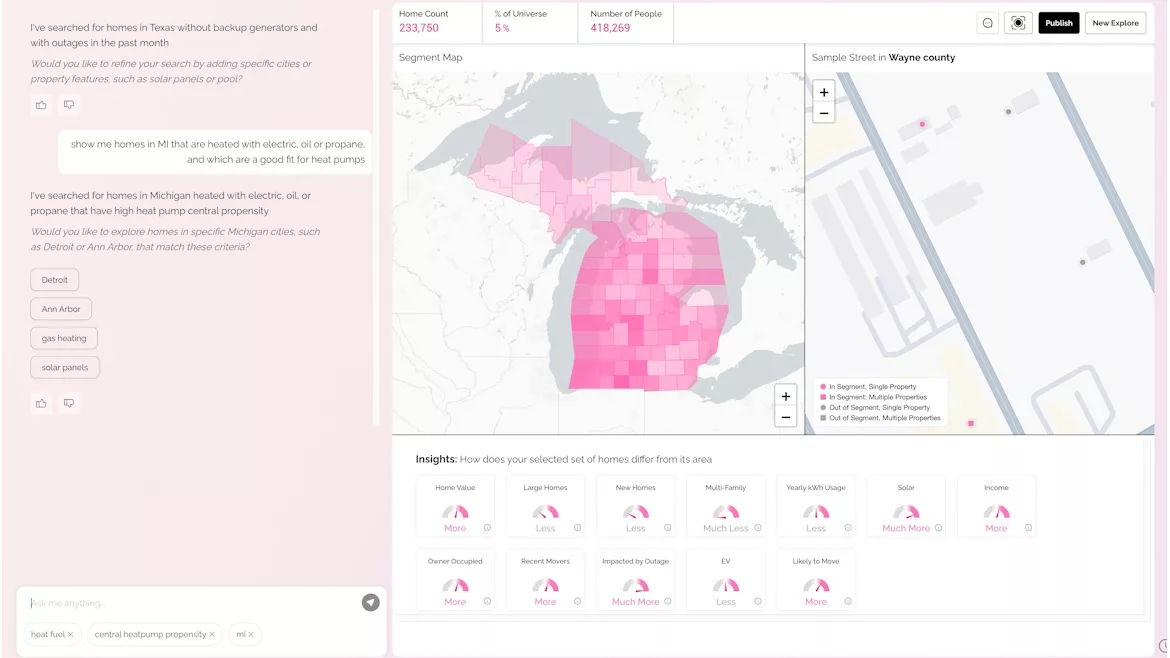
DATA DRIVEN: This screenshot from Pink shows homes in Michigan that could be a good fit for heat pumps. Zooming in further shows a street-by-street view.
Think about “big data” in HVAC, and what comes to mind? Touchscreen displays where refrigeration contractors can monitor hundreds of supermarket cases? Apps that scan decades of troubleshooting logs in less time than it takes to dial the service manager?
Pink, a new AI platform launched by data company 257 at Climate Week NYC, wants to apply HVAC data to a different contractor challenge: customer acquisition. Instead of relying on broad demographics, the system analyzes hundreds of public and private data sources to map which households are most likely to buy a heat pump, solar, home battery, or efficiency upgrade — based on the characteristics of the home itself.
Pink’s founders — Scott Rosenberg and Tal Chalozin — come from outside the HVAC world, having built data-driven platforms in media and streaming. Looking at HVAC, they saw an industry still relying on generic postcards and ad buys. Their pitch: If big data can personalize TV ads, why not use it to identify the homeowners most likely to need a heat pump?
They’ve staked a bold claim: “transforming” the U.S. residential energy market.
“Our mission is simple: to harness data and AI to help energy companies grow faster and accelerate residential electrification,” said Rosenberg.
The Need for Data
Marketing in HVAC has long lagged behind the sophistication of other industries, said Rosenberg. Contractors often spend heavily on ads that don’t reach the right homes.
“HVAC contractors and home services generally are not today equipped with particularly good data or marketing tools, and so they struggle to understand who they've served,” Rosenberg said. “When leads or opportunities come in, they're not necessarily sure how to prioritize them. And when it comes to brand-new customer acquisition, they're forced to use a very generic set of tools — going into Facebook and picking off-the-shelf criteria that are really about the person and the behavior and not the physicalities of the home, or direct mail to everybody in the neighborhood.”
Looking for quick answers on air conditioning, heating and refrigeration topics? Try Ask ACHR NEWS, our new smart AI search tool. Ask ACHR NEWS
In cases like this, the inefficiencies add up quickly. While data about U.S. homes is available publicly, it’s not in a format that’s easy for the average contractor to use. That’s where Pink comes in, delivering instant intelligence on all 130M U.S. homes through a chat-style interface and enabling smarter, lower-cost campaigns.
“That's the transformative moment,” said Rosenberg. “We think that data and AI can play in the HVAC market.”
The power of software, said Chalozin, lies in its ability to layer new insights on top of the contractor’s institutional knowledge.
“As you add more and more attributes, it starts to make an impact,” he said. “The same home with an 85-year-old couple and the same home with a 30- or 40-year-old couple with three kids will behave very differently.”
The Data Sources
Pink’s system draws from a vast web of public, private, and proprietary data.
“A critical component of any AI-based system is a large, proprietary data set, and the energy market is no different,” said Chalozin. “By training AI models on many millions of real-world electrification outcomes in American homes, 257 can rapidly grow our clients' businesses and accelerate residential electrification.”
“It's a lot about the property, the house itself,” Rosenberg explained. Then there’s demographic data about the people living in the house, weather data, utility information, real estate records, tax filings, the client’s own data, and private data sets that Pink licenses.
“It's ultimately a mix of public data, private data, and then generated AI-created data that we are able to produce hundreds of data points per home,” he said. “We use that to then model or understand the energy consumption of all homes.”
Chalozin gave an example of how the system synthesizes information.
“Show me homes in California that do not have a battery or generator,” he typed into Pink’s chat-style interface.
“This is coming from a real-time pull that we're doing from 1,700 utilities that fetch real-time data about every transformer and substation that we know is down,” he explained. “That allows us to walk back from the homes in that territory that most likely are out of power, and we do that every 10 minutes for every home in the country.”
This blending of multiple sources makes it possible to create marketing lists that go far beyond generic demographics.
“Let’s say you operate in Massachusetts,” Rosenberg said. “You can start by saying, ‘Show me homes with oil or propane or electric heat.’ These are homes that would be expensive to heat because they're truck fuels or resistance electric, but who don’t have a heat pump. Right here, out of the gate, we found 1.2 million homes and 2.2 million people — named people, email, phone, contact info — where those criteria applied.”
From there, contractors can filter further.
“Odds are, as a contractor, you don't service all of Massachusetts. You might filter this down. You might focus on, say, Boston. Now we're going to arrive at a much smaller audience — 31,000 homes, 35,000 people — and something that might be practical if that contractor is spending advertising dollars or sending emails for them to formulate a marketing campaign off of.”
Pink doesn’t replace existing marketing tools, Rosenberg stressed, but plugs into them, swapping a new target audience for whatever channel a client is already using. Pink keeps the data private and sends out the ad itself to audiences across Meta, Google, connected TV, and direct mail.
The analytics are free, and advertising is a performance-based model, so there is no upfront cost.
“You can advertise to them, and we will charge you only if we brought you a customer that you did not have before,” Rosenberg said.
Electrification Efficiency
While the idea of filtering thousands of homes to find the most promising prospects might sound attractive to any contractor, Rosenberg said that Pink is best suited for businesses already investing in marketing.
“We are primarily focused on organizations that have enough scale that they're thinking about marketing and operational efficiency,” he said. “For sure, manufacturers who run national and regional marketing programs, often in a cooperative fashion with preferred contractors. Distributors also often invest in marketing, again as an incentive to have their contractors buy from them versus another distributor. And then larger contracting groups, some of the private equity roll-ups, some of the larger regional players, entities that are spending real money … and they're really looking to drive efficiencies.”
The goal: bringing customer acquisition costs down.
“They want to get their customer acquisition cost from $2,000 or $3,000 to sell a heat pump down to $1,000 or $1,500,” Rosenberg said.
Among Pink’s early successes are a heat pump manufacturer that identified hundreds of megawatts of winter peak savings potential in the Southeast from retrofitting homes to cold-climate heat pumps, and a community solar provider that increased sales by 26% while delivering a customer acquisition cost below $250.
Looking for a reprint of this article?
From high-res PDFs to custom plaques, order your copy today!