FROSTlines
Turning A2L Challenges Into VRF Opportunities
Europe shows how smart zoning and charge-aware design can become strong selling points
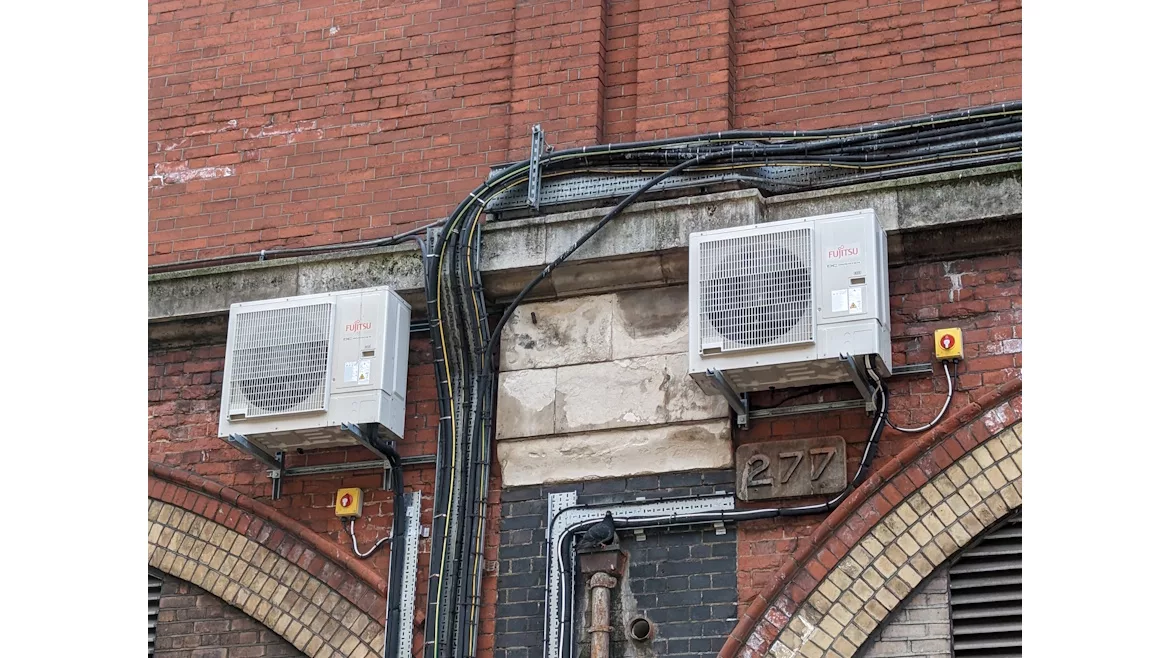
LONDON CALLING: European HVAC contractors are used to handling systems that contain A2L refrigerants such as R-32.
When it comes to the global transition from A1to A2L refrigerants, two clocks are ticking -- but they’re not running at the same speed.
The European Union (EU) began this transition in 2006 with its first F-Gas regulation, and a 2014 revision put HFC makers on a steep quota diet. Now, bulk supply has already dropped 55% below the baseline, and full sunset is mandated by 2050. On the adoption side, mildly flammable A2L refrigerants were incorporated in 2017. More than 80% of new European residential a/c now use A2L, and installers routinely handle these materials.
The U.S. is operating on a far more compressed timetable. The 85% phase-down only began in 2022, and yet high-GWP HFCs were banned in new comfort cooling equipment starting in 2025. Field familiarity with A2L refrigerants is still low, as the U.S. tries to accomplish in three years what the EU did in over a decade. To succeed, American HVAC professionals should take to heart Europe’s lessons learned with respect to A2L safety and charge management.
VRFs and A2Ls
ASHRAE 15 and the Environmental Protection Agency’s (EPA) Significant New Alternatives Policy (SNAP) refrigerant transition requirements are an immovable object, but VRF adoption is an unstoppable force gathering momentum to meet it. Sleek, quiet, and efficient VRF units are increasingly popular for both residential and light commercial applications. Despite their superb part-load efficiency, however, they move a lot of refrigerant through occupied spaces, creating compliance hurdles under
ASHRAE 15
Installers must navigate low charge limits for these mildly flammable substances. For example, the room-volume limit for R-32 is 4.8 lbs. per 1,000 ft3, but many existing VRF layouts exceed that threshold. In addition, the transition to materials classified as mildly flammable means isolation valves and electrical ratings must now be baked into VRF system designs.
This reality may already be influencing purchasing patterns. A 2024 market survey from The Air Conditioning NEWS shows VRF was included in 39% of current projects -- down from 2022. Still, respondents expect adoption to rebound and rise to 52% by 2029. This mirrors adoption patterns we observed in Europe around 2018: VRF implementation slowed slightly as HVAC pros navigated the refrigerant transition, then took off again as they adopted new training, tools, and design strategies.
One of the clearest lessons from Europe is that ducted zoning (with larger indoor units serving multiple spaces with motorized dampers) slashes both total charge and worst-case leak concentration. For example, a recent dental clinic retrofit in Spain compared a traditional eight-cassette VRF layout with a two-zone ducted design. The clinic had eight rooms with a total volume of 10,134.72 ft3, and the original, conventional VRF design included eight zones and eight individual ceiling cassette units (one per zone):
|
Zone |
Volume (ft3) |
Indoor Unit |
|
Reception |
3,953.20 |
15K Btuh cassette |
|
Dental Operatory 1 |
1,157.55 |
7.5K Btuh cassette |
|
Dental Operatory 2 |
1,144.20 |
7.5K Btuh cassette |
|
Dental Operatory 3 |
1,125.13 |
7.5K Btuh cassette |
|
Dental Operatory 4 |
1,223.34 |
9K Btuh cassette |
|
Sterilization Room |
390.93 |
7.5K Btuh cassette |
|
X-ray Room |
384.26 |
7.5K Btuh cassette |
|
Admin |
756.12 |
9K Btuh cassette |
Effective dispersal volume charge (EDVC) is calculated per zone. Under ASHRAE 15, the EDVC for a system with 16 lbs. of R-32 refrigerant charge is 3,337.5 ft3. Every zone in this dental clinic, except the reception area, was too small to comply. In the smallest zone, the X-ray room, the refrigerant concentration in the case of total leakage would be 0.0417 lbs./ft3, well in excess of the 0.0048 lbs./ft3 maximum required by ASHRAE 15.
Looking for quick answers on air conditioning, heating and refrigeration topics? Try Ask ACHR NEWS, our new smart AI search tool. Ask ACHR NEWS
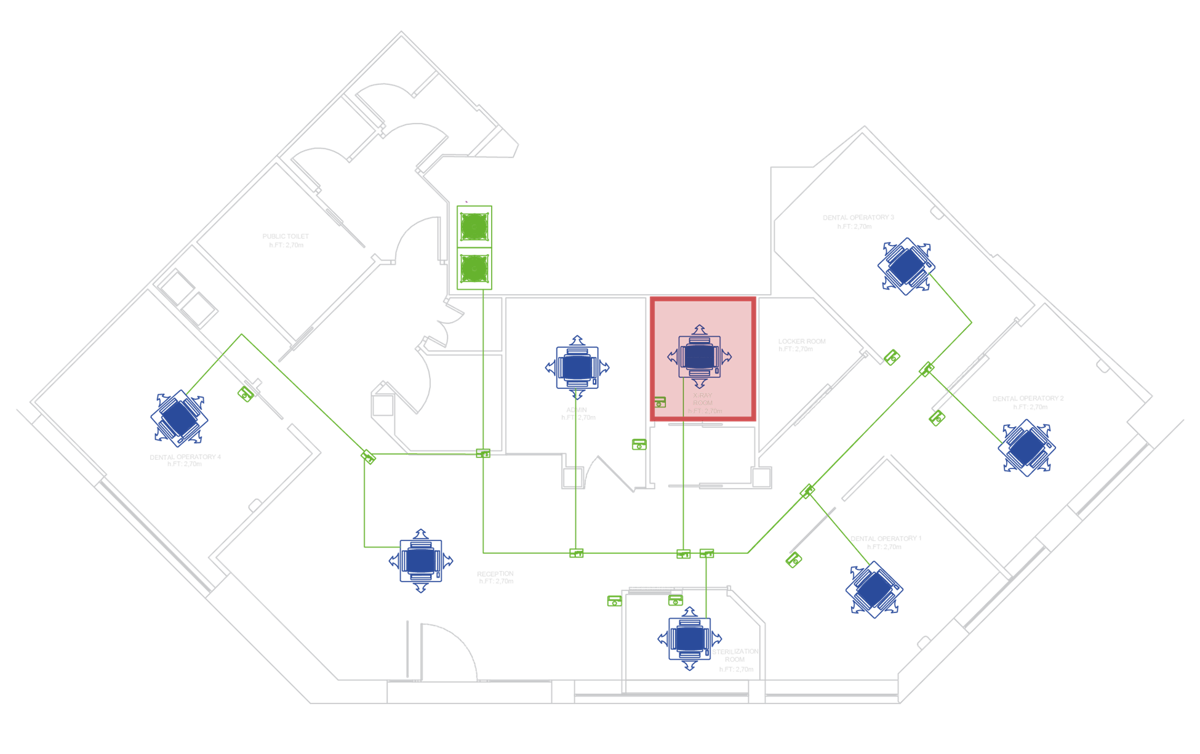
SMALL ZONE: Original system design with the smallest occupied zone, the X-ray room, highlighted in red. (Courtesy of Airzone)
An alternative ducted zoning solution for the dental clinic used two ducted VRF units with a combined capacity of 60,000 Btuh. Two zoning plenum kits with five dampers each added intra-zone independent temperature control. This more efficient design required only 10.29 lbs. of R-32 refrigerant charge and 110.52 feet of piping:
|
Zone |
Volume (ft3) |
Indoor Unit |
|
Zone 1: Reception, Admin, Dental Operatory 4 |
5,932.66 |
30K Btuh |
|
Zone 2: Dental Operatory 1, Dental Operatory 2, Dental Operatory 3[EG1] , Sterilization Room, X-ray Room |
4,202.07 |
30K Btuh |
With only 10.29 lbs. of R-32 refrigerant charge, the EDVC for the ducted zoning design is 2,143,75ft3 -- and in these new, larger zones, there is ample space for dispersal in the event of a leak. Even in the smaller zone, Zone 2, the refrigerant concentration in case of total leakage is only 0.002 lbs./ft3 -- less than half of the allowable maximum under ASHRAE 15. Because each zone also includes five dampers for individual temperature control by room, no comfort was sacrificed in pursuit of compliance.
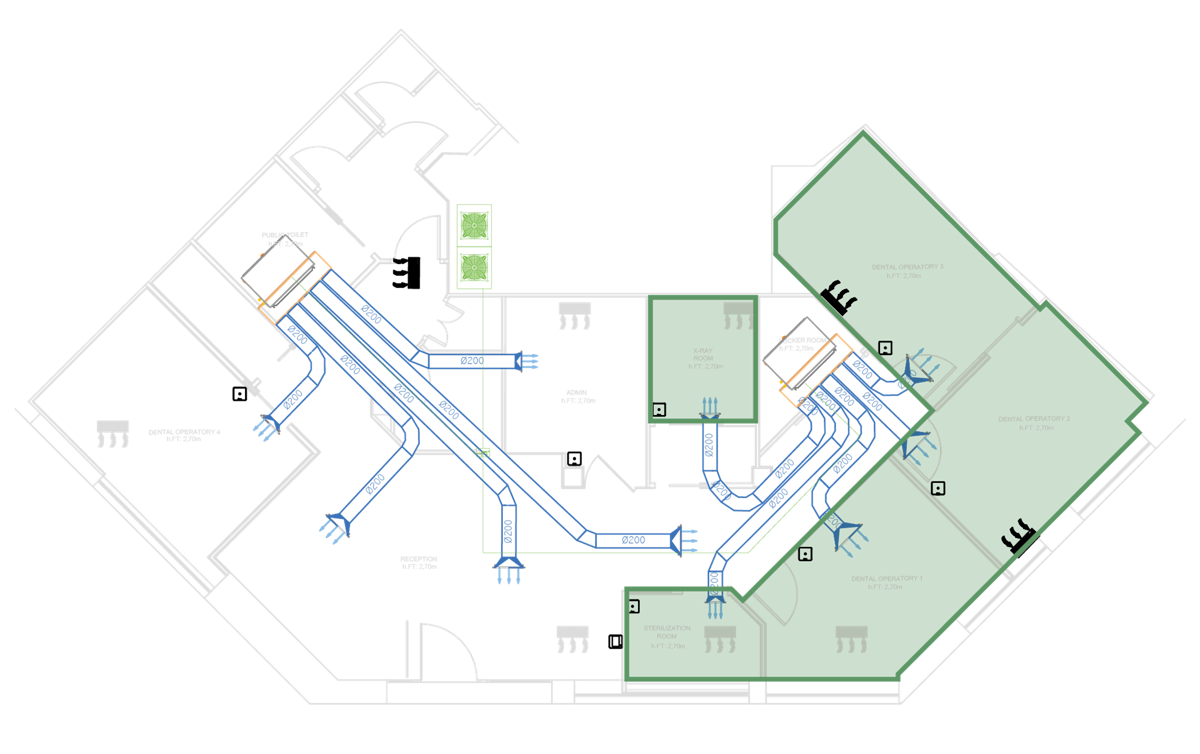
NEW DESIGN: Ducted zoning system design with the smallest occupied zone, Zone 2, highlighted in green. (Courtesy of Airzone)
A2L Transition Playbook
The transition to A2L refrigerants needn’t cool off the hot VRF market in North America. The following common-sense practices will enable HVAC professionals to continue specifying state-of-the-art inverter units while achieving full ASHRAE 15 compliance:
- Leverage ducted zoning to mitigate charge limits in small rooms. Run ASHRAE 15 calculations early in the design process and consider grouping small interiors under a shared ducted solution instead of deploying individual units per room. Ducted zoning lets adjacent plenum volume count toward the dispersal volume, pounds of refrigerant per cubic foot.
- Foreground installation. In terms of safety, the EU essentially treats A2Ls like natural gas. There’s wisdom in this caution: specify pre-engineered detector/valve packages to mitigate potential leaks, and update the onsite procedure for evacuation, vacuum, and brazing.
- Take the long view. In Europe, transparent cost-of-ownership models eventually overcame the initial price spikes that contributed to slower VRF sales around 2018. U.S. HVAC professionals should highlight the energy and capacity savings from zoned VRF systems, demonstrating how these improvements offset premiums relating to A2L-rated components.
As European contractors mastered these strategies, they saw resumed VRF growth that ultimately surpassed the pre-transition level. The United States is headed down the same path, and HVAC service providers who treat A2L compliance as an optimization opportunity rather than a burden will be poised to ride the coming wave of demand.
The A2L timelines may differ on each side of the Atlantic, but the physics are the same. Europe’s experience shows that smart zoning and charge-aware design transform A2L hurdles into VRF selling points. The U.S. market doesn’t have time to reinvent the wheel, but it can roll it faster.
Looking for a reprint of this article?
From high-res PDFs to custom plaques, order your copy today!