Contractor Pro Ductless Series
Heat Recovery VRF Systems Remain A Popular Choice
September 22, 2025
Contractor Pro Ductless Series
Heat Recovery VRF Systems Remain A Popular Choice
September 22, 2025TOO COOL FOR SCHOOL: A Fujitsu AIRSTAGE V-series VRF system utilizing heat recovery is shown being installed at a school in Colorado. (Courtesy of Fujitsu AIRSTAGE)


In the VRF market, heat recovery has established itself as an essential feature for many different types of commercial buildings. According to a recent survey conducted by myCLEARopinion Insights Hub, an average of 41% of VRF projects in 2024 incorporated heat recovery, and 44% of respondents reported using it in at least half their projects. For contractors, this reflects its growing role as a proven solution that can deliver significant energy savings and improved occupant comfort when applied correctly.
Heat Recovery
Consistent with previous years, an average of 41% of VRV, VRF, VRFZ projects utilize heat recovery in 2024. 44% of professionals indicate half or more of their VRV, VRF, VRFZ projects utilize heat recovery.

Click chart to enlarge
(Courtesy of myClearOpinion Insights Hub)
Comfort without Compromise
At its heart, heat recovery technology in VRF systems uses waste heat to simultaneously heat and cool different zones within a building, optimizing energy use while enhancing indoor comfort. In this way, the system allows the occupants in each zone to control temperature and mode to meet individual needs rather than have one set point for the whole building, explained Steven Southers, senior technical support and post-sales manager of ductless systems North America at Hitachi Air Conditioning.
“For instance, one tenant may have areas that require cooling year-round, while another tenant may need heating throughout its suite in the winter,” said Southers. “A VRF system with heat recovery technology can simultaneously meet these various occupant needs, which can improve tenant satisfaction while reducing energy costs. By transferring waste heat between occupied spaces, heat recovery VRF systems make it possible for businesses with varied heating and cooling needs, such as hotels, office buildings, and mixed-use properties, to see up to 30% energy savings.”
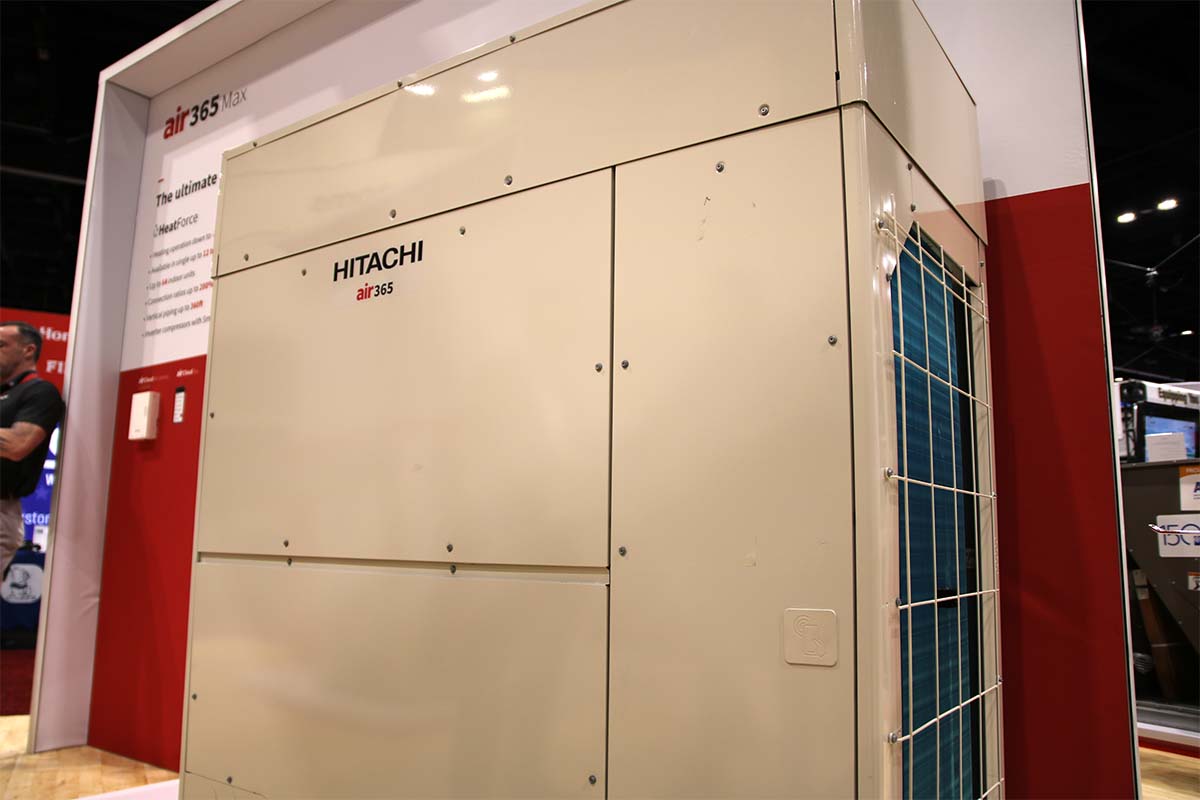
COLD-CLIMATE VRF: The Hitachi air365 Max is a cold-climate VRF system that offers universal heat pump or heat recovery operation. (Staff photo)
A key advantage of a heat recovery VRF system is its ability to provide heating and cooling at the same time from a single outdoor unit, making it indispensable for certain applications, said Steve Opromolla, Mid-Atlantic sales engineer at Fujitsu General America.
“First being whenever there is a mode flexibility requirement amongst individual zones and their occupants (e.g., hotel, apartment, nursing home). The second is when the magnitude of a building’s simultaneous heating and cooling needs are such that the energy savings more than pays for the upgrade by offering desirable ROIs. This is almost always the case in commercial buildings with zones on multiple exposures or diverse floor plans with both perimeter and interior spaces.”
The heat recovery process works by capturing waste heat from areas being cooled and redirecting it to spaces requiring heating, eliminating the need for separate units, said Paul Turner, senior manager of product support engineering at LG Air Conditioning Technologies. This results in numerous benefits for both facility owners and occupants.
“For facility owners and managers, these units deliver energy savings by efficiently redistributing heat instead of generating it anew. Over time, this translates into lower utility bills and a faster return on investment,” said Turner. “For occupants, the ability to maintain precise temperature control across multiple zones ensures maximum comfort. Whether it’s an office worker in a conference room or a hotel guest in their suite, everyone can enjoy their ideal environment.”
Unique Flexibility
While all heat recovery technology operates on the same principle — capturing and redistributing waste heat — the details differ. For example, Fujitsu’s Refrigerant Branch Units (RBUs), which control whether an indoor unit delivers heated or cooled air, offer unique flexibility in system design, said Opromolla.
Looking for quick answers on air conditioning, heating and refrigeration topics? Try Ask ACHR NEWS, our new smart AI search tool. Ask ACHR NEWS
Looking for a reprint of this article?
From high-res PDFs to custom plaques, order your copy today!
Also unique is Fujitsu’s universal outdoor unit, which can function as either a heat pump or heat recovery system.
“This can be extremely helpful in shell-and-core type projects, where the occupant’s operations — and subsequent thermal profile — may not be known before the building is built,” said Opromolla. “Likewise, if building use changes down the road, a previously configured heat pump can become heat recovery by adding some refrigerant piping and our RBUs, but without replacing the outdoor unit.”

THREE PIPES: Observers can tell this is a heat recovery VRF system, as it has three pipes connected to the condenser, as opposed to two for heat pump systems. (Courtesy of Fujitsu AIRSTAGE)
LG’s advanced heat recovery technology manages the refrigerant flow between indoor units: When one zone calls for cooling, the unit captures the heat extracted from that space and sends it to another zone that needs heating. This process eliminates wasted energy and allows for simultaneous heating and cooling, making it highly efficient for buildings with varying temperature requirements, said Turner.
“What sets LG apart is its commitment to innovation and user-centric design,” he added. “Its solutions feature inverter-driven compressors that adjust output based on demand, ensuring consistent performance and optimized energy use. Additionally, LG offers modular configurations that adapt to various building layouts, and the intuitive smart controls integrate seamlessly with building management units. These features combine to create a solution that is efficient, flexible, and easy to operate.”
Hitachi heat recovery VRF systems are made up of one, two, or three outdoor units that can connect to up to 64 indoor units and/or zones. The heat recovery technology transfers waste heat from a zone being cooled to a zone that needs heating by way of a three-pipe system that includes a suction gas pipe, discharge gas pipe, and liquid pipe. These three pipes allow the system to send refrigerant to units that need cooling and carry waste heat to the rest of the system, said Southers.
“For greater design flexibility, Hitachi heat recovery VRF systems feature a compact, integrated Change Over Box (CH-Box), which connects the outdoor and indoor units and is available as a single- or multi-port type that ranges from four, eight, and 16 ports,” said Southers.
Design Considerations
As with most HVAC equipment, the performance of a heat recovery VRF system depends on proper design and installation. That is why Turner advises contractors to focus on proper zoning and load calculations to ensure the unit meets the building’s specific needs.
“Accurate refrigerant piping design is also critical to maintaining efficiency and avoiding operational issues,” said Turner. “Additionally, contractors should consider how the unit integrates with ventilation components to ensure balanced airflow throughout the building. Common mistakes include improper refrigerant charging, neglecting manufacturer guidelines, and failing to account for the building’s unique thermal dynamics.”
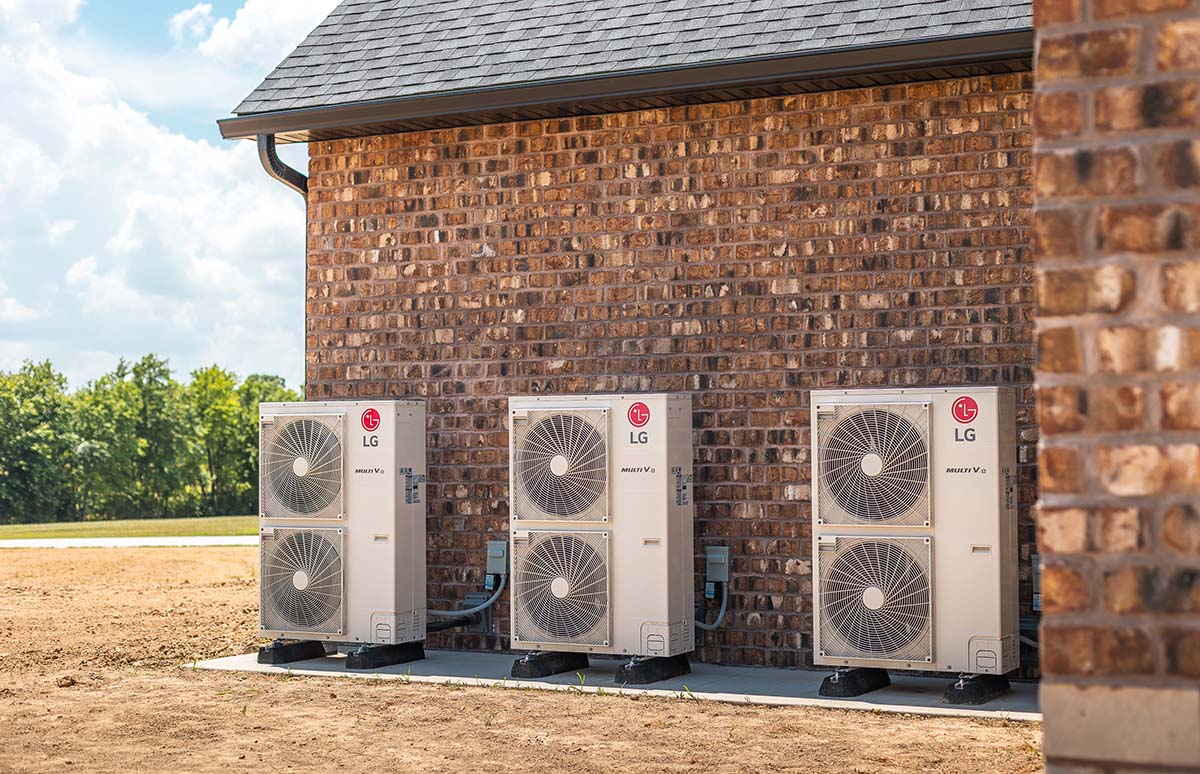
ADVANCED TECHNOLOGY: LG’s advanced heat recovery technology manages the refrigerant flow between indoor units to allow simultaneous heating and cooling. (Courtesy of LG)
Southers stressed that every VRF application is unique, so there’s no one-size-fits-all approach. That said, he noted that VRF systems are very flexible and can meet most application requirements and goals, which gives contractors a significant advantage.
“A selection of single- and multi-port options makes it easier for contractors and technicians to tailor each project to the specifics of the building’s architecture and layout. It also results in fewer installation components and less impact on interior aesthetics,” said Southers. “To speed up commissioning and test runs during installation and service, our VRF systems can connect to the Hitachi airCloud Tap app. The app allows professionals to read and configure settings on their phone using a step-by-step guide.”
Opromolla noted that while heat recovery VRF systems do cost a bit more to purchase and install, cost-driven decisions can backfire.
“One of the biggest mistakes I’ve seen is forgoing the heat pump to heat recovery upgrade in the name of first cost — especially for environments that absolutely require simultaneous heating and cooling for occupant comfort.”
That’s because the core benefit of heat recovery VRF — simultaneous heating and cooling — often justifies the added investment. As Opromolla explained, “The ability to independently operate individual indoor units in either heating or cooling whenever desired typically paints the value proposition on its own. But if that’s not enough on its own, even a very short period of simultaneous operation can make it a no-brainer from an operating cost ROI perspective.”
Want deeper insights? The data in this article comes from the exclusive VRV/VRF/VRFZ CLEAReport, conducted by myCLEARopinion Insights Hub. This in-depth report identifies brand familiarity, evaluates manufacturer performance and industry leadership, explores key factors influencing specification decisions, and tracks trends shaping the ductless HVAC market.




.webp?height=300&t=1783699250&width=300 "LA Heating_Craning moving new hvac condensing unit onto roof (2).jpg")