Heat Pumps Gain Ground in Multifamily Housing Market
Only 25% of heat pump installs are in multifamily — but incentives and new technology are closing the gap.
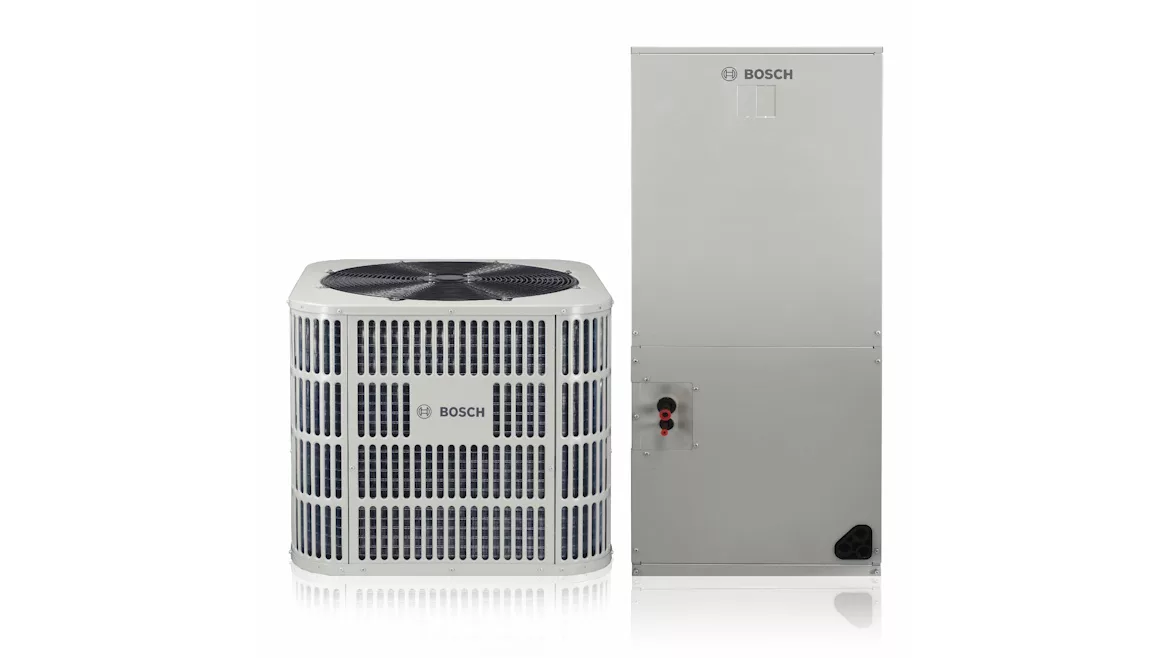
INSTALLATION VERSATILITY: The Bosch IDS Light heat pump, along with a Bosch air-handling unit (AHU). The outdoor unit can also be paired with either a ceiling-mounted AHU or a wall-mounted AHU.
As environmental and decarbonization goals, financial incentives, and improved technology make heat pumps more attractive for home heating and cooling, there is still plenty of room for growth — especially in the multifamily housing sector.
As of 2020, about 14% of U.S. homes — approximately 17.2 million households — used a heat pump as the primary source of heating, according to Atlas Buildings Hub, which collects data on building electrification and decarbonization. Of those homes, 61% were traditional detached, single-family dwellings, while only 25% were in multifamily buildings, according to Atlas Buildings Hub. (Mobile homes and single-family detached homes, such as townhouses, made up the rest.)
Heat pumps for multifamily housing are catching on, though. Manufacturers are building models designed specifically for multifamily buildings, California has programs to incentivize the application, and New York City is in the midst of having 30,000 air-source heat pumps installed in public housing through New York state’s Clean Heat for All Challenge.
Here’s a look at some of the heat pumps manufacturers are offering for use in multifamily buildings.
Bosch IDS Light
The Bosch IDS Light is an air-source heat pump for ducted split systems, available in capacities of 2, 3, and 5 tons. Modulating inverter technology is capable of adjusting the compressor speed, in 1% increments, between 33% and 110%. The IDS Light has a SEER2 rating of up to 15.2 and an HSPF2 rating of up to 8.5.
The IDS Light can be paired with Bosch’s BVA15 air-handling unit (AHU), the wall-mounted BWA16 AHU, or the ceiling-mounted BCA16 AHU, said Syed Shahzer, engineering applications and training manager, Bosch Home Comfort Group. Each outdoor unit serves one indoor AHU, typically for one apartment or zone, Shahzer said.
“The Bosch IDS Light offers a cost-effective way to enjoy the benefits of inverter technology,” Shahzer said. The modular system integrates into standard ducted systems for easy retrofits, and offers flexible installation options and quiet operation, he said.
Looking for quick answers on air conditioning, heating and refrigeration topics? Try Ask ACHR NEWS, our new smart AI search tool. Ask ACHR NEWS
“Bosch IDS compact air handlers are designed for multifamily construction and limited space applications, enhancing comfort and keeping both installation and operating costs manageable,” said Shahzer.
Hitachi airHome Multi
The new Hitachi airHome Multi heat pump uses a single outdoor inverter compressor to heat or cool multiple rooms through either a ductless or a ducted system, or a combination of both.
The airHome Multi is a cold-climate heat pump with a SEER2 rating of up to 23 and an HSPF2 rating of up to 10. It’s available in capacities ranging from 1.5 to 3.5 tons.
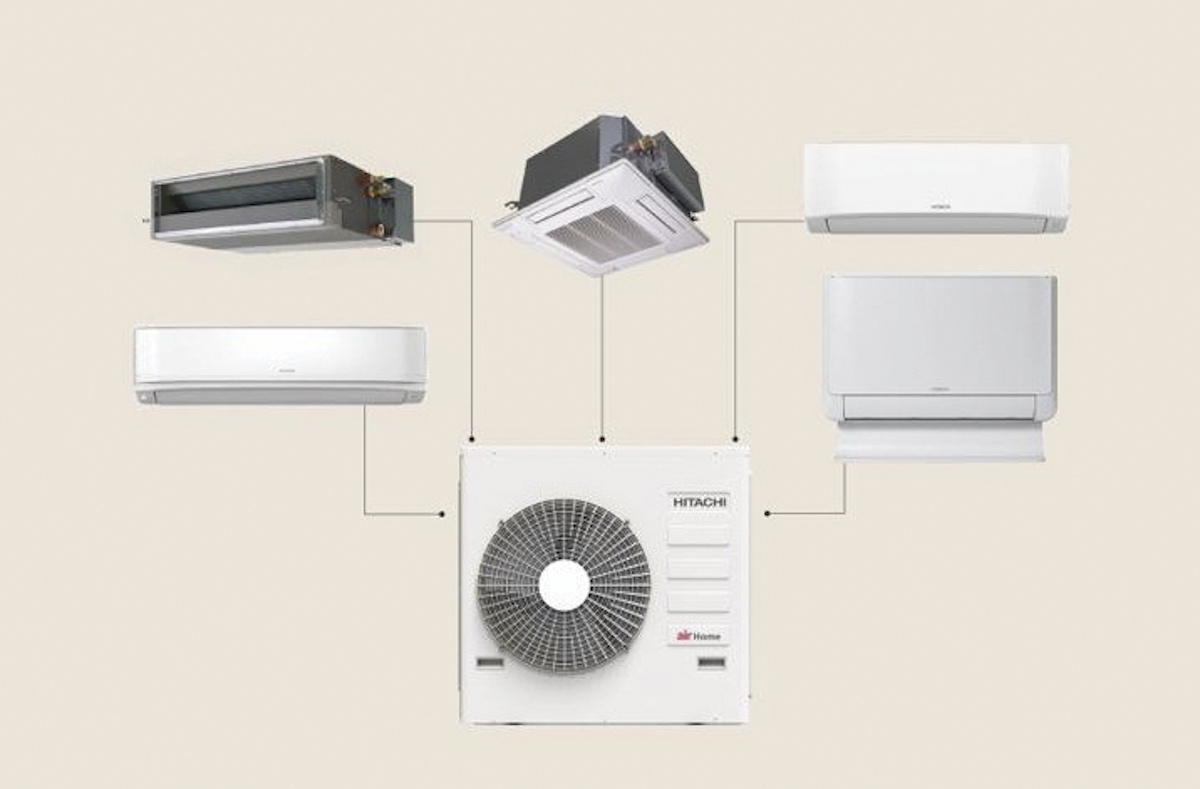
FLEXIBILITY: A Hitachi airHome Multi outdoor unit (bottom) can be used in either a ducted or a ductless system. Shown above are the various indoor units it can be paired with. (Courtesy of Bosch Home Comfort Group)
“The airHome Multi was designed to take multifamily comfort to a new standard by creating a flexible solution that delivers an occupant-centric experience while meeting environmental standards for decarbonization,” said Samuel Vivar, residential product portfolio manager for Bosch Home Comfort Group. (Bosch recently acquired the Hitachi HVAC brand.)
The outdoor unit, Vivar said, can service between two and five indoor units. “Indoor units can be mixed, allowing contractors or property teams to pull from wall-, floor-, (or) ceiling-mounted cassette, or horizontal ducted equipment, based on the performance, user features, and aesthetic requirements of each room,” he said.
Each indoor unit can be independently operated and has its own controls, Vivar said. Indoor units are also enabled for smart home systems with the use of the Hitachi airCloud Go app.
Indoor units are equipped with Hitachi’s FrostWash technology, which traps dust, mold, and other particles by freezing them, then rinsing them away. “This helps to maintain efficient airflow and enhance heat transfer while also supporting healthy IAQ,” Vivar said.
The airHome Multi outdoor unit has a rust-resistant casing, anti-corrosion fins, and a fireproof electrical enclosure, Vivar said.
RTUS For Multifamily
Greenheck Fan Corp. makes heat pump-equipped rooftop units (RTUs) that can be applied to ducted systems in multifamily buildings.
The new Greenheck Model RT is available in capacities of between 10 and 30 tons; smaller-capacity units are planned for late this year and early next year.
The Model RT’s air-source heat pump uses an inverter compressor and can perform in cold weather; there is an option for an indirect gas furnace. The model has an integrated energy efficiency ratio (IEER) of up to 23.1 and a coefficient of performance (COP) of up to 3.8, according to Allison Snoxell, Greenheck’s conditioning and ventilating products marketing manager.
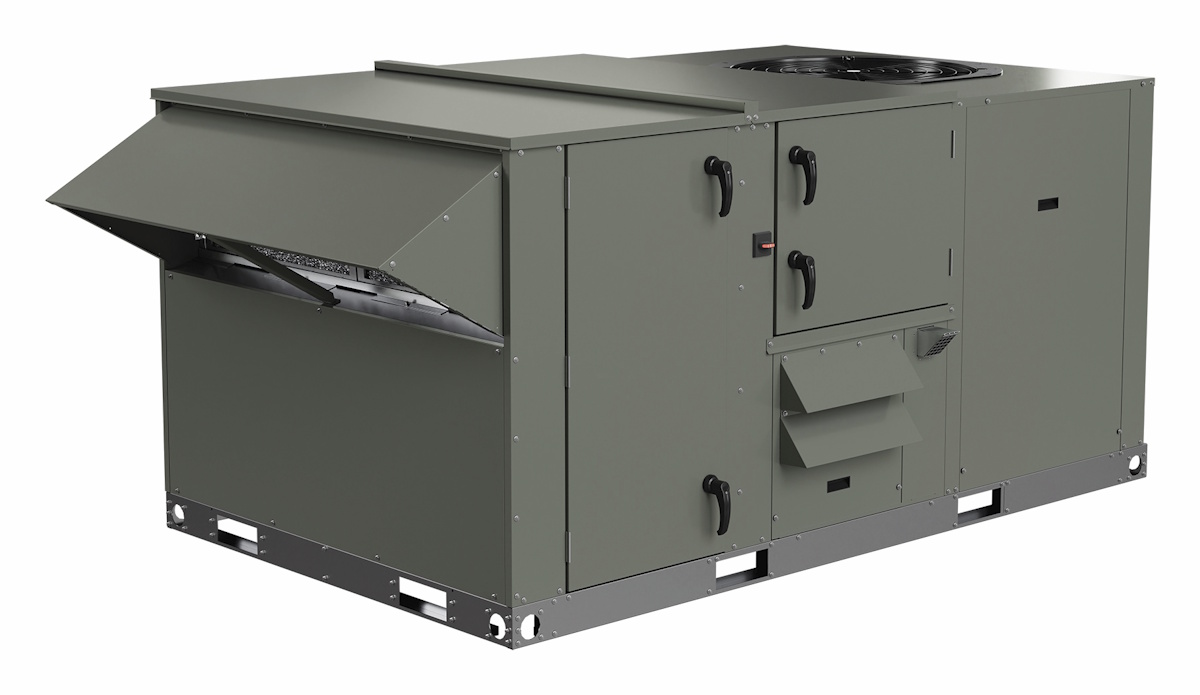
UP ON THE ROOF: A Greenheck Model RT, available in capacities of between 10 and 30 tons, has an air-source heat pump with an inverter compressor and can provide heating and cooling for several units in a multifamily building. (Courtesy of Greenheck Fan Corp.)
“The Model RT was designed with comfort in mind,” Snoxell said. “It is capable of delivering higher percentages of outside air than a typical rooftop unit by using standard modulating components such as variable-speed compressors and modulating hot gas reheat to precisely dehumidify and condition the supply air for ultimate occupant comfort. It’s a great fit for multifamily applications.”
The Model RT, which can deliver up to 13,000 cfm, can be tied to multiple housing units, Snoxell said. Supply fan and damper controls can integrate it with a variable-air-volume (VAV) system “to provide both ventilation and individualized space comfort needs,” she said. Variable refrigerant flow (VRF) technology can be used with the Model RT to adjust varying comfort needs across several housing units.
“Model RT includes factory-installed and pre-programmed controls that are engineered specifically for rooftop applications and configured exactly how the unit is needed to operate in the field. This makes it simple to install, operate, and service,” Snoxell said.
The Model RT’s factory-programmed controls, Snoxell said, have commissioning sequences that guide technicians through the startup process.
The Greenheck Model RV dedicated outdoor air system (DOAS), also for ducted systems, is available in capacities of 5 to 30 tons, with smaller-capacity units (between 3 tons and 7 tons) planned for December.
Also outfitted with a cold-climate, air-source heat pump, the Model RV has an IEER rating of up to 23.7 and a COP of up to 3.46.
“This product can be tied to multiple multi-family units,” Snoxell said. “Model RV can deliver up to 12,500 cfm (with a heat pump) or 29,000 cfm with other cooling and heating options.”
VRF technology, as well as energy-recovery equipment, can be used with the Model RV, she added. “Model RV includes factory-installed and pre-programmed controls designed specifically for DOAS applications, making it simple to install, operate, and service,” Snoxell said. “The unit easily connects to most building management systems via BACnet or Modbus.”
Midea One-To-Ones
Midea offers heat pumps for multifamily housing that are designed to be used on a one-to-one basis: One outdoor unit for each housing unit or zone.
The EVOX G3, available in capacities from 1.5 to 5 tons, is an inverter-driven, variable-speed heat pump for ducted systems that’s paired with an AHU.
The EVOX G3 has a SEER2 rating of up to 19 and an HSPF2 rating of up to 10.2, said David Rames, senior product manager at Midea. The heat pump’s dual-voltage design means it can run on either 115V or 208/230V.
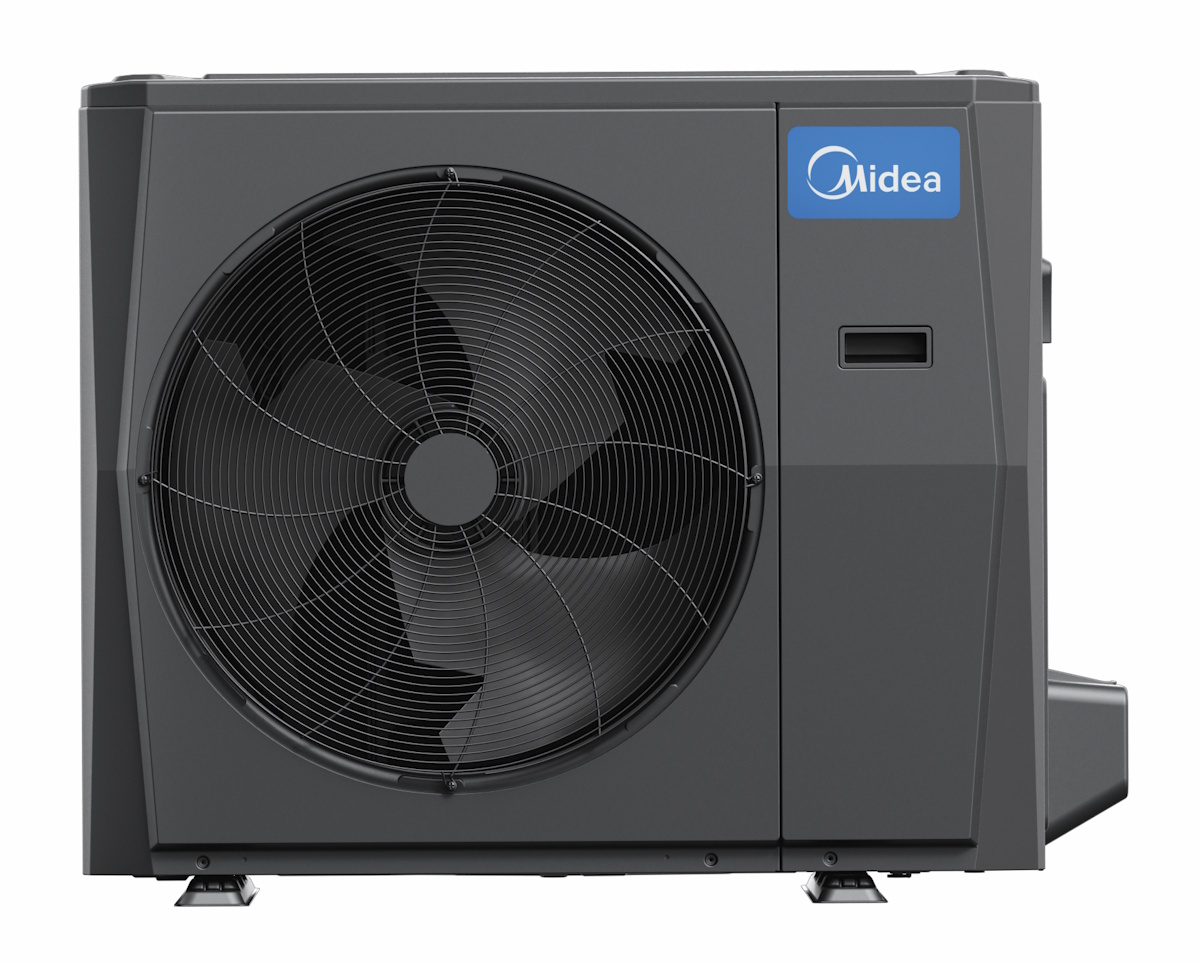
ONE-TO-ONE SOLUTION: A 2.5-ton Midea EVOX G3 outdoor unit. The EVOX G3 is an inverter-driven, variable-speed, cold-climate heat pump for ducted systems. (Courtesy of Midea America Corp.)
A forthcoming Evox G3 will deliver full heating capacity at an ambient temperature as low as -31°F, and 100% of its cooling when it’s as hot as 140°F outside, Rames said.
“The EVOX G3 is primarily a one-to-one solution, with each outdoor unit paired to a dedicated indoor AHU,” Rames said. “This makes it ideal for multifamily buildings with individual metering or where tenants require autonomous climate control.”
The system is designed to work in tight spaces, Rames said; the AHU’s narrow profile, modular design, and adaptability to six different installation configurations smooths its integration into building systems.
Midea also offers the Packaged Window Heat Pump, or PWHP, a self-contained, cold-climate heat pump similar to a window a/c unit.
The PWHP, designed specifically for multifamily buildings, has a capacity of 9,000 Btuh, a combined energy efficiency ratio (CEER) of 17.6, and a heating energy efficiency ratio (HEER) of 11, and can run on a standard 115V, 15-amp outlet, Rames said.
“Each unit serves a single living space, replacing both heating and cooling systems in that room,” said Rames. “This approach allows phased retrofits with minimal tenant disruption and avoids the cost and complexity of VRF or central plant systems.”
The PWHP has a compact design that fits over existing windows — no drain piping, refrigerant lines, or extensive electrical upgrades are needed, Rames said. “It’s especially well-suited for urban retrofits, public housing, and buildings where rooftop or wall space is limited,” he said.
The PWHP was introduced in 2023 and is being deployed in more than 20,000 public housing units in New York City. Another company, Gradient, makes a similar heat pump that is also being installed in New York City public housing.
Looking for a reprint of this article?
From high-res PDFs to custom plaques, order your copy today!