What Comes After R-454B and R-32?
Manufacturers are preparing for the next generation of comfort cooling refrigerants
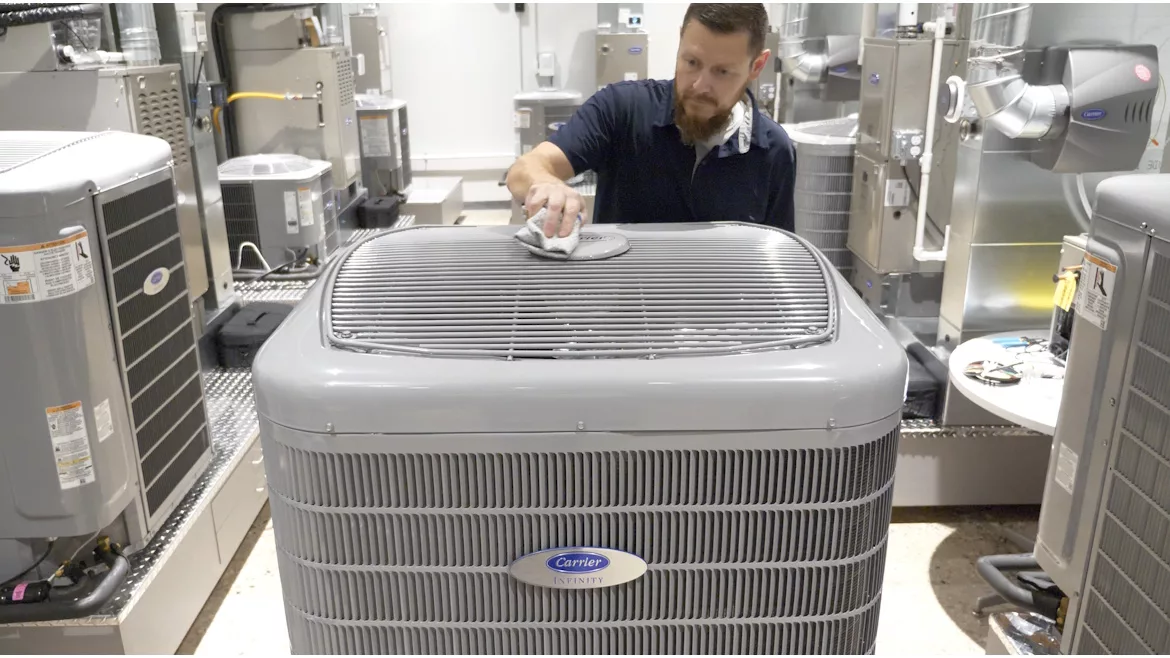
SMOOTH TRANSITION: Carrier’s focus is on ensuring a smooth refrigerant transition for its customers and partners. Here, a cold climate heat pump is installed in Carrier’s training center.
Most would agree that the rollout of A2L refrigerants in comfort cooling equipment has been a little rocky, largely due to widespread shortages of aftermarket R-454B. As a result, HVAC contractors have faced delays, frustration, and uncertainty while trying to comply with the low-GWP requirements of the AIM Act.
As contractors continue adapting to R-454B and R-32, attention is already turning to what comes next. While both refrigerants have significantly lower GWPs than R-410A, many view them as transitional solutions. That’s because global and state climate policies continue to push for even deeper emissions reductions. In response, refrigerant and equipment manufacturers are already researching the next generation of ultra-low-GWP options.
New Developments
Arkema is among the refrigerant manufacturers already researching next-generation, lower-GWP solutions, said Kris Crosby, lead technical services engineer at the company.
“Developing new refrigerants is a highly complex process that requires balancing desired properties, performance in systems, environmental impact, and safety. Additionally, each new refrigerant candidate must be carefully evaluated for manufacturability, which includes the evaluation of the availability and supply chain of raw materials used in production.”
For these reasons, Arkema’s developmental efforts for the next generation of refrigerants will be focused on the A1 and A2L ASHRAE classification categories, said Crosby.

NEXT GENERATION: A manufacturer of R-32 and other A2L refrigerants, Arkema is already researching next-generation, lower-GWP solutions.
Orbia Fluor & Energy Materials is also expected to accelerate the development and evaluation of next-generation refrigerants, said Sarah Kim, technical business development manager at the refrigerant manufacturer.
“Achieving significantly lower GWP levels will likely require tradeoffs that go beyond those seen in the move from R-410A to R-32 or R-454B,” said Kim. “These may include the adoption of refrigerants with higher flammability, lower fluid densities, and increased temperature glide. As a result, substantial system redesigns could be necessary, particularly in the areas of heat exchanger design, control strategies, and overall system architecture, to ensure performance, safety, and efficiency are maintained.”
Looking for quick answers on air conditioning, heating and refrigeration topics? Try Ask ACHR NEWS, our new smart AI search tool. Ask ACHR NEWS
Kim added that Orbia F&EM is working closely with customers to develop products that meet or exceed regulatory requirements without compromising refrigerant performance or safety.
“Our unique approach involves pushing the typical boundaries of pressure and flammability to deliver differentiated solutions, while carefully balancing the key attributes of refrigerants, which include performance, safety, and environmental impact.”
Given the charge limitations based on the lower flammability limit (LFL), the residential and light commercial sectors will likely continue to rely on A2L refrigerants, noted Kim. She added that while A3s offer very low GWP, their high flammability presents a challenge for these applications.
“The A2 classification, which has been largely overlooked in recent transitions, may also emerge as a viable option.”
Chemours is adapting to the evolving regulatory landscape by focusing on technologies that balance critical properties to meet customers' needs, said Alejandro Elnejem Medina, marketing manager for New Generation Refrigerant (NGR) at Chemours. To that end, their innovation roadmap spans three horizons:
- Horizon 1: Supporting current commercial adoption;
- Horizon 2: Collaborating on new blend development; and
- Horizon 3: Development of NGR solutions.
“Chemours expects this novel fluorinated technology to balance critical properties from GWP to flammability and performance,” said Elnejem Medina. “As we continue to move forward, our focus isn't merely on researching one specific attribute, such as ultra-low GWP. Instead, our approach involves a comprehensive assessment of each application we've identified as a priority.”
For example, when it comes to residential and commercial comfort equipment, Chemours’ goal is to provide the best thermal management options available, explained Elnejem Medina. By considering all relevant factors and applications, he noted that Chemours can ensure that its solutions meet the diverse needs of its customers while complying with the necessary qualifications.
The Propane Question
One refrigerant receiving less attention in the U.S. is R-290 (propane), which is a low-GWP alternative widely used in European comfort cooling units — mainly in monobloc air-to-water systems. While A3 refrigerants like propane have a place in specific uses, particularly in small-charge systems, Elnejem Medina noted that their high flammability presents significant challenges for broader adoption in U.S. residential comfort cooling, where safety standards and building codes tend to be more restrictive.

MARKET FACTORS: The next refrigerant transition will likely still include A2L refrigerants for the residential and light commercial HVAC sectors.
“We see more promise in engineered solutions that offer safety without compromising sustainability while increasing overall system efficiency and lowering costs,” said Elnejem Medina. “Based on our assessment of residential and light commercial comfort equipment, we believe that maintaining the A2L classification for new generation refrigerants will facilitate a more rapid market adoption. This is largely due to the current safety standards and building codes, which are already in place.”
Indeed, using propane in comfort cooling equipment in the U.S. is a non-starter right now, primarily due to safety standards.
“The international safety standard, IEC 60335-2-40, permits up to 1 kilogram (2.2 lbs.) of A3 refrigerant with appropriate safety mitigations,” said Kim. “This is significantly more permissive than the current UL 60335-2-40 safety standard in the U.S., where the allowable indoor charge for propane is limited to just 114 grams. Even with the IEC’s higher charge allowance, it is still well below the typical refrigerant charge required for standard residential ducted systems, mainly used in the U.S.”
Crosby agrees that in the U.S., the adoption of R-290 in residential cooling equipment is highly unlikely in the near future, if at all. He added that while R-290 works well in specific applications, other refrigerants typically offer superior performance and energy efficiency in residential HVAC systems.
“Moreover, significant updates to product standards and building codes would be required before A3-classified refrigerants like R-290 could be approved for residential use,” said Crosby. “Additionally, system architectures commonly used in the U.S., like split systems and packaged units, could not be used in their current form with propane. Implementing R-290 would also require new system architectures not commonly used in the United States, such as monobloc systems. Finally, a shift to A3s would require education and training of installation and repair technicians across the country at a scale far beyond what has been required in any past refrigerant transition.”
Availability
So when will these new lower-GWP refrigerants become available? Right now, it’s unclear — mainly because of regulatory uncertainty at the federal level. The EPA’s recent decision to reconsider the Technology Transition rule has raised questions about whether a national GWP limit and compliance timeline will be established anytime soon, said Kim.
“In the absence of firm federal direction, the next phase of refrigerant transition may unfold through a more fragmented approach led by state-level initiatives and influenced by market factors such as cost, refrigerant availability, and OEM readiness,” said Kim.
The planning is already underway at Chemours, and regulatory frameworks like the AIM Act and SNAP Rule 26 are accelerating the transition, said Elnejem Medina. Equally influential are market forces, he said, especially customer demand for global sustainability and energy-efficient solutions, and safety.
“At Chemours, we’re not waiting for mandates,” said Elnejem Medina. “Our three-horizons development pipeline is aligned with anticipated regulatory timelines, and we’re working closely with OEMs and the industry to ensure readiness for the next wave of refrigerants.” To that end, Chemours is anticipating its next-generation refrigerants to be available for initial customer evaluation in the second half of 2025.
The industry is already preparing for the next generation of refrigerants beyond R-32 and R-454B, said Crosby. He added that Arkema is constantly working with regulators and OEMs to ensure the company is developing products that help achieve compliance, while giving OEMs the properties and performance they require.
“Currently, the industry is transitioning from legacy HFC refrigerants as outlined by the AIM Act. In addition, some states have chosen to implement their own initiatives, and even international regulations can impact the market in the United States,” said Crosby. “The current regulatory landscape is undergoing significant change, but the industry must continue to pursue lower-GWP refrigerants for the future, whatever the timeline becomes.”
Equipment manufacturers also recognize that the refrigerant landscape is evolving rapidly, which is leading to many questions about the next transition. While change brings complexity, Carrier’s focus is on ensuring a smooth, well-supported transition for its customers and partners, said Nick Arch, vice president and general manager of residential HVAC solutions at Carrier.
“R-454B delivers comparable performance to R-410A with a significantly lower environmental impact, making it a strong choice for the future,” said Arch. “At the same time, we recognize the need to support both the current installed base and the next generation of equipment. Our approach is pragmatic and forward-looking: providing continuity today while building a scalable, reliable path forward as codes, standards, and supply chains continue to evolve. We’ll keep working closely with regulators, industry organizations, and channel partners to help ensure a transition that’s smart, safe, and serviceable.”
Looking for a reprint of this article?
From high-res PDFs to custom plaques, order your copy today!