ACHR News
search
Ask ACHR NEWS AI
cart
facebook twitter instagram linkedin youtube
  • Sign In
  • Subscribe
  • Sign Out
  • My Account
ACHR News
  • NEWS
    • Breaking News
    • New HVAC Products
    • Featured Products
    • Manufacturer Reports
    • HVAC Data
    • Legislation
    • ACHR NEWS Centennial
  • RESIDENTIAL
    • Air Conditioners
    • Furnaces
    • Residential Heat Pumps
    • Ductless
    • Residential IAQ
    • Testing, Monitoring, Tools
    • Components & Accessories
  • COMMERCIAL
    • Air Handlers
    • Rooftop Units
    • Chillers and Cooling Towers
    • Commercial Heat Pumps
    • Boilers and Hydronics
    • VRF/Ductless
    • Commercial IAQ
  • REFRIGERATION
    • Refrigerants
    • Refrigerant Regulations
    • Leak Management
  • CONTRACTOR PRO
    • Geothermal
    • Homeowner Study
    • VRF and VRV Ductless
    • Unitary Trends
  • EDUCATION
    • Training and Education
    • Business Management
    • Service and Maintenance
    • Continuing Education
    • Market Research >
      • HVAC Brand Awareness Report
      • VRV, VRF, VRVZ Report
      • Unitary Trends Report
      • Water Heat Professionals Report
    • Webinars
    • Sponsor Insights
    • eProducts Info
    • White Papers
  • EVENTS
    • HVAC Contractor Forum
    • Industry Events and Webinars
  • MEDIA
    • Videos
    • AHR Expo 2025 Videos
    • Podcasts >
      • ACHR News Podcast
      • HARDI Podcasts
      • AHR Expo Podcasts
      • ACCA Podcasts
    • Interactive Spotlights
    • Quizzes
    • eBooks
    • HVAC Talkback
  • HVAC GROUP
    • ACHR NEWS >
      • Current Issue
      • Digital Edition
      • Subscribe
    • Distribution Trends
    • SNIPS NEWS >
      • Join SNIPS NEWS
    • Engineered Systems News >
      • Join ES News
    • HVACR Directory
    • Contests
    • Newsletters
    • Contact
    • Advertise
    • My Account
NewsHVAC Residential Market

The Heat Trap No One Talks About

Plug-and-play attic/garage ventilation can help HVAC systems run cheaper, improve indoor air quality
By Maria Taylor
attic access.jpeg

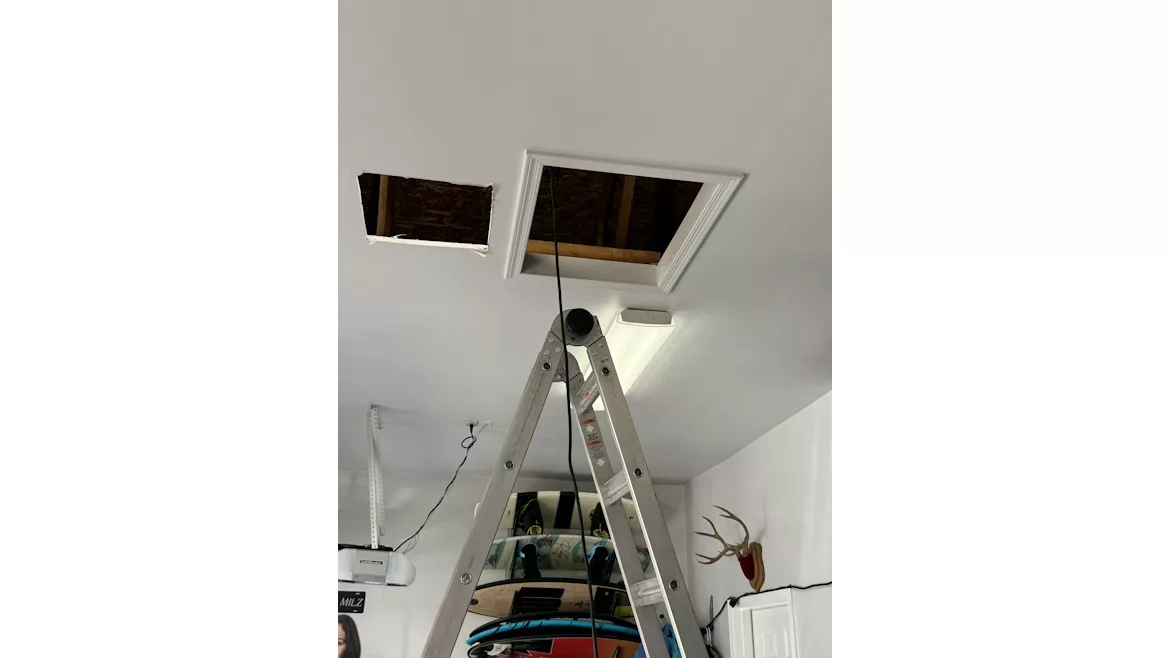
THERMAL DEAD ZONE: A garage is prepped for the installation of a GF-14 Garage Ventilation Fan.  (Courtesy of Cool My Garage)

May 9, 2025
✕
Image in modal.

It seems like basic knowledge: Attics and garages are hot in the summer and cold in the winter. 

They’re adjacent to the house. They impact its thermal load — and the homeowner’s energy bills. But they are not conditioned, and most HVAC contractors don’t touch them at all. 

Nathan deNight, owner of Cool My Garage and an HVAC installation director at Arizona-based Parker & Sons, thinks that’s an industry-wide blind spot. He calls it a “thermal dead zone.” 

“It's the silent heat trap next to every kitchen, living room, or bedroom — stealing comfort and jacking up energy bills,” he said. 

The issue starts with home construction. 

“Most garages and attics are not insulated, or barely insulated, so they absorb and retain heat from the sun all day long,” deNight said. In attics, heat transfers directly from the roof to the space below. In garages, he said, bare drywall, uninsulated walls, and metal garage doors let heat pour in with no barrier to block it. 

Then there’s the lack of ventilation. 

Looking for quick answers on air conditioning, heating and refrigeration topics? Try Ask ACHR NEWS, our new smart AI search tool. Ask ACHR NEWS →

attic fan.

EASY INSTALL: The GF14 is designed to be installed by everyone from DIYers to HVAC professionals, who could offer it as an add-on sale during home visits. (Courtesy of Cool My Garage)

“Garages and attics typically have little to no airflow, which means hot air has nowhere to go,” he said. “Heat rises and gets stuck in attics, and in garages, sealed doors and windows just trap that heat.” On top of that, garages house a lot of machines that throw off extra heat — think driving in a hot car, running an EV charger or an extra fridge, or putting away a hot lawnmower after mowing the yard on a summer day. 

“During summer months, these spaces can reach upwards of 120°F, radiating heat into adjacent living areas, damaging tools, stored items, and even impacting the longevity of your HVAC system by increasing workload,” deNight said. It makes the a/c run harder and longer, too, as well as causing appliances in the garage to work harder themselves. 


Garage Fan 

Most garages don’t have HVAC — and most building codes prohibit garages from being tied into a home’s central HVAC system because of the risk of pulling car or chemical fumes into the house. Still, in the case of an attached garage, it’s directly adjacent to a conditioned living space, and it does affect the home’s thermal load. 

DeNight has a simple solution: Add a fan. He calls it “plug-and-play ventilation.” Cool My Garage’s flagship product, the GF-14 Garage & Attic Ventilation Fan, is a pressure-based solution designed to draw cooler fresh air from outside, through the garage, into the attic, then push the trapped, superheated air out of the attic or gable vents. It mounts to the garage ceiling, runs on 60 watts, has an adjustable thermostat, and includes a fire-rated damper to meet code in all 50 states. There’s no ductwork, no retrofitting, and it’s independent from the rest of the home’s heating and cooling setup. Product specs say it will cool garages by 20° and attics by 40°. 

The fan helps lower the thermal load on the home’s livable space and reduce the a/c runtime, particularly in the late afternoon and early evening, and it will “absolutely” reduce cooling costs, deNight said. Most homeowners can expect a 5-15% reduction in their cooling energy bills during peak summer months, he said, although the actual savings vary depending on the home’s insulation, attic ventilation setup, and how the homeowner runs their a/c. 

fan in attic.

PLUG AND PLAY: Adding ventilation, like this attic/garage fan from Cool My Garage, to an attached garage can reduce home cooling bills 5-15%, according to the company, because the fan lowers the thermal load on the home’s livable space. (Courtesy of Cool My Garage)

Like other garage fans on the market, the GF-14 is designed to be installed by everyone from DIYers to HVAC professionals, who could easily offer it as an add-on sale during home visits — similar to what the industry does with IAQ equipment, filters, a smart thermostat, or a smart doorbell. 


The Air Quality Argument 

Another reason for ventilating the garage? Keeping toxins out of the house. 

“The typical garage has a lot of bad stuff in it,” wrote Allison Bailes III, PhD, founder and owner of Energy Vanguard in Decatur, Georgia, and the author of the Energy Vanguard Blog, in an ACCA blog post. “The odds are high that the indoor air quality is worse in a home with an attached garage than in a home without one.” 

Ventilation, he said, is a great way to address that — after getting rid of all that really nasty, toxic stuff that’s off-gassing into the garage in the first place, or at least moving it to a shed that’s not attached to the house. 

“With an exhaust fan in the garage, you can do two things to improve your indoor air quality,” Bailes said. “First, when the fan runs, it removes pollutants from the garage air and sends them outdoors. Second, the exhaust fan puts the garage under a negative pressure. That way, when you open the door between the garage and the house, air is more likely to flow from the house to the garage rather than from the garage to the house.” 

He suggests using a controller, like AirCycler’s GarageVent, that turns on the exhaust fan either at a certain temperature or whenever a door to the garage is opened. 


A Portable Option 

If a homeowner is really serious about cooling their garage — for example, if they use it as a workshop and want cool air blowing — it could be worth recommending a small swamp cooler. 

“Fans don’t actually do any cooling. Fans just move around air,” pointed out portable a/c manufacturer Portacool in a post on their site. “Cool air moving over your skin can help your body lose heat. … But this doesn’t necessarily help you in the garage. If you’re wearing coveralls, you won’t have much skin exposed to the moving air to allow you to cool off with a fan. Sweating also works less when you’re covered with oil and grease. The water just can’t evaporate very well.” 

An evaporative cooler uses the same principle as sweating: It evaporates water — so the occupant doesn’t have to. Like the overhead fan, it operates independently from the rest of the home’s HVAC, and can be wheeled in and turned on as needed. 

“Now, instead of drawing in 95° or 100°F air from outside, you’re dropping the air temperature to a cool 72° to 76°F,” Portacool explained. “That makes all the difference for your garage. That air is cool enough to help you feel comfortable even in coveralls, and you don’t have to sweat ridiculously to stay comfortable.” 

KEYWORDS: exhaust fans ventilation control ventilation products

Share This Story

Looking for a reprint of this article?
From high-res PDFs to custom plaques, order your copy today!


Maria taylor 400x400

Maria Taylor is Senior Managing Editor for The ACHR NEWS. Maria holds a bachelor’s in English from Alma College and has worked in journalism since 2013. Contact her at 248-786-1741 or mariataylor@achrnews.com.

Recommended Content

JOIN TODAY
To unlock your recommendations.

Already have an account? Sign In

  • HVAC-enrollment

    The Trades Are Back: HVACR Programs See Nearly 30% Enrollment Spike

    A new wave of future technicians is entering the pipeline.  
    News
    By: Matt Jachman
  • 2025 Top 40 Under 40

    2025 Top 40 Under 40 HVACR Professionals List

    The 11th annual Top 40 Under 40 list highlights those...
    HVAC Contracting
    By: Hannah Belloli-Oster
  • LG Ductless Mini-Split Systems

    The 9 Types of Heat Pumps

    As the U.S. moves toward electrification, heat pumps are...
    News
    By: Joanna R. Turpin
Subscription Center
  • Create an Account
  • Start a Subscription
  • Manage My Account
  • Sign Up for Newsletters
  • Visit Customer Service
  • Update Preferences

More Videos

Sponsored Content

Sponsored Content is a special paid section where industry companies provide high quality, objective, non-commercial content around topics of interest to The News audience. All Sponsored Content is supplied by the advertising company and any opinions expressed in this article are those of the author and not necessarily reflect the views of The News or its parent company, BNP Media. Interested in participating in our Sponsored Content section? Contact your local rep!

close
  • Piggy Bank
    Sponsored byWatercress Financial

    Energy Prices, Inflation, and HVAC: What Today’s Homeowners Care About

  • Refrigerated Food
    Sponsored bySolstice Advanced Materials

    R-455A Refrigeration: A Cold Storage Solution for the Future

  • Airex Rooftop Units
    Sponsored byAirex Manufacturing Inc

    Consolidating Roof Penetrations: A Growing Trend in Multifamily HVAC Design

Popular Stories

HVAC-Price-Increase-graphic

HVAC Price Increase List: July 2026

price-raising-practices.jpg

Rising Costs Force Contractors to Take a Harder Look at Pricing

DOE-sign.jpg

HVAC Groups Support DOE’s Rulemaking to Cut Energy Efficiency Mandates

scotus-decision.jpeg

SCOTUS Declines to Hear Refrigerant Case Seeking to Curb EPA Power

Tradeswomen on the job

Celebrating the Women Shaping HVACR’s Future

View The ACHR NEWS
Centennial Anniversary Timeline

The ACHR News Timeline Chart
Submit a Letter
Submit a letter to our editors.

Events

November 6, 2025

Next-Gen Data Center Cooling: HVAC Innovation and Real-World Solutions

On Demand As AI workloads and high-density computing push traditional cooling methods to their limits, the data center industry is accelerating the adoption of next-generation HVAC technologies.

July 22, 2026

Designing VRF Systems Using A2L Refrigerant

In this session, we will cover how to design VRF systems for the U.S. market using new A2L refrigerants. These systems provide an advanced zoning solution by using inverter technology to deliver precise heating and cooling control across multiple zones and spaces.

View All Submit An Event

Poll

Summer Staff

Are you fully staffed for the summer season?
View Results Poll Archive

Products

BNI Mechanical/Electrical Square Foot Costbook, 2026 Edition

BNI Mechanical/Electrical Square Foot Costbook, 2026 Edition

See More Products
Designing Systems Using A2L Refrigerant - Free Webinar - 7/22/2026

Related Articles

  • Phil-Mutz

    Phil Mutz Talks About the Challenges and Opportunities of the Current Market

    See More
  • Steve Scarbrough

    Industry Interview: New Senior VP of LG Electronics USA Talks About Job Transition and the HVAC Market

    See More
  • Rob-Minnick

    Rob Minnick Talks About the Importance of Lifelong Learning

    See More

Related Products

See More Products
  • Uncomplicating The Heat Pump: Electrical System Troubleshooting DVD

  • Uncomplicating The Heat Pump: Refrigeration & Air Flow Systems DVD

  • The ACHR News - June 16, 2025

    ACHR NEWS June 16, 2025, Issue

See More Products

Events

View AllSubmit An Event
  • June 16, 2026

    Hybrid Heat: The Future of Light Commercial Rooftops

    On Demand This session explores the technical fundamentals of hybrid heat RTU technology of Carrier’s WeatherMaster™ 48QE, detailing how heat pump and gas heat operation work together to optimize energy performance, climate flexibility, and occupant comfort.
View AllSubmit An Event
×

Sign Up. Stay Informed.

The #1 trusted source for the HVACR industry since 1926

SUBSCRIBE
  • RESOURCES
    • Advertise
    • Contact Us
    • Advisory Board
    • Classifieds
    • Submit a Letter
    • Directories
    • Store
  • ACCOUNT CENTER
    • Create an Account
    • Start a Subscription
    • Manage My Account
    • Sign Up for Newsletters
    • Visit Customer Service
    • Update Preferences
  • SERVICES
    • Marketing Services
    • Reprints
    • Market Research
    • List Rental
    • Survey/Respondent Access
  • STAY CONNECTED
    • LinkedIn
    • Facebook
    • Instagram
    • YouTube
    • X (Twitter)
  • PRIVACY
    • PRIVACY POLICY
    • TERMS & CONDITIONS
    • DO NOT SELL MY PERSONAL INFORMATION
    • PRIVACY REQUEST
    • ACCESSIBILITY

Copyright ©2026. All Rights Reserved BNP Media, Inc. and BNP Media II, LLC.

Design, CMS, Hosting & Web Development :: ePublishing