FROSTlines
HVACR Regulations in Flux
Administration change creates uncertainty across the HVACR equipment supply chain
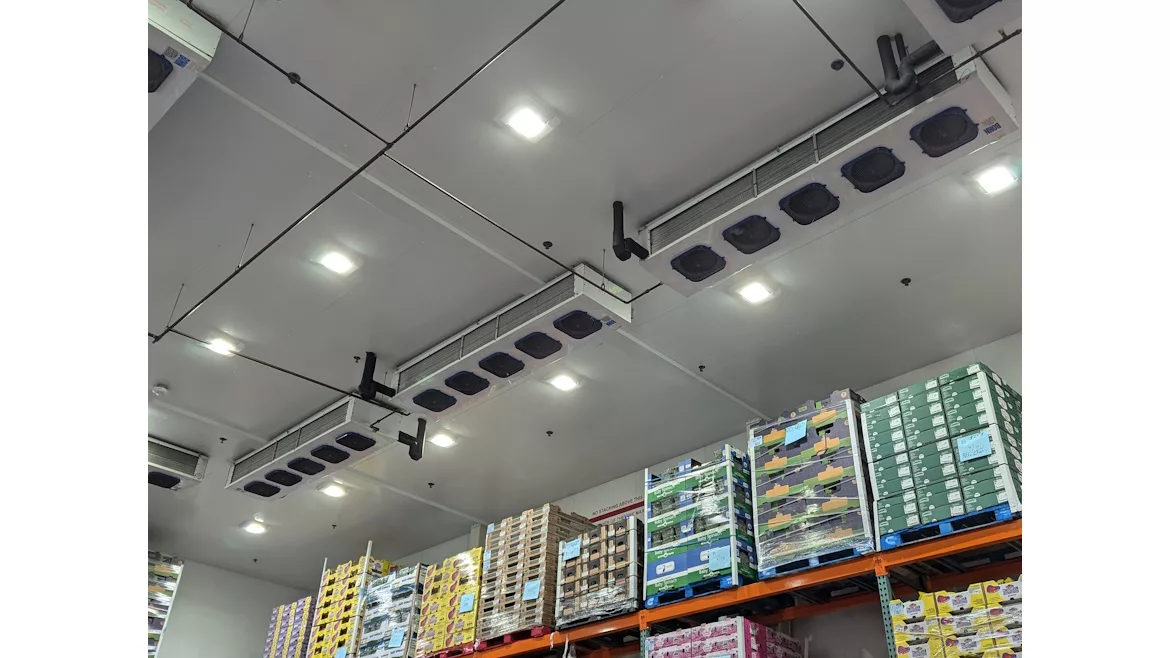
MINIMUM EFFICIENCY: A final minimum efficiency standard for walk-in coolers and freezers was published in December 2024. (Staff photo)
Changes to regulations impacting HVACR equipment and applications can be expected with any transition from one presidential administration to the next. This is especially true when transitioning between political parties with different philosophies that guide rulemaking.
Rules passed during this transitional period can be delayed in the short term. For example, regulations finalized in the Federal Register that have not yet reached their effective dates are commonly postponed up to 60 days. Underlying philosophical changes can have potentially much more prolonged, unforeseen impacts.
All the above has seemingly held true with the Biden-to-Trump administration transition.
For industry end users, contractors, and original equipment manufacturers (OEMs) impacted by these changes, navigating the uncertainty requires a balanced and objective understanding of their implications.
If you’re trying to stay informed of the regulatory changes that may impact your business, here’s a recap of key issues to keep an eye on.
Technology Transition Rule
In March, new Environmental Protection Agency (EPA) administrator Lee Zeldin announced a “day of deregulation” during which 31 actions were taken to support President Trump’s agenda. Among these included a “reconsideration” of the EPA’s Technology Transitions Rule (2023).
The rule set GWP limits intended to phase down the demand for HFC refrigerants in new equipment across specific HVACR sectors — some of which have already taken effect. As of January, the residential and light commercial air conditioning and comfort chiller sectors require a 700 GWP limit on new equipment. Retail food stand-alone also transitioned to a 150 GWP limit.
Looking for quick answers on air conditioning, heating and refrigeration topics? Try Ask ACHR NEWS, our new smart AI search tool. Ask ACHR NEWS
Timelines for the remainder of the food retail sector are not far behind. In 2026, new remote condensing units are slated for GWP limits of 150 to 300 GWP, with similar GWP limits on supermarket parallel rack systems following in 2027.
The EPA has not changed any GWP limits or implementation timelines for now. However, the uncertainty has prompted numerous stakeholder responses.
Industry organizations, manufacturers, and the equipment supply chain have been preparing for this lower-GWP transition and tracking to meet applicable deadlines, while using the opportunity to improve system reliability, performance, and efficiency. Pausing could stall the rollout of these advancements. Reversing the transition could mean returning to previous-generation technologies, which would put significant investments already made at risk and require additional investments to transition back.
Much of the work leading up to now has been preparing the equipment supply chain for A2L refrigerants. For example, efforts to approve A2Ls in state building codes were recently completed.
However, some food retail stores and trade associations, which previously expressed concerns about the HFC phasedown timelines, would support delaying the rule’s implementation.
The Food Industry Association (FMI) recently filed a lawsuit challenging the EPA’s Technology Transitions Rule, arguing that it didn’t have the time or financial resources to meet the transition deadlines across all impacted equipment categories, including remote condensing units, reach-in coolers, cold storage warehouses, and air conditioning. Under the new administration, the EPA and FMI could reach a settlement more favorable to the FMI.
The National Grocers Association (NGA) supports measures to alleviate “financial and administrative burdens,” especially on small grocers.
Copeland empathizes with retailers’ challenges, while recognizing that timely HFC reductions are needed to align with 2029 HFC phasedown targets. Delays in phasing down the demand for higher-GWP refrigerants, however, could increase refrigerant pricing pressures and challenges in future transitions.
The EPA previously granted petitions for reconsideration related to the Technology Transitions Rule, which is in the process of being implemented. Items impacting HVACR include:
- Revision to exclude R-410A condensing units as “specified components” for residential air conditioning to prevent a potentially perpetual replacement cycle; and
- Revision to allow new low-temperature intermodal transport containers for deep-frozen temperature ranges to continue using refrigerants above 700 GWP.
Recently, a petition has been filed for a revision to allow the cold storage sector to use up to 700 GWP (currently listed as 150 to 300 GWP); it’s under consideration and has not yet been granted.
Refrigerant Management
Under the previous administration, the EPA introduced a refrigerant management rule in the AIM Act, Subsection (h). It authorizes the EPA to manage HFCs through proper leak repair, detection, and refrigerant management provisions (i.e., recovery and reclamation).
Subsection (h) was finalized in October 2024; Congress had a standard 60-day review period, which extended into the new administration. In February, a Joint Resolution of Disapproval was introduced in the House, followed by a similar motion in the Senate. As a result, it is now under the Congressional Review Act (CRA).
The rule covers widely agreed-upon refrigerant management best practices and extends upon Section 608, which was previously enacted for ozone-depleting substances. Under the CRA, removing it would wipe it off the books and put it back in the hands of the EPA to redraft a new rule, which would be dissimilar to Subsection (h).
Like many HVACR industry stakeholders, Copeland supports Subsection (h) and its many advantages of refrigerant management best practices, including:
- Lowering maintenance and operating costs;
- Increasing refrigeration performance; and
- Minimizing negative environmental impacts.
We also recognize there may be implementation challenges pertaining to some of its provisions, such as the requirement to use 100 percent reclaimed refrigerant for servicing specific sectors in 2029. This could present challenges, given that some common HFCs (i.e., R-448A and R-449A) have not been used long enough to support adequate recovery. However, the CRA does not allow for more narrow modifications; thus, we do not support this approach.
IRA Uncertainty
Incentives authorized under the previous administration’s Inflation Reduction Act (IRA) are also up for reconsideration. Many of these were designed to help homeowners and businesses ease the costs of decarbonization, including the transition to electric heat pumps and efforts to reduce reliance on traditional fossil-fuel heating methods.
The new administration’s budgetary reconciliations, likely to last through the summer, will determine whether these tax credits will be removed, preserved, or given a shortened availability period.
For example, 25C of the IRA, which offers up to $2,000 for qualified heat pumps, water heaters, biomass stoves, or biomass boilers, is slated through 2032. A growing number of Republicans have spoken out about protecting these tax credits, stating that developing clean energy is critical to achieving the new administration’s goal of the U.S. being energy dominant.
Copeland has worked with OEMs and national labs for many years to advance heat pump technologies. We share the goal of making them technologically and financially viable alternatives to gas-powered HVAC systems, giving contractors and end users the confidence to implement these technologies in electric-only or dual-fuel applications.
Energy Star Program Defunding
The EPA’s ENERGY STAR program is also at risk of defunding. The current EPA leadership has stated its goals of cutting its budget by 65% and eliminating unnecessary expenses.
Recently, AHRI submitted a letter supporting the preservation of existing ENERGY STAR programs. Copeland and numerous leading private companies and industry organizations have joined in support, including:
- National Electrical Manufacturers Association (NEMA);
- Association of Home Appliance Manufacturers (AHAM); and
- North American Association of Food Equipment Manufacturers (NAFEM).
Since the program’s inception in 1962, hundreds of manufacturers have actively participated in achieving ENERGY STAR certification. As the AHRI letter states, partners in this non-regulatory (i.e., voluntary) program have ultimately delivered robust, efficient products to American consumers.
Copeland manufactures ENERGY STAR-certified Sensi thermostats and components, such as compressors and controls, to help HVACR OEMs achieve ENERGY STAR certification.
Energy-Efficiency Standards
Recent announcements regarding postponing and reversing HVAC efficiency standards have led to confusion about the status of Department of Energy (DOE) efficiency standards across various types of HVACR equipment.
The most recent efficiency increases (SEER2 and HSPF2) for residential and commercial central air conditioning and heat pump (CAC/HP) equipment took effect in 2023. Per the anti-backsliding provision in the Energy Policy and Conservation Act (EPCA), these levels cannot be rolled back easily.
Generally, DOE efforts to increase efficiency occur in two phases: publishing a test procedure and finalizing a separate energy conservation standard. This process typically takes multiple years to complete. In December 2024, DOE published an update to the CAC/HP test procedure, which resulted from a multiyear negotiation with a diverse group of stakeholders. It did not increase the appliance’s minimum efficiency but modified how efficiency was calculated. The DOE has postponed its effective date from February 6, 2025, to May 20, 2025. However, the enforcement date of July 7, 2025, remains unchanged for now.
Future plans to update DOE efficiency standards may also be impacted, as the process of defining the next iteration of efficiency metrics was expected to have begun in January, per the DOE’s latest regulatory agenda. However, it is unclear how the new administration could impact these timelines, potentially pushing the next step in industry-wide efficiency standards out several years.
A final minimum efficiency standard for walk-in coolers and freezers (WICFs) was published in December 2024, mandating efficiency adherence to the annual walk-in efficiency factor (AWEF2) rating. The effective date has been pushed from February 21, 2025, to May 20, 2025, with a 30-day comment period. However, the December 31, 2028, compliance date for systems using the new AWEF2 metric remains unchanged.
A final energy conservation standard for CRE was published on January 21, 2025. The initial effective date of March 24, 2025, was extended to May 20, 2025. The January 22, 2029, compliance date for commercial refrigeration equipment (CRE) appliances meeting the new minimum efficiency levels remains unchanged.
Delaying or eliminating WICF and CRE standards would affect longer-term efficiency and emissions reductions, although the near-term impact on the market is expected to be minimal.
Don’t Panic
Over the next few months, the HVACR industry will likely see updates to these key issues, including the potential for new, unexpected developments. With any administration change, we know from long experience that the regulatory wheels turn slowly. Keeping an objective viewpoint about the implications is wise as we wait for clarity during this transitional period. For our part, Copeland is committed to staying current on these changes and helping the industry make sense of this dynamic regulatory landscape.
Looking for a reprint of this article?
From high-res PDFs to custom plaques, order your copy today!