Canadian Smoke Crisis Prompts Urgent IAQ Response
Research shows that PM2.5 from wildfire smoke is particularly damaging and can cause a range of issues, including both pulmonary and cardiovascular concerns.

Smoke from Canadian wildfires continues to permeate much of the northern U.S., stretching as far as Greenland, Iceland, and Norway.
As a result, about 123 million people were under air quality alerts last week.
Health officials in New York advised residents to limit strenuous outdoor activity "to reduce the risk of adverse health effects," and school districts in New York; Washington, D.C.; and other major metropolitan areas canceled classes and outdoor activities.
Wildfire smoke contains a variety of air pollutants that can have significant health consequences not only for those near the fire but also for people in areas downwind of the source. Hazardous pollutants include particulate matter, carbon monoxide, and various volatile organic compounds — several of which are known to be carcinogenic. These particles have proven harmful when they infiltrate human lungs. Outdoor air quality can also impact the air quality inside buildings, as most buildings bring in outside air to improve IAQ. If outside air is not filtered, it can increase the particulate matter inside the building.
“Research shows that PM2.5 from wildfire smoke is particularly damaging and can cause a range of issues, including both pulmonary and cardiovascular issues,” said Christian Weeks, CEO, enVerid Systems Inc. “Individuals with asthma and pregnant women are also at high risk for the impacts of the wildfire smoke.”
When ambient air quality is adversely affected, it’s crucial for those living in the path of the smoke to find ways to maintain their health and well-being.
“Particulate matter from smoke is small enough to penetrate deep into the lungs and affect the heart and bloodstream,” said Normand Brais, founder, Sanuvox by Sanuvox Technologies. “There’s no question that particulate pollution has a negative impact on health, and some HVAC equipment, such as high-end air purifiers, are designed to trap the vast majority of these particles and improve air quality for this very reason.”
Looking for quick answers on air conditioning, heating and refrigeration topics? Try Ask ACHR NEWS, our new smart AI search tool. Ask ACHR NEWS
IAQ Solutions
When it comes to clean air, high-efficiency particle filtration is a chief consideration. When conditions are exceptionally bad, homeowners should consider running HEPA filters at full throttle and ensure their windows and doors are closed.
Another key IAQ consideration in such circumstances is to reduce reliance on outside air ventilation to maintain good IAQ through dilution ventilation and instead control indoor generated gaseous contaminants directly using sorbent media-based filtration technologies on recirculated indoor air.
According to Weeks, this can be done using ASHRAE’s IAQ Procedure (IAQP) in Standard 62.1, which may be used to permanently set a lower outside air requirement when accounting for the air-cleaning efficiency of a technology like enVerid’s Sorbent Ventilation Technology.
“This approach is in line with the recommendations of the ASHRAE 62.1-2019 user's manual, which says, ‘If outdoor air is deemed to be unacceptable for general ventilation, consider using air cleaning and the IAQP in lieu of the VRP [ventilation rate procedure] for the ventilation system design,’” said Weeks. “In addition to making buildings more resilient to polluted outside air, this approach has the added benefit of permanently saving energy associated with conditioning outside air without compromising indoor air quality.”
Jon Douglas, director, healthy building services and solutions, Johnson Controls, encourages building managers and building operators to run MERV-13 filters on their outside air, especially in times of wildfires, and monitor air quality at all times.
“People know when they’re hot or cold but do not know whether they are getting good indoor air quality,” he said. “Because of this, problems associated with maintaining IAQ systems are typically not addressed. And we’ve found that routine problems oftentimes go undetected for long periods of time. We recommend installing high-quality IAQ sensors in the space that measure temperature, relative humidity, carbon dioxide particulate matter, and total volatile organic compounds.”
Air purifiers are also suitable options for those living and working in wildfire-prone areas.
“The most effective air purifiers for wildfire smoke are equipped with HEPA filters,” said Brais. “In order to be HEPA-certified, the filters must be able to trap at least 99.97% of 0.3-micron particulate, a size that is particularly difficult to filter mechanically. Since wildfire smoke particles tend to be of a similar size range, they will be trapped just as effectively. Sanuvox air purifiers are equipped with proprietary UV technology that breaks down the hazardous pollutants contained in wildfire smoke through a process called photo-oxidation. This process reduces the concentration of VOCs in the air as well as the persistent smell of smoke, which might otherwise linger indefinitely.”
Pyure Dynamic Protection manufactures devices designed to rapidly and effectively eradicate airborne chemicals, smoke, and odors. These units are suited to provide temporary remediation or can be used on a permanent basis.
“Our industrial line of products, including the Slimline, Boss, and Boss XL3 units, are durable and robust, can be plugged into a standard outlet, and are rugged enough for transportation to various sites as required,” said Mahyar Khosravi, P.E., chief strategy officer, Pyure Dynamic Protection. “When using any Pyure air purification device, end users will quickly notice odors and smoke disappear, meaning the chemicals in the air have been eliminated and a healthier environment has been restored. Pyure can do this by actively eradicating the chemicals in the breathing space and not relying on the air to circulate through a filter. Occupants will experience significantly reduced irritation to their eyes, lungs, and nose and be rewarded with the ability to relax and enjoy indoor spaces while breathing fresh, clean air.”
Contractor Considerations
Just as with COVID-19, the attention around the Canadian wildfires has led to increased attention to air quality. HVAC contractors are poised to benefit, both through their reputation as air quality experts and through the sale of IAQ solutions.
While Seattle-based ACI Mechanical and HVAC Sales is not directly affected by the current Canadian wildfire situation, it deals with Pacific Northwest wildfires on a regular basis. The company’s current book of business is 90% commercial and 10% residential.
Keith Glasch, president and principal, ACI Mechanical, said customers in his region are constantly overcome with poor air quality, battling air quality ratings that rival those currently influencing the Northeast.
“We’re dedicated to educating our customers on the hazards a wildfire can cause,” he said. “We host lunch and learns and in-person meetings — though, in times of crisis, we can’t get our guys in front of customers soon enough, so we rely on social media, particularly LinkedIn, to spread the word.”
While the particulates from smoke are of the utmost concern, many residents complain about the smell.
“The odors during and after a fire can be alarming,” Glasch said. “Many people want to know if they need to install some form of carbon filter, and the answers is ‘no.’ A MERV-13A filter is the best option in an air handler or rooftop unit.”
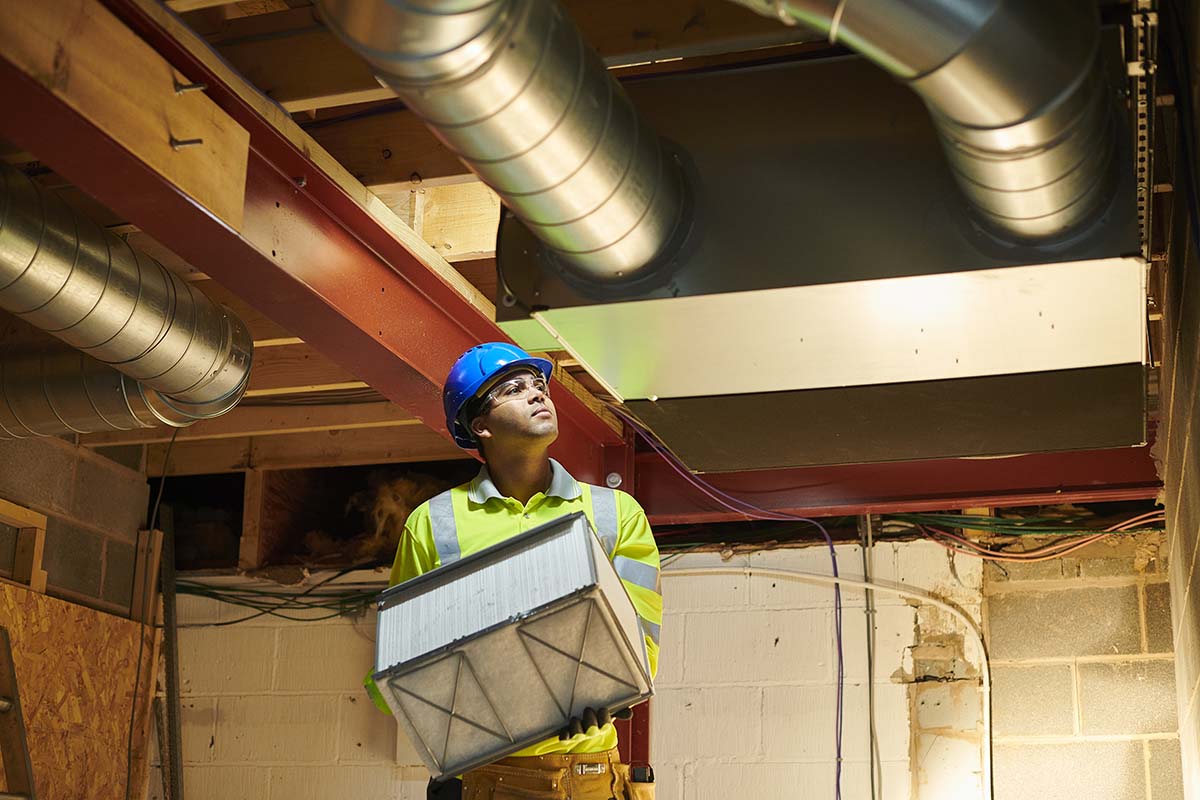
The primary purpose of filtration is to remove particulate from the air. To achieve optimal performance, a homeowner or facility manager must keep the filter surface clean.
(Courtesy of Getty Images)
“A low-quality, pleated filter will get clogged quickly and should be changed to a MERV-8-A or higher to produce better filtration,” said Glasch. “The Camfil City M room purifier includes a HEPA with verified performance to filter 99.995% of airborne particles. We have one in a conference room at work and it is excellent. Once the filter is clogged, it can’t absorb any more particulate. So we recommending changing filters as soon as an event like the Canadian wildfires happens. Also, customers should be educated on the effectiveness of higher performance filters with a greater dust holding capacity.”
In a time of need, a certified room air purifier can be of great assistance.
“If a family spends most of its time in a living room or bedroom, or a corporate team finds itself in one office area, I suggest adding a room air purifier,” Glasch said. “Though, make sure the unit carries an industry-recognized certification. Just going on Amazon and buying a product for $50 that makes a bunch of unsubstantiated claims is a mistake. Oftentimes, you get what you pay for.”
Nate Adams, CEO, HVAC 2.0 and founder of Energy Smart Home Performance, said an event such as this one allows contractors to further establish themselves as problem-solvers.
“Contractors should consider sending emails to customers, encouraging them to improve filtration and close fresh air dampers if IAQ monitors show filtrations systems are not keeping up.”
Adams also encourages contractors prescribe MERV-13 filters with a minimal bypass.
“Low filter velocity is important,” he said. “This approach requires installing as large of a filter as possible, which we call a big air drop (BAD),” he said. “Additionally, Corsi-Rosenthal boxes — four to five filters taped to a window box fan — are a very good stop gap solution as well as a booster.”
When paired with slight pressurization, whole-home filtration is critical.
“This can be achieved with a fresh-air duct piped into the return just before the central filter, said Adams. “Central air monitors and controllers can be used to close the outdoor air duct when outdoor particulate levels become too high and overwhelm central filters.”
If nothing else, the Canadian wildfire crisis has heightened awareness of outdoor and indoor air quality. HVAC contractors should make sure their techs are educating customers of the importance of IAQ, conducting the proper testing, discussing the results, and offering the appropriate solutions.
Seeking refuge indoors does not guarantee clean air. Even with windows shut, the smoke and pollutants from wildfires can easily infiltrate indoor spaces through various openings, leading to higher concentrations of harmful substances — especially PM2.5, an airborne particulate matter smaller than 1/70th the diameter of a human hair — which can contain dangerous levels of heavy metals and other toxins. According to a Stanford study, this type of air pollution may be 10 times more dangerous for kids than other forms of air pollution.
Representatives from Sheet Metal and Air Contractors’ National Association (SMACNA) and the International Association of Sheet Metal, Air, Rail and Transportation Workers (SMART) encourage the public to take the following steps to protect themselves and their pets during wildfires:
- Close doors and windows;
- Ensure the HVAC and ventilation system is operating correctly and has been maintained properly;
- Check the system’s filters — for most HVAC systems, a MERV-13 or a HEPA filter will be best;
- Ensure the home’s system is providing the required minimum adequate ventilation rate;
- Disable the economizer/eco-friendly option (if applicable); and
- Make sure the ventilation system is operating correctly and has been maintained properly.
Looking for a reprint of this article?
From high-res PDFs to custom plaques, order your copy today!