Evaporator Determines Refrigeration System Efficiency
A cold evaporator can still result in warm refrigerated space temperatures

Service technicians often wonder how the refrigerated space temperature of a refrigeration system can be so high when the evaporator temperature is so cold. What the service technician fails to realize is that it is how active or full the evaporator is with vaporizing (phase changing) refrigerant that determines the cooling content or efficiency in any refrigeration system. An evaporator can be very cold but inactive with a lot of superheat, robbing it of its heat absorbing abilities.
System Check
In the following example, the service technician finds a very cold evaporator temperature with a high refrigerated space temperature. The evaporator superheat is also very high, meaning the system has an inactive evaporator.
A service check is recommended when analyzing a system, so the service technician installs gauges and thermistors on an undercharged, R-134a, closed-door, medium-temperature, refrigeration system cooler, which incorporates a liquid high side receiver, a piston-type compressor, and a TXV as the metering device. The technician records the following values:
| Measured Values | |
| Compressor discharge temperature | 215°F |
| Condenser outlet temperature | 78°F |
| Evaporator outlet temperature | 10°F |
| Compressor inlet temperature | 50°F |
| Ambient temperature | 70°F |
| Refrigerated space temperature | 46°F |
| Compressor volts | 230 volts |
| Compressor amps | Low |
| Low side (evaporator) pressure | 3.94 inches Hg (-20°F) |
| High side (condensing) pressure | 86.4 psig (80°F) |
| Calculated Values | |
| Condenser temperature over ambient (CTOA) | 10°F |
| Condenser subcooling | 2°F |
| Evaporator superheat | 30°F |
| Compressor superheat | 70°F |
Analysis
A low evaporator pressure of 3.94 inches Hg causes a low evaporator temperature of -20°F. Both are caused from the compressor being starved of refrigerant. The compressor is trying to draw refrigerant into its cylinders, but there is not enough refrigerant to satisfy it. The entire low side of the system will experience low pressure and low temperatures. This scenario will often confuse service technicians because of the evaporator temperature being so cold (-20°F), along with the refrigerated space temperature being so warm (46°F).
Most medium-temperature refrigeration systems try to keep the refrigerated space temperatures between 35° and 37°F, depending on the application. However, the service technician must look at the evaporator superheat to see how active or full the evaporator is with vaporizing (phase changing) refrigerant.
Since the evaporator is starved of refrigerant from the undercharge, there will be high evaporator superheats. In this service scenario, the evaporator superheat is 30°F, meaning that the evaporator is starved of refrigerant and is not very active (see Figure 1). This, in turn, will lead to high compressor (total) superheats.
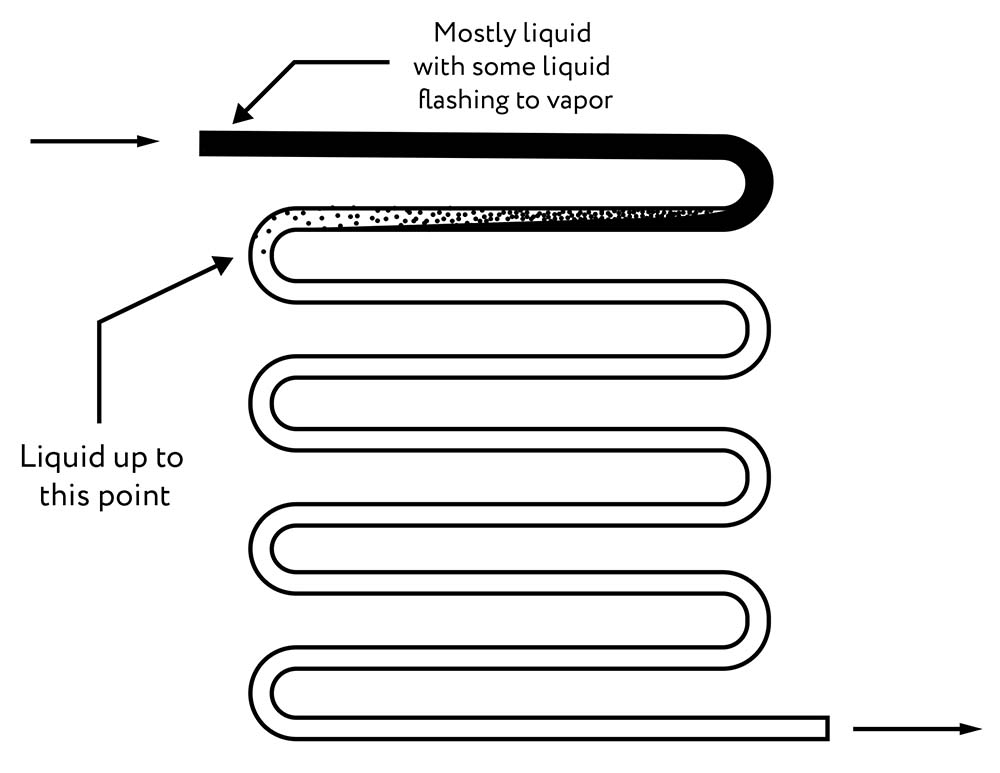
Click diagram to enlarge
Figure 1: An inactive evaporator with an abundance of superheat.
The 215°F compressor discharge temperature is high compared to normal systems and is caused by the evaporator and compressor running high superheat along with high compression ratios. When undercharged, do not expect the TXV to control superheat, because the TXV may be seeing a combination of vapor and liquid at its entrance. The evaporator will be starved of refrigerant and running high superheat. As a result, the compressor, with each compression stroke, will superheat the refrigerant even more.
Compression ratios will also be elevated, due to low evaporator pressures, giving the system a higher-than-normal heat of compression. High compression ratios will give the system very low volumetric efficiencies and cause unwanted inefficiencies with low refrigerant flow rates. The compressor will have to compress much lower pressure vapors coming from the suction line to the condensing pressure, which requires a greater compression range and a higher compression ratio.
Looking for quick answers on air conditioning, heating and refrigeration topics? Try Ask ACHR NEWS, our new smart AI search tool. Ask ACHR NEWS
The greater compression range from the lower evaporator pressure to the condensing pressure is what causes compression work and generates added heat of compression. This increased heat may be seen by the high compressor discharge temperature of 215°F; however, because of the lower refrigerant flow rates from the lower volumetric efficiencies, a somewhat low heat load is seen by the compressor. This low load is what keeps the discharge temperature from getting too hot. Remember that higher compression ratios and higher superheats are what cause the discharge temperature to be high and that the discharge line sees all of the superheat coming to the compressor, the motor heat generated, and the heat of compression.
The limit for any discharge temperature measured about 3 inches from the compressor on the discharge line is 225°F. The back of the discharge valve is usually about 50° to 75°F hotter than the discharge line, which would make it about 275° to 300°F. This could vaporize oil around the cylinders and cause excessive wear, and at 350°F, oil will breakdown and overheating of the compressor will soon occur. Compressor overheating is one of today's most serious field problems, so try to keep discharge temperatures below 225°F for longer compressor life.
Starving System
When the compressor sees very hot vapors from the high superheat readings, the gases entering the compressor will be extremely expanded and have a low density. The compression ratio will be high from the low suction pressure, causing low volumetric efficiencies, and the compressor will not pump much refrigerant. All components in the system will be starved of refrigerant.
The receiver will not get enough liquid refrigerant from the condenser because of the shortage of refrigerant in the system, which will starve the liquid line and may even bubble a sight glass if the condition is severe enough. The TXV will not see normal pressures and may even try to pass liquid and vapor from the starved liquid line. The TXV will also be starved and cannot be expected to control evaporator superheat.
The 100% saturated liquid point in the condenser will be very low, which will cause a low condenser subcooling. The condenser will not receive enough refrigerant vapor to condense it to a liquid and feed the receiver. Condenser subcooling is a good indicator of how much refrigerant charge is in the system.
Because the evaporator and compressor are being starved of refrigerant, the condenser will also be starved. Starving the condenser will reduce the heat load on the condenser because it isn't seeing as much refrigerant to reject any heat. With not as much heat to reject from the compressor, the condenser will be at a lower temperature. This lower temperature will cause a lower pressure in the condenser because of the pressure/temperature relationship at saturation. The temperature difference between the condensing temperature and the ambient is the CTOA. As the condenser sees less and less heat from the compressor from the undercharge of refrigerant, the CTOA will decrease.
High superheats will cause compressor inlet vapors from the suction line to be extremely expanded, decreasing their density. Low density vapors entering the compressor will mean low refrigerant flow rates through the compressor, which will cause a low amp draw, because the compressor doesn't have to work as hard compressing the low density vapors. Low refrigerant flow will also cause refrigerant-cooled compressors to overheat.
Below are the seven symptoms or telltale signs of a system low on refrigerant:
- Low evaporator temperatures and pressures;
- High refrigerated space temperatures;
- Medium-to-high discharge temperatures;
- High evaporator superheat;
- High compressor superheat;
- Low condenser subcooling;
- Low compressor amps; and
- Low condensing temperatures and pressures.
Also, remember that it is the British thermal units (Btu) that determine how much heat content is being absorbed by the evaporator, not its temperature. Temperature is simply a measure of the heat intensity of something, not its heat content.
Looking for a reprint of this article?
From high-res PDFs to custom plaques, order your copy today!