Improving Indoor Air Quality: Protecting the Air We Breathe
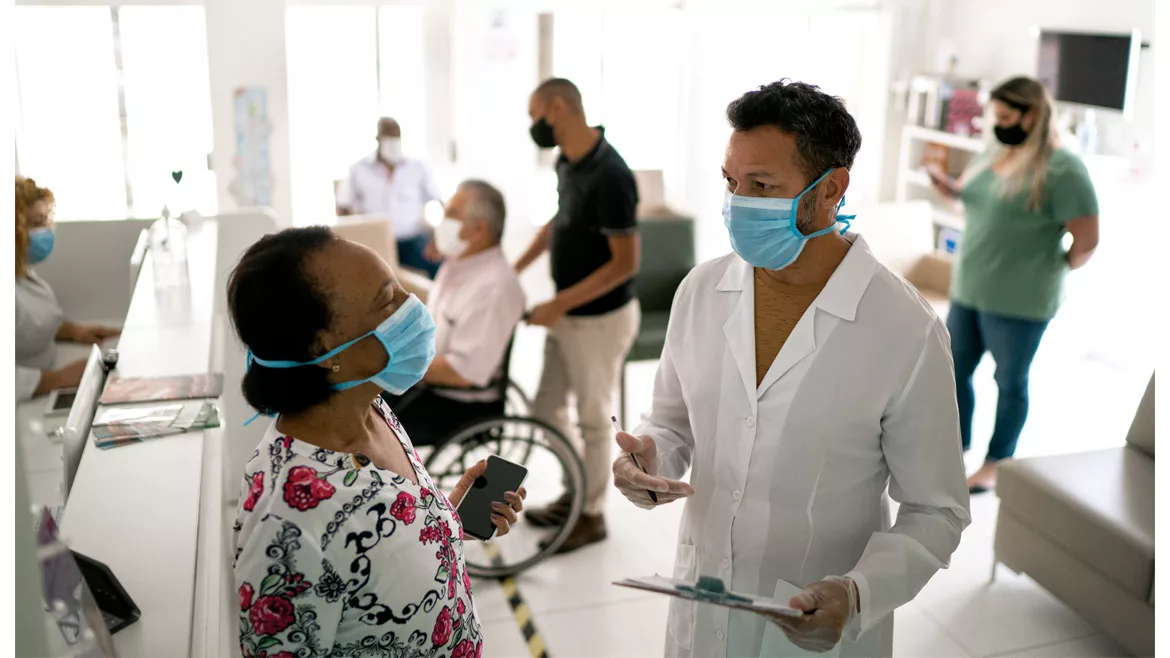
STAYING SAFE: As the COVID-19 global pandemic continues to evolve, IAQ becomes increasingly important. (Courtesy of Getty Images)
Indoor air quality (IAQ) has become a very important topic as the COVID-19 global pandemic has continued to evolve. We have learned a great deal about the air we breathe and the precautions we need to take to protect ourselves and those around us from airborne particles that can cause us to become ill. At any given time, particulate matter is suspended in the air we breathe. This particulate can be wet, dry, solid, vapor, or gas — think of dust, spores, pollen, fumes, microorganisms, bacteria, viruses, and bioaerosols, to name a few.
Air Purification Using UV-C
Inhalable or respirable particles are small, generally less than 10 microns. Often labeled as PM10 (particulate matter), these particles include dust, dirt, soot, or smoke. Fine respirable particles are even smaller in size and tend to be 2.5 microns. These particles are also categorized as PM2.5.
PM2.5 and PM10 can both be inhaled, while PM2.5 can be absorbed. People exhale these respiratory fluids or particulates during quiet breathing, speaking, singing, exercise, coughing, and sneezing. These fluids come in the form of droplets of various sizes that can carry a virus and transmit infection. The larger droplets are heavy in mass and tend to drop quickly to the ground. The smaller, fine droplets are very light in mass and can become suspended in the air and travel throughout an enclosed space until they meet a surface, are drawn into an HVAC system, or are inhaled by another person within the room. N95 masks may provide a form of protection against airborne PM2.5 and PM10 particulate. HEPA filtration is another tool that can be used to filter out airborne PM2.5 and PM10 particles.
A building ventilation system will draw air into the system, condition it, and return it to the room it serves, often through filtration media and mixing in outside air. These systems process the ambient air and may mix or combine air between rooms and spaces — something that may be wise to avoid when trying to control and mitigate particulate such as bacteria, viruses, and bioaerosols, especially during a global pandemic.
Portable air purifiers are most effective when used to complement building ventilation systems and reduce exposure to respirable particles through high-efficiency particulate air (HEPA) filtration. It is important to minimize air sharing between rooms and help with localized (room) ambient air mixing and dilution to reduce the accumulation of particulates and bioaerosols. If the general building ventilation system is inadequate to improve air quality, further reliance on portable air purifiers may be necessary to provide improved and localized air purification.
The Center for Disease Control and Prevention (CDC) recommends several steps or tools to improve room ventilation, including:
- Increasing the introduction of outdoor air into an indoor space
- Ensuring the building ventilation system is operating properly
- Increasing building ventilation filtration efficiency while maintaining the design airflow
- Rebalancing or adjusting the general ventilation system to increase total airflow to occupied spaces
- Running building ventilation systems for as long as possible, even if the building is not occupied
- Using portable high-efficiency particulate air (HEPA) fan/filtration systems to enhance air cleaning
- Using UVGI to help neutralize particulate and enhance air purification
Using both UVGI and HEPA filtration can be an effective method of neutralizing bioaerosols and filtering out respirable particles. Any device that utilizes UV technology should use a non-ozone-creating UV wavelength — such as 254nm, which falls in the UV-C spectrum — and should employ safety devices that turn off the fan and UV lamps when a unit is opened. The unit should carry electrical certification such as an Underwriters Laboratory (UL) for personal protection against UV exposure or ozone, and to ensure safe electrical operation.
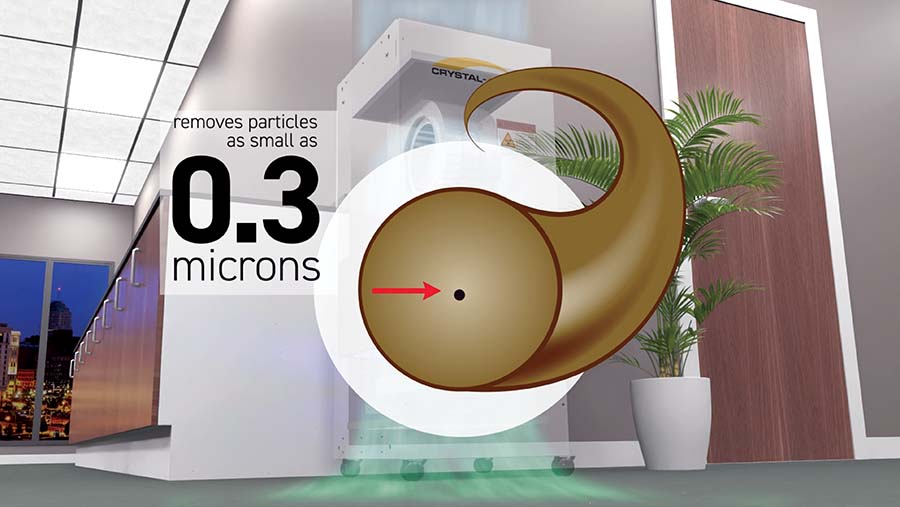
Filtration media rating is important to consider as well. The higher the efficiency, the more effective the system will be in removing particulate from the air. Use the highest-rated efficiency filter media that will not drastically affect the ventilation system. A high-efficiency filter media, such as HEPA, will deliver a high rate of particulate removal down to 0.3 microns in size, which is 250 times smaller than a human hair follicle.
Looking for quick answers on air conditioning, heating and refrigeration topics? Try Ask ACHR NEWS, our new smart AI search tool. Ask ACHR NEWS
(Courtesy of Parker Hannifin)
Due to high static pressure, HEPA filter media may negatively affect the airflow dynamics of a building ventilation system if the system was not originally designed for HEPA filter media use. Ensure that any filter media that you use is rated with a Minimum Efficiency Report Value (MERV). Or, when using HEPA, ensure the media is tested and verified to be a true 99.97% at 0.3-micron efficiency.
Air changes per hour (ACH) is the number of times the total volume of air in a defined room or space is replaced in one hour. ACH is used for building ventilation system designs and can also be used when trying to determine how many portable air purifiers should be used within a space. The ACH is determined by a calculation using the volume of a room space, the ventilation/filtration system airflow, the room type (classroom, conference room, medical office, lunchroom, etc.), and the recommended ACH for the room type. Using these metrics within a formula will determine how many portable air purifiers should be employed within an occupied space. ASHRAE has recommended ACH for different types of rooms and occupied spaces, as do other professional organizations, and it is best to use these as resources when determining the ACH of an occupied space and the best solutions for your specific room or indoor space
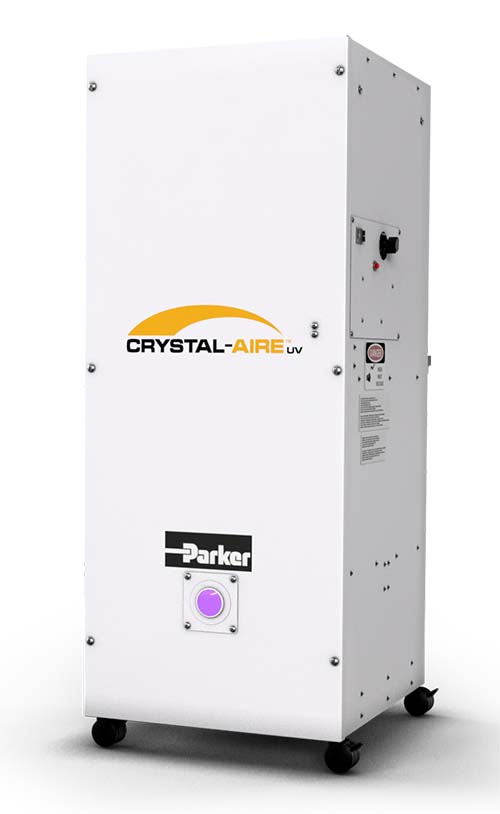
FILTRATION: Crystal-Aire®uv is a filtration system that utilizes ultraviolet-energy (UV-C) and high efficiency particulate air (HEPA) to clean and disinfect the air in your surrounding environment. (Courtesy of Parker Hannifin)
Ultraviolet germicidal irradiation (UVGI) is the method of using high-intensity UV energy at a wavelength of approximately 254nm (UV-C) and directing that energy onto a living particulate or microorganism such as a bioaerosol, virus, or bacteria as a process of neutralization. The particle is dosed with UV-C, causing the RNA or DNA to be scrambled or neutralized by penetrating the cell wall and disrupting its structure by breaking the base pairs, therefore, prohibiting the particulate from breeding or multiplying and rendering it sterilized.
There are two primary techniques used in the air treatment and ventilation space to dose and irradiate particulate and bioaerosols with UV-C: fly-by and surface dosing.
Fly-By Technique
With the fly-by technique, the particle is dosed and irradiated by the UV-C energy as it passes through a UV chamber where the energy is reflecting, impacting, and dosing the particulate. The UV source, such as a lamp, is located within the chamber where the air that passes through is dosed and irradiated, thereby disinfecting the air and particulates. In-duct UV systems are also a form of fly-by where the ducting from an HVAC system is used through insertion of UV lamps to create an irradiation zone where the UV energy is dispersed within the duct and irradiates passing air and particulate.
The fly-by technique requires critical particulate ‘hang’ or ‘dwell’ time so the particulate receives enough energy to be deactivated as it is passing through the dosing chamber and is therefore neutralized. Neutralization of the particulate is a function of exposure time. To get enough UV energy exposure to air in a fly-by ventilation system, a long, straight, reflective section or chamber coupled with low airflow will allow for sufficient time to dose and neutralize particulate as it passes through the UV lighted stage. The light energy drops off as a square of the distance from the source, so when designing a UV irradiation system, critical design characteristics, equations, and parameters must be followed. Therefore, it is recommended that someone with HVAC and UV system design experience is involved in designing this type of system.
Surface Dosing Technique
Surface dosage is simply when a particle or bioaerosol is resting on a surface and is being dosed and irradiated by UV-C energy. Surface dosing is the most effective deactivation technique because the particulate is consistently being dosed and irradiated by the UV-C energy for as long as the bulbs are illuminated, and the particulate is not moving. This process of capturing, holding, and neutralizing the particulate or microorganism takes place when the particulate is captured by filter media or a metal coil and held in place. Direct dosing is a very efficient method of neutralizing particulate, as it is exposed to long-term UV energy. The design technique for this type of system is much less critical versus the ‘fly-by’ dosing technique because the media or coil acts as a ‘catch’ or barrier to keep the particulate in place and exposed to the UV energy.
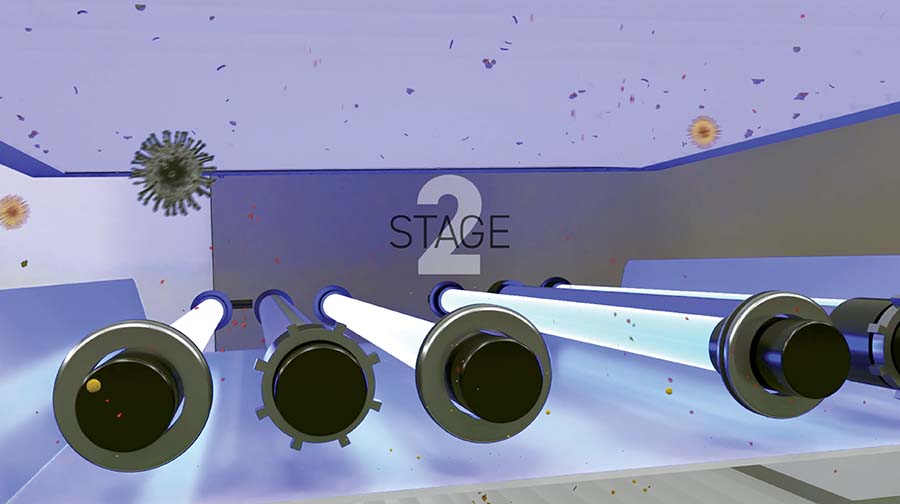
Surface dosing is the most effective deactivation technique because the particulate is consistently being dosed and irradiated by the UV-C energy (Courtesy of Parker Hannifin)
When either technique is used in portable air purifiers, the device should be designed such that it is a sealed system with proper UV technology, and high efficiency filter media such as HEPA. The UV technology should work along with the filter media where the media captures and holds the particulate and the UV doses, irradiates, and neutralizes the particle(s). There are often prefilters in place to capture large particles and prolong the life of the HEPA filter before they enter a UV chamber and the high efficiency filtration media. Other options include filter monitoring devices to let the user know when it is time to change the filters and carbon filters as a final filtration stage to help remove volatile organic compounds (VOC) and odors from the air.
Good design practice for portable air purifiers is to draw the air in from the bottom of the unit and expel it at the top to ensure proper air circulation and minimize resuspension and disruption at the floor level. The positioning of a portable air purifier is best in the center of a space to help with proper air dispersion and dilution.
Looking for a reprint of this article?
From high-res PDFs to custom plaques, order your copy today!