A1 Versus A2L Refrigerants: Similar But Different
Some new tools will be needed with A2Ls, but overall best practices remain the same
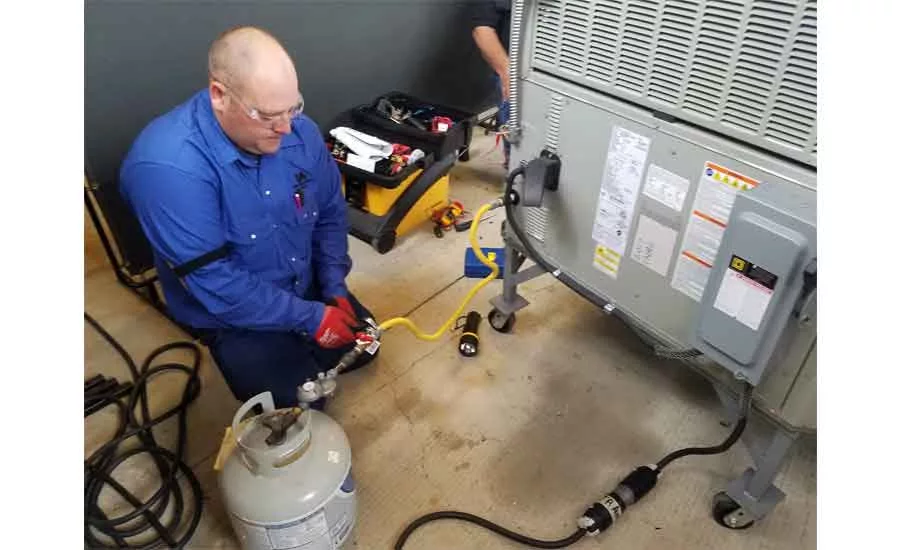
SAME BUT DIFFERENT: Refrigerant cylinders containing A2Ls will be the same as those containing A1s, with a few differences. (Courtesy of ESCO Group)
With the impending phasedown of HFCs, including the widely used R-410A, air conditioning equipment containing lower-GWP refrigerants will be coming to market over the next few years. Unlike previous refrigerant transitions, which moved from one nonflammable (A1) refrigerant to another, this transition will likely be to A2L refrigerants, which are mildly flammable. This has caused some concern among HVAC contractors and technicians who wonder whether it is safe to work with these types of refrigerants.
Experts at a recent webinar hosted by AHRI (video below) sought to put those concerns to rest by discussing the differences between A1s and A2Ls, as well as how best practices will remain essentially unchanged for the new refrigerants.
Safety First
It is important to note that all A2L refrigerants are approved by the Environmental Protection Agency’s (EPA) Significant New Alternatives Policy (SNAP) program, said Mary Koban, senior director regulatory affairs at AHRI. Under this process, EPA considers the safety, toxicity, flammability, and other environmental factors before approving any new refrigerant, and all flammable refrigerants are subject to additional safety requirements.
“EPA has allowed flammable refrigerants in residential and light air conditioning since May 2021,” she said. “They’ve also been allowed in smaller equipment, like window units and PTACs, since 2015 and chillers since 2012.”
Some of the safety issues associated with A1 refrigerants will be the same as with A2Ls, noted Koban. Notably, hydrogen fluoride is a gas formed upon combustion of any fluorinated refrigerant, and oxygen deprivation is possible when a refrigerant leaks out into a tight and enclosed space. Frostbite is also possible due to quickly releasing liquid refrigerant, so personal protective equipment (PPE) should be used by technicians and firefighters.
“As for differences, lower (A2L) and higher (A3) flammability refrigerants will need to be used in compliance with new regulations,” said Koban. “In addition, A2L refrigerants are characterized as having a low flame speed or burning velocity less than 10 centimeters per second and a low heat of combustion. A3 refrigerants, such as R-290 (propane), have higher flame speeds and a higher heat of combustion.
The important takeaway is that A2L refrigerants are difficult to ignite, have a slow or lower flame speed, and a low heat of combustion. Still, stakeholders need to wear PPE and be properly trained in the mitigation of risks due to A2L refrigerants.
Looking for quick answers on air conditioning, heating and refrigeration topics? Try Ask ACHR NEWS, our new smart AI search tool. Ask ACHR NEWS
Best Practices
When comparing installation and service practices, according to the appropriate standard (UL 60335-2-40), there are only three requirements for an A2L installation that are not required for A1 systems, said Jason Obrzut.
“These requirements are to purge the circuit with an inert gas, evacuate, and leak test the unit,” he said. “However, based on industry best practices, most would agree that these requirements were things that should have been done with an A1 installation as well. Technicians and contractors employing industry-accepted best practices will notice little or no change at all in their service practices or their installation practices.”
As for the tools required to service A2L equipment, some will remain the same, but some, including recovery machines, vacuum pumps, and leak detectors, will need to be compatible with A2L refrigerants.
“For things like recovery machines or vacuum pumps, it would be best to verify that they’re A2L capable moving forward,” said Obrzut. “If you have an arsenal of recovery machines, as you replace them over the next few years, it would be beneficial to ensure that they’re A2L rated, so you’re set up for the transition. AHRI offers a list of A2L-compatible tools at www.ahrinet.org/saferefrigerant.”
Technicians will be able to identify equipment that uses A2L refrigerants by way of labels that OEMs will be required to affix to the units. These labels will include a flame symbol, which will alert technicians to the fact that additional precautions will need to be taken when servicing that equipment, said Obrzut.
Refrigerant Cylinders
Disposable refrigerant cylinders containing A2Ls will be the same as those containing A1s — DOT 39 — but there will be some differences, said Jeff Warther, HVACR business development and training manager at Chemours.
“Disposable refrigerant cylinders will be the same rated pressure as the current R-410A cylinders, but the A2L cylinders will have a pressure relief valve. If the cylinder pressure is too high, this relief valve will only release enough refrigerant to reduce the pressure in that cylinder, and then it’ll reset,” he said. “This compares to R-410A cylinders, which have a rupture disc, which means when it is overpressurized, the rupture disc pops and releases all the refrigerant.”
Another difference between R-410A and A2L disposable refrigerant cylinders is that while both will be gray in color (as are all refrigerant cylinders, per AHRI Guideline N), the A2L cylinders will either have a red band or the entire top of the cylinder will be red. In addition, A1 refrigerant cylinders have a right-handed thread, and A2L cylinders will more than likely have a left-handed thread on them, said Warther.
All of the safe handling practices that apply to A1 refrigerant cylinders also apply to A2L cylinders with the main difference occurring at the end of life, said Warther. With an A1 cylinder, technicians remove or puncture the rupture disc, and on an A2L cylinder, a tool must be used to puncture the side of the cylinder itself.
As for recovery cylinders, both A2L and A1 cylinders will be gray in color with a yellow top; however, the A2L cylinders will likely have a red band or stripe as well. When recovering refrigerant from an A2L system, the best practices are the same as with A1 systems:
- Maintain a vacuum on empty cylinders to help ensure refrigerant purity when filled with refrigerant;
- Properly label recovery cylinders by refrigerant type contained within the cylinder;
- Never tamper with relief valves;
- Ensure that scales are accurate (all refrigerants have different liquid densities and fill weights will vary by product); and
- Return full recovery cylinders to the proper source for reclamation.
The best practices for handling A2L returnable cylinders include:
- Verifying the refrigerant label matches any color code or equipment labels;
- Verifying proper hookup of charging hoses. Do not charge to the discharge side of the compressor;
- Removing liquid phase refrigerant from the cylinder. Once removed, refrigerant can be flashed to vapor for charging;
- Opening access valves slowly;
- Protecting cylinders from moisture and rusting during storage; and
- Keeping cylinders away from incompatible or incendiary materials in storage.
As Warther noted, “Hopefully everyone sees there’s a theme to the transition from refrigerants like R-410A to new A2L or lower-GWP refrigerants like R-454B or R-32. Basically, getting back to basics and incorporating just a few new procedures and tools will help make the transition much easier.”
Looking for a reprint of this article?
From high-res PDFs to custom plaques, order your copy today!