Optimizing Energy Efficiency Measurements in High-Performance Sustainable Buildings
Advanced measurement technology can improve HVAC system performance
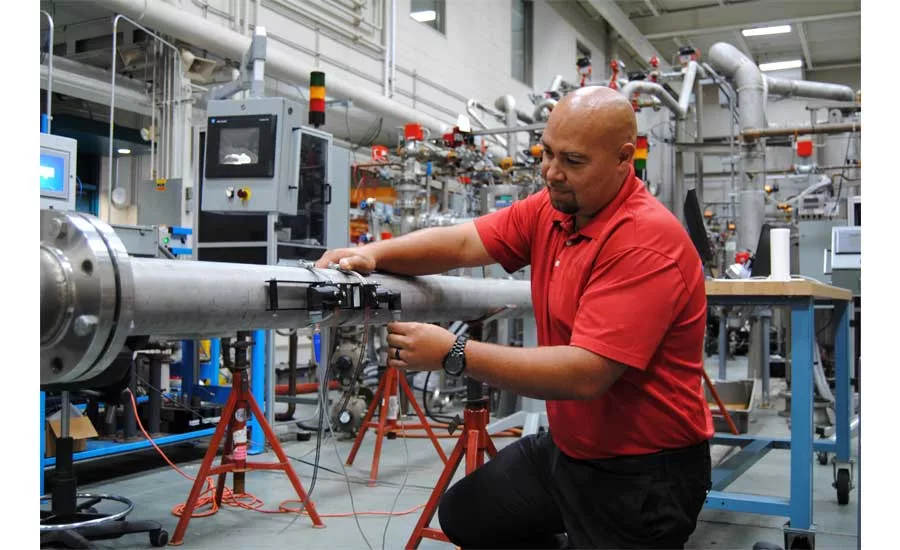
For building owners and operators, optimizing the efficiency of commercial and industrial facilities can be a challenging task. They need precise and timely information in order to commission, validate, and operate large facilities, and evaluate their energy consumption on an ongoing basis.
Today’s sustainable buildings can utilize advanced flow measurement technology to better leverage their valuable energy resources. With accurate and repeatable flow metering data, they can improve the performance of critical HVAC systems.
Introduction
In most large facilities, enhancing the energy profile of hydronic HVAC systems is a critical initiative. Building engineers and maintenance technicians need proven solutions to improve efficiency in key applications such as chilled water, hot water, and condenser water; domestic water and domestic hot water; make-up water and blow down; and steam, steam condensate, and boiler feed water.
Most major facility owners now recognize the importance of sustainable building operational practices. Although they may choose to prioritize energy reduction, water conservation, waste minimization, or any number of individual priorities, the practice of sustainable buildings is really about an integrated approach to planning, design, construction, operations, and maintenance.
The need for a sustainable operating approach as a basic business principle is balanced between a genuine desire to protect the environment and the practical economic driver of reducing building energy costs.
Sustainable building practices go beyond simple return on investment from specific efficiency improvements; rather, they focus on improvements over the entire lifecycle of building assets, including subsequent operations, maintenance, and disposal costs.
Role of Heating and Cooling Systems
The goal of using green principles to support energy efficiency in new facilities and renovations is to create high-performance buildings that have limited environmental impact and the lowest possible long-term lifecycle costs.
Looking for quick answers on air conditioning, heating and refrigeration topics? Try Ask ACHR NEWS, our new smart AI search tool. Ask ACHR NEWS
According to a study by the International Energy Agency (IEA), buildings account for almost a third of final energy consumption globally and are an equally important source of CO2 emissions. Currently, both space heating and cooling as well as hot water are estimated to account for roughly half of global energy consumption in buildings. These end-uses represent significant opportunities to reduce energy consumption, improve energy security, and reduce CO2 emissions due to the fact that space and water-heating provision is dominated by fossil fuels while cooling demand is growing rapidly in countries with very carbon-intensive electricity systems.
To meet their sustainability objectives, facility engineers have a critical need to optimize the operation of chillers, chilled water systems, thermal energy tank systems, boilers, cooling towers, pumps, and other assets used in hydronic systems. Increasingly, there is a keen eye on building utility and water usage reduction surveys and planning.
Many building owners have shown a willingness to invest in energy-efficient systems that may require a higher upfront cost but could deliver substantial cost savings down the line. This includes prioritizing improvements to HVAC systems as part of the push for energy efficiency. Heating and cooling units remain essential in both commercial and industrial facilities, and moving forward, new technology may revolutionize the way operators heat and cool their properties.
Need for Flow Measurement Solutions
Hydronic HVAC systems have rigorous operational characteristics, including strict flow measurement requirements that commercial and industrial facilities must meet. Effective flow measurement solutions are needed to measure the energy within a closed energy loop where a source receives the liquid, heats or cools it, and then supplies it to a load that needs heating or cooling.
The specific flow-related requirements for optimizing the efficiency and reliability of HVAC systems include:
- Maintain proper design flow throughout cooling towers and provide adequate system cooling
- Convert flow rate and supply to show when a chiller load reaches 40% or lower, indicating it’s time to stage down a chiller
- Measure the British Thermal Unit (BTU) energy consumed within the heating liquid solution and hot water usage for billing purposes
- Determine the volume of water consumption to help detect leaks in automatic cold-water make-up assemblies
- Measure flow rate and temperature to maintain peak performance in condenser water systems
- Ensure good quality boiler supply water by measuring boiler feed/blowdown and condensate return flow on a volumetric basis
- Monitor water and/or energy to improve inefficiencies and address cost allocation/sub-metering needs
- Precisely determine steam delivery within facility heating systems
- Report the volume of water consumption to aid in leak detection and evaporation measurement within saturated steam systems
- Balance chilled and hot water systems in a way that minimizes throttle loss and meets design flow conditions
- Maintain proper cooling tower design flow and provide sufficient system cooling
- Provide the measurement information needed for precise staging of chillers
- Determine heat energy within central heating (or cooling) systems, including both glycol and water solutions
Integrating metering components with flow and temperature sensors allows facility managers to measure energy costs in hydronic chilled and hot water applications. Meters that accurately measure flow aid in system capacity analysis, individual building cost allocation and sub-metering, energy efficiency calculations, hydronic system optimization, and equipment troubleshooting.
Instrumentation manufacturers have responded to the demands of hydronic heating and cooling system applications in high-performance buildings by developing a new generation of accurate and cost-effective flow measurement devices.
Advantages of Ultrasonic Technology
End users involved with commercial and industrial buildings can choose from a broad range of flow and energy measurement products for their facility’s hydronic HVAC systems. Common choices range from electromagnetic flow meters to vortex, differential pressure, positive displacement, turbine, nutating disc, and ultrasonic meters. The typical flow meter selection criteria include accuracy requirements, installation environment, output requirements, interconnectivity needs, maintenance and serviceability requirements and budget limitations.
As building engineers and operators become more concerned with managing energy and resources, advanced ultrasonic flow meters have emerged as a strong choice to support these efforts. Ongoing technology advancements have improved the accuracy and versatility of ultrasonic meters, making them an effective solution for measuring volumetric flow as well as BTU energy in the most demanding environments.
Transit time ultrasonic flow meters measure the time it takes for an ultrasonic signal transmitted from one transducer to cross a pipe and be received by a second transducer. At no flow conditions, it takes the same time for the signal to travel upstream and downstream between the transducers. Under flowing conditions, the upstream wave will travel slower, as it is going against the fluid and will take more time than the (faster) downstream wave that is traveling with the fluid. When the fluid moves faster, the difference between the upstream and downstream times increases and this time difference is proportionate to flow velocity. The transmitter processes these upstream and downstream time differences to determine the flow rate.
Transit time ultrasonic flow meters, combined with resistance temperature detectors (RTDs) on the supply and return pipe, are a cost-effective solution for measuring volumetric flow and obtaining energy readings to evaluate the efficiency of hydronic HVAC system components. This type of meter is specifically designed to not only show flow rates but to calculate energy measurement in BTUs, Watts (W), Kilowatts (kW), Megawatts (MW) or Megacalorie (MC); however, most plant engineers will use BTUs. By measuring flow and differential temperature (ΔT), users can calculate the energy consumed in BTUs. Efficiencies can then be calculated as a baseline, and ongoing performance can be continuously monitored.
Modern clamp-on transit time ultrasonic flow meters are becoming the choice for new construction and Basis of Design (BOD) for engineering firms. The latest clamp-on transit time ultrasonic flow meters also provide easy retrofits of existing systems so hydronic loops can be monitored where it wasn't previously possible as the need to better understand existing system energy use becomes extremely important. The meters eliminate the need to shut down critical systems for installation as well as the need for welding hot permits when installing insertion and inline types of metering solutions. Hot tap, in-field drilling, and welding are not required when installing the device. Furthermore, clamp-on technology does away with the need for O-rings and seals, which equates to less maintenance and no failures due to internal leaking into meter components down the road. This solution reduces total installation cost and startup time for projects both large and small.
When an existing in-line or insertion flow meter fails and is difficult to replace, or additional metering is needed on an HVAC system, the best choice may be a non-invasive solution like a clamp-on ultrasonic flow measurement instrument.
By delivering precise energy-related data with accuracies of +/- .5% of reading, and low flow velocity down to .1ft/sec., transit time ultrasonic flow meters enable building managers to implement strategies to improve HVAC equipment operation, assist with utility procurements, and help in energy budget planning.
For example, building operators are often faced with mapping all the sub-metering points for energy or water usage, as well as measuring flow at both the design rate and minimum rate required for seasonal operation. This can be accomplished by using noninvasive ultrasonic flow technology without disruption to the hydronic system.
In some cases, users can pair transit time ultrasonic flow meters with a cloud-based advanced metering analytics (AMA) software to provide flow data for consumption analysis, leak detection and other purposes. These meters were developed with modern, data-centric operations in mind, and can interface with building automation systems for real-time flow balancing.
Conclusion
Sustainability means many things to many people. In the area of hydronic HVAC systems, much of the focus is centered on energy efficiency and carbon footprint.
There are many parameters that require measurement and monitoring to allow efficient heating and cooling performance in buildings and provide accurate local billing. Among the most important parameters are accurate flow and temperature, as they are used to calculate energy consumption.
Experience has shown that owners and operators of sustainable facilities can benefit from the use of clamp-on transit time ultrasonic flow meters with a thermal BTU capability to assess the energy efficiency of their HVAC system and make smart energy-saving decisions.
Content by Badger Meter
Looking for a reprint of this article?
From high-res PDFs to custom plaques, order your copy today!