Why Actuators for Connected Industry Run on Brushless DC Motors
“Smart” electric actuators offer efficiency, flexibility, and connectivity for process applications
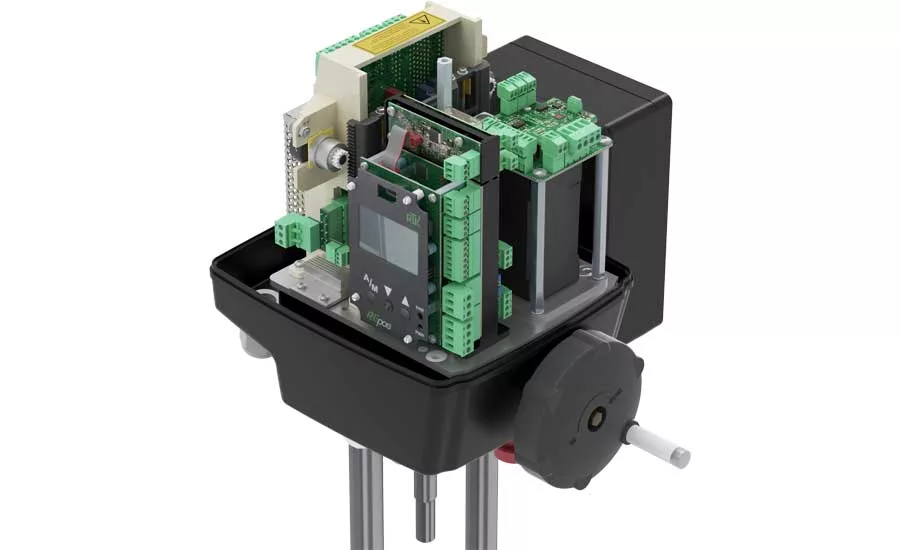
With no need for compressed air, early electric actuators could operate with less sound and less maintenance than the predominant pneumatic actuator. Of course, the standard pneumatic option offered its own apparent benefits — performance in extreme temperatures, for example, and an elegant simplicity. As a result, the flow control industry has stubbornly clung to pneumatic actuators, specifically in the American market, for decades.
Now, the American market is changing. In the next four years, the market for electric actuators in the U.S. is expected to balloon by 17 percent annually. This shift comes amid growing interest in interconnectivity, in harnessing the IoT, and enabling Industry 4.0. While the electric actuator was once a replacement technology for a pneumatic option, next generation electric actuators offer new functionalities that make them distinct products altogether. These new actuators can connect to networks.
The difference starts at the core of these devices: the motor. Brushless DC technology is making electric actuators more efficient, more adaptable, and more connected — and changing expectations for what an actuator can do.
How Brushless DC Motors Think
Outdated versions of DC electric actuator motors use brushes to mechanically connect the rotating and stationary parts of the motor. The resultant friction is necessary for operation, but causes some undesirable outcomes. Brushes wear down over time and must be replaced. Sparking can occur, a danger in explosive environments. If pushed, the motors will overheat and damage components. Another more popular option on the market, synchronous motors with AC power supplies, are brushless, but still present some meaningful limitations. For example, AC synchronous motors run at full torque and speed whenever engaged, so these models require downtime. They also lack “smart” features.
Next generation electric actuators utilize brushless DC technology. BLDC motors are engineered without brushes, instead utilizing a “smart” motor management system to control rotation. With no space wasted on brushes, these compact motors can provide more power and torque in the same dimensions as their brushed counterparts. Without the friction, these actuator motors also require much less maintenance. The brushless design of the RTK REact DC enables 100 percent running time.
However, a more consequential difference to the forward-thinking engineer than running time is the “intelligence” of the controller. Because there are no brushes to regulate rotary motion, and no alternating current to alternate magnetism in the motor, BLDC motors charge segments of the stator in a circular pattern to propel the rotor with a moving magnetic field. In order for the system to control the motor’s rotation, to “know” where to align the stator’s electromagnetic fields with the correct parts of the rotor, it gathers data on the speed and position of the rotor. To do this, Hall effect sensors are embedded to determine the relative position of motor parts.
These Hall effect sensors enable intra-motor communication nonexistent in other technologies. Essentially, they feed real-time information on the outcome of the controller’s decisions back to the controller. So, the system can detect a change in conditions by measuring how real outcomes differ from expected outcomes. For example, if changes to flow conditions cause greater resistance to the operation of the actuator, the Hall sensors will be able to sense that the rotor is moving at a lower speed than intended. Then, the intelligent controller will act on that information, accelerating electromagnetic rotations in order to make up for new conditions. This process is similar to how a driver would push down the gas pedal to maintain a car’s speed up an incline.
Looking for quick answers on air conditioning, heating and refrigeration topics? Try Ask ACHR NEWS, our new smart AI search tool. Ask ACHR NEWS
Likewise, if flow conditions require less torque, the BLDC motor can reduce the amount of energy it uses. These “smart” motors can independently match speed and torque to conditions. As a result, BLDC motors such as the RTK REact DC can reduce energy consumption by over 60 percent compared to synchronous motors.
Programming Flexibility for Flow Control
Additionally, because the BLDC motor’s sensors and controller are digital and not mechanical, operators can select the speed at which they want the motor to run. Synchronous AC motors are limited to one mechanically predetermined speed, torque, and supply voltage, and each motor requires its own capacitor. So, in order to change the speed of an actuator in a system, a synchronous AC actuator must be replaced with another built to run at the desired speed.
For BLDC actuators, though, changing speed is a matter of programming, not replacement. Models can include switches to select a number of speeds. For example, RTK REact DC actuators offer four speed presets which can be toggled by operators. The ability for a motor to self-regulate also serves as a maintenance prevention and safety feature; the REact DC is programmed with over force limiting to protect the actuator.
This flexibility is a boon to process engineers. A system may call for an actuator at one speed with one supply voltage at a critical juncture. Before, a spare actuator matching those precise characteristics would have to be kept in stock. With BLDC actuators like the REact DC, one unit can offer four speeds and can operate with two different supply voltages. This means that operators can keep one BLDC actuator on hand as a backup component to cover the equivalent of eight distinct synchronous AC actuator types used in a process.
A still greater benefit is the flexibility this provides engineers seeking to optimize a system. Engineers often install an actuator with a certain speed only to realize that the control loop does not function correctly. Now, with BLDC actuators, troubleshooting engineers can simply change the speed of the installed actuator instead of replacing it to get a process up and running.
Networking Smart Actuators for Efficient, Future-Proof Processes
Importantly, the internal communications of smart motors can be networked and monitored on system-wide scales. Actuators such as the REact DC sport LED lights to indicate actuating direction for easy maintenance, but operators no longer need to inspect each actuator by sight. The REact DC is built to be networked. This allows operators to remotely monitor temperature, number of strokes completed, running time, and actuator position, as well as flow direction and online/offline status for each actuator in a system. Then, operators can communicate with these remote units to make adjustments. This connectivity not only streamlines maintenance, as data can guide preventative measures before failures have a chance to occur, but can reveal data that can be used to make flow more efficient.
Excitingly, the hardware of today’s BLDC actuator models enables connectivity now and in the future. Cutting-edge integration—REact DC actuators feature Profibus, and CAN-open integration—will surely be usurped by future communication systems, and “smart” actuators will require little retrofitting to function in these new networks. In the context of market growth driven by the desire to connect, the flexibility of the REact DC reveals its most salient advantage here: whether one designs a network connected by USB to a central computer or to function with a mobile app using QR codes, the BLDC actuator is a programmable tool able to deliver efficient actuation force according to changeable parameters.
BLDC Actuators: The New, Smart Actuator
While other actuators simply provide actuating force, BLDC actuators not only provide, but also monitor and adjust that force independently and on an ongoing basis—and according to parameters selected and reselected by operators. These capabilities put this new generation into a class of its own, but the greatest value to this technology is its networkability. As process engineers consider new electric actuators, they should consider BLDC models like the RTK REact DC to unlock efficiency and future-proof their systems.
Looking for a reprint of this article?
From high-res PDFs to custom plaques, order your copy today!