How to Properly Size Finned-tube Baseboard Heat Emitters
Divide by 1.15
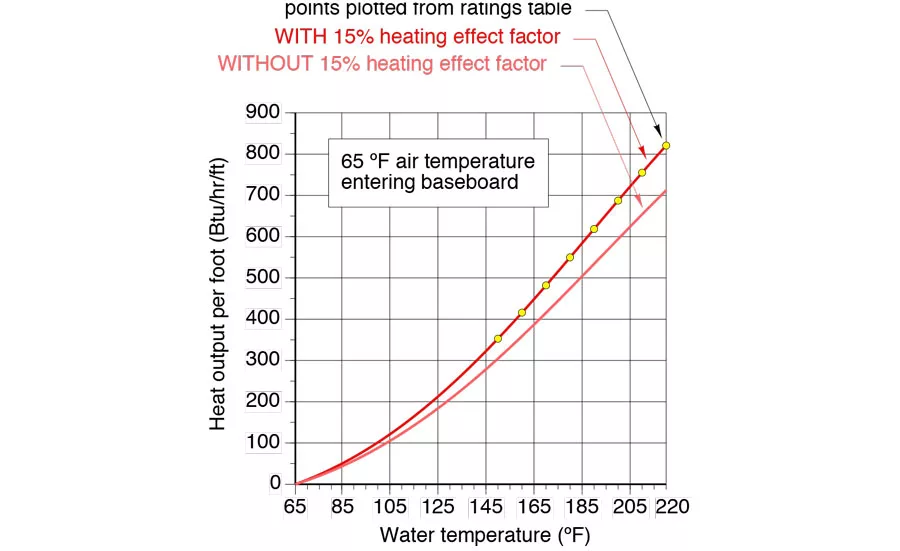
FIGURE 1: A comparison of typical residential finned-tube baseboard output with and without the 15 percent heating effect factor.
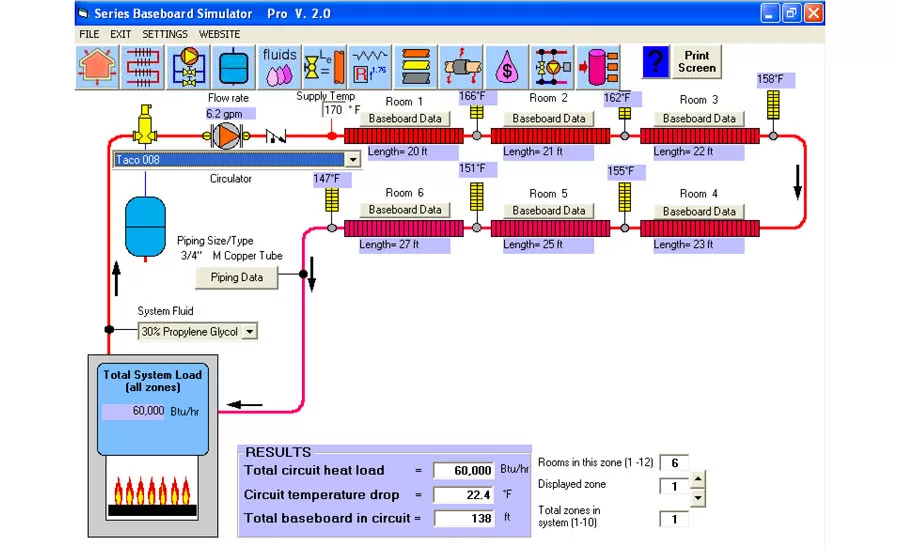
FIGURE 2: Software like Hydronics Design Studio can size series-connected baseboards, taking temperature drop and several other variables, such as circuit flow rate, fluid type, and individual room temperatures, into account.
Have a look at the rating tables for most finned-tube baseboards sold in North America, and chances are, you’ll see a footnote under the table that reads something like this: “Ratings are based on active fin length and include 15 percent heating effect factor.”
So what exactly is meant by heating effect factor?
According to the 2016 ASHRAE Handbook - HVAC Systems & Equipment, the generally accepted method of testing and rating baseboards in the U.S. is covered in the Air-Conditioning, Heating and Refrigeration Institute’s (AHRI’s) Testing and Rating Standard for Baseboard Radiation (AHRI 2005a). It goes on to say baseboard ratings include an allowance for heating effect factors of 15 percent in addition to the test capacity, which must be shown in the manufacturer’s literature.
The I=B=R/2009 AHRI Directory of Certified Product Performance states the following: “All baseboards listed have been tested at the I=B=R Laboratory and ratings approved based upon these tests. An I=B=R Baseboard Rating is the output, determined under the strict limitations and conditions set forth in the I=B=R Testing and Rating Standard for Baseboard Radiation, plus 15 percent. This added percentage is credited to the baseboard unit because this type of radiation is usually installed at low levels where maximum heating effect results.”
So what can be gathered from these statements?
- The AHRI testing standard allows baseboard manufacturers to add 15 percent to the tested heat output ratings of their baseboards, provided they indicate it in published ratings.
- The 15 percent added output is credited to baseboard because it is usually installed in “low levels” where “maximum heating effect results.”
This still doesn’t explain the conditions upon which the 15 percent adjustment is based or how those conditions differ from those in which the baseboard is tested or typically installed. And for what it’s worth, have any of you ever seen finned-tube baseboard installed at levels other than close to a floor?
A LONG TIME AGO
In the late 1980s, I had a long conversation about the heating effect factor with the technical director of the Hydronics Institute. We discussed the origin of the heating effect factor. He explained that when finned-tube heat emitters were first introduced, they were installed at the nominal top height of a cast-iron radiator. Apparently, someone at the time discovered that moving the finned-tube element to just above floor level produced greater heat output, and apparently those writing the rating standard felt a 15 percent adder was justified.
Looking for quick answers on air conditioning, heating and refrigeration topics? Try Ask ACHR NEWS, our new smart AI search tool. Ask ACHR NEWS
The problem I have with this is that the baseboards are tested and rated based on 65°F entering air temperature. To achieve a 15 percent output boost would require the air temperature entering the baseboard to be about 54° (assuming 170° water in the baseboard). While such low floor level air temperatures might have existed in homes during the middle of the 20th century when the heating effect factor was “discovered,” these temperatures are not common in homes meeting current energy standards.
Based on this, the only technically supportable observation I can offer is that adding 15 percent to laboratory tested heat transfer values, based on the assumption of the baseboard being placed in abnormally cool locations, does not facilitate accurate sizing in normal applications.
WHY DOES IT WORK?
After reading this, you’re probably thinking: If the actual heat output from baseboards is 15 percent lower than the published ratings, why aren’t there more complaints about inadequate heat delivery? This is where things get interesting.
Think about a typical residential series baseboard circuit. It might have three to six baseboards and several yards of uninsulated ¾-inch copper tubing connecting those baseboards and completing the circuit back to the boiler. A ¾-inch tarnished copper tube carrying 170° water through a building space at 65° loses about 46 Btuh per foot of length. Consider a baseboard circuit with 60 feet of bare ¾-inch copper tubing operating at this condition. The heat loss from that bare tubing is about 2,760 Btuh. That’s enough output to easily heat a typical bedroom on a cold day.
If this same circuit contained 35 feet of finned-tube, releasing an average of 425 Btuh per foot (assuming 170° average water temperature and 65° inlet air temperature), the finned-tube portion of the circuit would have a total output of 14,875 Btuh.
The bare tubing in that circuit therefore releases about 18.6 percent of the heat output of the finned-tube in the circuit.
It’s my assertion that, in many heating systems, the heat released from bare copper tubing compensates for the lower-than-rated heat output of the finned-tube baseboard.
CONFIRMATION
Years ago, my software partner, Mario Restive, and I developed a hydronic baseboard simulation program called HYDRON. It had a rather bland DOS user interface, but under the hood, it used very detailed engineering equations to model the performance of series connected baseboards, including the heat loss of the tubing connecting the baseboards.
After making many runs of that software, we found that the total output of uninsulated bare copper tubing connecting baseboards into a complete circuit was often in the range of 15 percent of the total heat output of the baseboards. This percentage would obviously go down for systems with minimal interconnecting tubing, and up for systems with lots of tubing.
THE TAKEAWAY
Series baseboard circuits are common in North America, especially in basic residential systems. In most systems, they provide comfortable heating. In situations where tubing such as PEX, PEX-AL-PEX, or Polypropylene is used to connect the baseboards, or where the interconnecting tubing is insulated, the heat loss of that tubing will be substantially reduced relative to the heat loss of traditional copper tubing. In such cases, it’s prudent to select baseboards based on tested heat output rather than the tested plus 15 percent output.
You can do this by dividing the I=B=R heat output ratings that include a 15 percent heating effect factor by 1.15.
If the baseboards are connected in series, keep track of the water temperature drop from one baseboard to the next during the sizing procedure. There is software that can quickly size series-connected baseboards, taking this temperature drop and several other variables, such as circuit flow rate, fluid type, and individual room temperatures, into account.
As modern materials, such as PEX tubing, become more common for hydronic distribution piping, the heat output associated with traditional bare copper tubing will decrease. It will also decrease in situations where either type of tubing is insulated. Some building codes now require this for any tubing run through an “unheated basement.”
My advice is to size baseboards based on a heat output per foot that does not include the 15 percent heating effect factor. The heat output from distribution piping can then be viewed as a safety factor.
I also urge you to size the baseboard around lower supply water temperatures, perhaps even as low as 120° under design load. That baseboard is going to last a long time, easily outliving its first heat source. Sizing for lower supply water temperatures helps preserve compatibility with future low temperature heat sources, such as modulating condensing boilers or heat pumps. If limited by wall space, consider the use of finned-tube with larger fins to achieve a given output at lower water temperatures. And remember this formula: added emitters = added efficiency.
Publication date: 10/8/2018
Want more HVAC industry news and information? Join The NEWS on Facebook, Twitter, and LinkedIn today!
Looking for a reprint of this article?
From high-res PDFs to custom plaques, order your copy today!