LEED-ing the Way in Green Building
Upkeep is key to maintaining energy efficiency
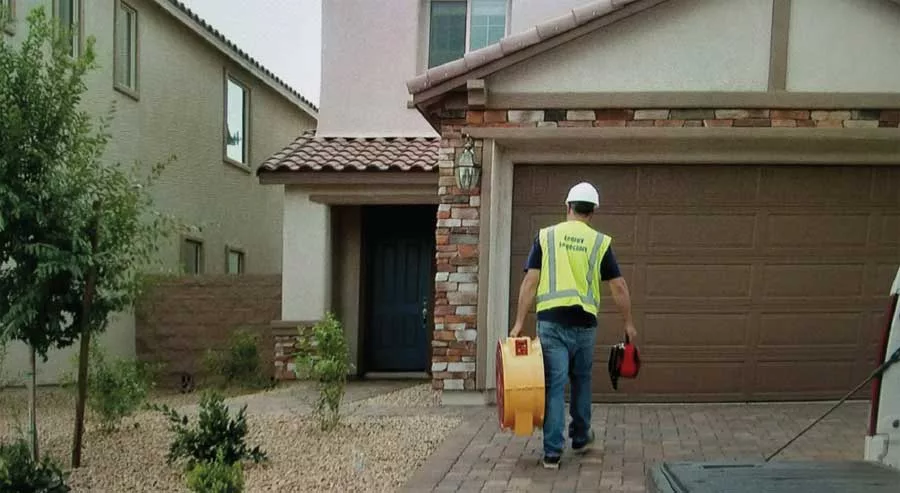
SCORE IT LOW: Properly maintaining a green home pays off in terms of utility cost to homeowners. Here, an HVAC contractor performs a Home Energy Rating System (HERS) audit.
Anyone can buy a fuel-efficient car. But once it’s driven out of the showroom, how it performs depends partly on how it’s used — so if it’s not getting the mpg expected, the onus might be on the driver to change driving habits or make sure the mechanics are up to snuff.
The same principle applies to green construction. Building a LEED Gold or Platinum office building is the first step. But sometimes, the best-laid plans in design and construction don’t get translated into practice. What happens once the construction workers leave and the ribbon-cutting is over — the operations and ongoing maintenance — plays a big role in making sure that building lives up to the energy efficiency standards promised.
BENCHMARKING
As of 2018, more than 93,000 projects participate in LEED across 167 countries and territories, for a total of 19.3 billion square feet of space used worldwide. Nearly 5 million people experience a LEED building on a daily basis, according to the U.S. Green Building Council (USGBC).
Under previous standards, new LEED-certified buildings required recertification after a five-year period. That was leading to falloff from what was required in terms of operation maintenance for existing buildings, said Stefanie Young, vice president of technical solutions, USGBC.
“Five years might not seem like that long a period, but even with a single building, a lot can change,” she said. “More often than not, [lack of maintenance to LEED standards] is due to personnel changes, ownership changes. Even though the original team had that effort at the time, it’s just challenging, given the turnover. We would come in and find … five years later, there were a lot of gaps, and it was not maintained as expected.”
To address this issue, one of the changes in LEED 4.1, which debuted earlier this year, requires LEED buildings to be recertified annually rather than every five years.
“It’s not about coming in and checking up on them,” Young said. “It shows how they’re tracking and trending, so they can make changes in real time as opposed to at the end of the period, where they can’t go back and make that change.
Looking for quick answers on air conditioning, heating and refrigeration topics? Try Ask ACHR NEWS, our new smart AI search tool. Ask ACHR NEWS
“For a long time, LEED has always been focusing on identifying building performance: climate change, human experience, water efficiency measures, and other resource management,” she continued. “Because we are a comprehensive rating system, we are now looking at ongoing tracking for other key metrics: things as far as transportation … how visitors are traveling to your project, because that does affect greenhouse gas emissions. A highly maintained building with strong efficiency measures can really transform operations and monitor contributions to global climate change or enhancements to human health and well-being.”
That impact isn’t tangible, though, unless tracking and monitoring is in place — benchmarking sets the bar and raises it.
“We can say we’ve reduced energy usage by 10, 15, 20 percent, and that’s great,” she said. “But what are competitors doing? … It can drive some healthy performance.”
On the residential side, Valerie Briggs, communications director at the nonprofit Residential Energy Services Network (RESNET), said its ratings are static once the house is built and certified.
The Home Energy Rating System (HERS) measures a home’s efficiency. The average rating for an energy-efficient home is 62. A standard new home is about a 100, and a typical resale home scores 130. Each point is a percentage decrease in energy usage, so the lower the score, the better.
“The rating is how it’s built, not how it’s used,” Briggs said. “You could have a home that’s a 0 on a HERS scale, but even if there’s no upkeep ... for the most part, it stays as-is in ratings.”
Maintaining the investment is more or less built into the return-service format of the industry, she said.
“A lot of companies that work with us as ratings guys are also HVAC contractors or plumbing contractors,” Briggs said, “which offers the opportunity for the contactor to go back in and offer those energy-saving tips. I think, as with any contractor, it’s like having that relationship with the customer.”
DOLLARS AND CENTS
Maintaining a green home pays off in terms of utility costs, and that’s what drives upkeep, Briggs said: saving money.
“Honestly, a lot of the tips are the same for any home,” she said. “Some of it is as simple as not having furniture blocking room vents, or not making wild swings in setting the thermostat; checking simple things like window tracks and making sure they seal. In instances where we’re called back out, it’s mostly ‘user error’ that has compromised energy efficiency.”
Marc Tannenbaum is president at Dr. Energy Saver & Attic Systems, a network of home energy contractors.
“A house that is ‘greener’ — less costly to own and operate, and healthier than other homes — should be easier to market and sell than other houses of equal size and condition when the owner decides to sell their home,” he said.
In a competitive market, using green products can help HVAC contractors differentiate themselves from their competition.
“Adding green products, like insulation, allows you to offer a fully comprehensive solution for homeowners concerned with comfort, health, and energy savings,” Tannenbaum said. “This will help position the HVAC contractor as the go-to company for homeowners looking to improve their overall experience of living in their homes.”
Recently, Tannenbaum’s company launched the Attic Systems program, which helps HVAC contractors market, sell, and install attic air sealing and insulation and related services. Insulation is a popular request from customers looking to make their homes more energy efficient, he said.
“One of the nice things about attic air sealing and insulation is that it requires no maintenance,” said Tannenbaum. “Once installed, these products will continue to deliver comfort and energy-efficient benefits to homeowners for years.”
Mechanical equipment, on the other hand, will need maintenance, he said, so it’s important to be upfront about that while showing how added cost savings of highly efficient equipment offset any extra maintenance costs. Most homeowners realize that, Tannenbaum said. A green home is an investment, and homeowners want to protect that investment, making them more likely to have a tech come out twice a year and make sure it runs efficiently, so they’re getting their money’s worth.
When it comes to protecting the environment, Kevin Fay, executive director of the Alliance for Responsible Atmospheric Policy (ARAP), noted that lowering a building’s initial energy consumption is what makes the biggest difference.
“From a greenhouse gas standpoint, consumption is 95 percent of impacts from an air conditioning/heating operation,” he said. “It’s more from the consumption side than the actual compounds side. We have been talking the importance of refrigerant management as part of any policy, whether it’s energy efficiency or greenhouse gas emissions, because of just that: Properly maintained systems perform much better from an efficiency standpoint. You prevent the leakage but also prevent the consumption.
“Typically, in the larger buildings, like the LEED certified, you have full-time staff taking care of that,” Fay added. “So it’s a continual reminder that we have to stay on top of it all the time.”
Energy does hinge largely on power, Young pointed out.
“Specific to energy in building equipment, we really encourage maintenance professionals to look at how they’re calculating energy efficiency and how they’re communicating that to the owners,” she explained. “You have to get others in the organization and on your own team on board while being really transparent.”
There’s the marketing perspective, too: another way to look at dollars and cents that goes beyond the energy bill itself.
“Consumers are certainly becoming more in tune to where we spend our dollars and where we spend our time, outside where we work and live, and how that aligns with environmental stewardship,” Young said. “Maybe it’s not all they’re looking at, but if [building owners] are transparent in how they are making improvements, that is important to consumers, whether it’s a hotel or a retail space, convention centers, maybe even an arena.”
FUTURE
As the costs of heating fuels and electricity have leveled off in recent years, so has the overall demand for green products, Tannenbaum reported. But the motive to save money never disappears completely.
“Abundant natural gas and lower oil prices have driven down homeowner concerns over rising costs to heat and cool their houses,” Tannenbaum added. “With that said, we see more homeowners looking to add products to make their homes more comfortable, with any gain from energy efficiency being seen as a bonus that helps pay for the investment over time. We see requests for insulation of all types increasing dramatically, especially when we have extremely hot or cold temperatures.”
According to Young, interest on the commercial side continues to ramp up.
“I’d definitely say we are seeing more and more professionals want to support green buildings, sustainable practices … they really want to understand how their performance compares with other similar buildings and how they measure up to their peers,” she said. “Generally, they start with one or two key metrics, like energy and water, and start building up from there, and we’re seeing more coming in and starting with those key aspects.
“A lot of this is starting at the local level or regional,” Young continued. “Private industry or local government are taking these initiatives into their own hands: taking matters into their own hands in a really good way and not waiting for top-down policies because they know this does impact their infrastructure, their quality of life.”
As an advocacy group, the Alliance seeks to influence these types of policies.
“On the maintenance side, we see reports that energy savings alone from properly maintained building systems could be 2 to 5 percent or more,” Fay said. “We’re continuing to support proper maintenance and proper management policies, as part of our overall goal, as we support the Kigali Amendment.”
That has included tightening up refrigerant management rules under the Clean Air Act and making sure HFCs are covered under the same requirements that HCFCs are covered under.
In today’s political climate, there’s been a big push for regulation. But those proposals have run into pushback from several businesses that don’t want to meet those requirements.
“So we’ve talked about ... not having no regulation, but smart regulation: finding a balanced approach in how to go about it in a way that’s reasonable,” Fay said. “Everybody loves to find ways where you could not have to necessarily rely on regulations. But the fact of the matter is, it’s good to have some uniform practices.”
Fay said a big part of the Alliance’s work is educating the government about what they can do in terms of helping to facilitate this.
“We’re also trying to help stimulate further dialogue among the industry players, be it the equipment providers, chemical manufacturers, service providers,” he said. “We’re glad to see that groups like ACCA have been working very hard at boosting responsible management practices, right from the get-go.”
Publication date: 9/24/2018
Want more HVAC industry news and information? Join The NEWS on Facebook, Twitter, and LinkedIn today!
Looking for a reprint of this article?
From high-res PDFs to custom plaques, order your copy today!