ACHR News
search
Ask ACHR NEWS AI
cart
facebook twitter instagram linkedin youtube
  • Sign In
  • Subscribe
  • Sign Out
  • My Account
ACHR News
  • NEWS
    • Breaking News
    • New HVAC Products
    • Featured Products
    • Manufacturer Reports
    • HVAC Data
    • Legislation
    • ACHR NEWS Centennial
  • RESIDENTIAL
    • Air Conditioners
    • Furnaces
    • Residential Heat Pumps
    • Ductless
    • Residential IAQ
    • Testing, Monitoring, Tools
    • Components & Accessories
  • COMMERCIAL
    • Air Handlers
    • Rooftop Units
    • Chillers and Cooling Towers
    • Commercial Heat Pumps
    • Boilers and Hydronics
    • VRF/Ductless
    • Commercial IAQ
  • REFRIGERATION
    • Refrigerants
    • Refrigerant Regulations
    • Leak Management
  • CONTRACTOR PRO
    • Geothermal
    • Homeowner Study
    • VRF and VRV Ductless
    • Unitary Trends
  • EDUCATION
    • Training and Education
    • Business Management
    • Service and Maintenance
    • Continuing Education
    • Market Research >
      • HVAC Brand Awareness Report
      • VRV, VRF, VRVZ Report
      • Unitary Trends Report
      • Water Heat Professionals Report
    • Webinars
    • Sponsor Insights
    • eProducts Info
    • White Papers
  • EVENTS
    • HVAC Contractor Forum
    • Industry Events and Webinars
  • MEDIA
    • Videos
    • AHR Expo 2025 Videos
    • Podcasts >
      • ACHR News Podcast
      • HARDI Podcasts
      • AHR Expo Podcasts
      • ACCA Podcasts
    • Interactive Spotlights
    • Quizzes
    • eBooks
    • HVAC Talkback
  • HVAC GROUP
    • ACHR NEWS >
      • Current Issue
      • Digital Edition
      • Subscribe
    • Distribution Trends
    • SNIPS NEWS >
      • Join SNIPS NEWS
    • Engineered Systems News >
      • Join ES News
    • HVACR Directory
    • Contests
    • Newsletters
    • Contact
    • Advertise
    • My Account
HVAC ContractingTechnical

Utilizing VRF and DOAS for High-Performance Building Applications
By Joe Cefaly
EE_Mitsubishi
September 17, 2018

Today’s building owners and occupants are more tech-savvy than ever before, demanding greater connectivity, control, and efficiency from technology — including HVAC systems. A heightened interest in more sophisticated ventilation systems is driven by similar trends that motivate the AEC community to adopt variable refrigerant flow (VRF) technology for a more efficient, intelligent approach to cooling and heating. This article explores these trends and how the use of VRF and complementing systems leads to high-performance buildings with complete HVAC solutions.

An increased awareness of indoor environmental quality (IEQ) is one trend driving demand for better-performing ventilation systems. Building occupants have a greater awareness of the importance of IEQ and how it can be affected by climate and population density.

Energy efficiency is also more relevant. Market-based incentives, a sustainability mindset, and government regulation are leading building owners to look for energy efficient HVAC solutions.

Additionally, more efficient and sophisticated cooling, heating, and ventilation systems are necessary as architects design high-performance buildings to satisfy the requirements associated with LEED®, Green Globes®, Passive House, zero-net energy, deep-energy retrofits and other sustainability programs. High-performance buildings also require tighter envelopes, making sophisticated mechanical ventilation even more critical for occupant wellbeing. Furthermore, regulatory requirements like AHRI Standard 920 are forcing efficiency into the ventilation segment of the HVAC industry.

WHERE DOES VRF COME IN? 

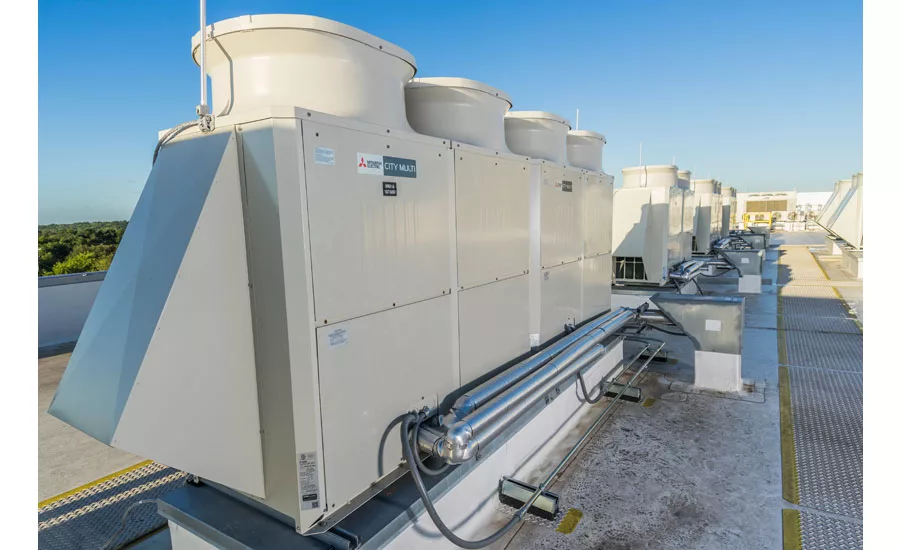
VRF technology addresses many of these needs. Designed to provide energy efficient comfort for a building’s occupants according to the conditioning needs of a building’s zones, a VRF system moves conditioned refrigerant directly to each indoor unit instead of moving conditioned air through ductwork (or conditioned fluid through hydronic piping). The outdoor unit works in tandem with integrated controls and sensors that measure cooling and heating loads for each zone, and its compressor seamlessly adjusts speed to maintain the zone’s set point. VRF systems minimize the energy-intensive process of turning a compressor on and off to meet loads, which change throughout the day.

A complete, high-performance HVAC solution will also offer greater design flexibility. As a function of its sophisticated design, VRF systems are relatively compact, giving architects and building owners a range of equipment options to maximize usable space within a building. Because the equipment is more compact than traditional HVAC systems, architects and building owners may design around an aesthetic vision without impacting the designs of engineers responsible for ensuring optimal performance of mechanical systems. Design freedom is also supported by whisper-quiet operation — VRF indoor units run at sound levels between 19 and 34 decibels, and outdoor units operate quieter than a typical conversation.

Finally, consumers are accustomed to interacting with smart technologies that provide near-instant access to information, and have expectations for personalized comfort control. Building occupants are looking for personalized control within their space, while facility owners and managers want better centralized control through building management systems. These allow for more efficient management, greater insight, and reporting and tighter control of utility costs.

Looking for quick answers on air conditioning, heating and refrigeration topics? Try Ask ACHR NEWS, our new smart AI search tool. Ask ACHR NEWS →

VRF systems address this by using one (or more) outdoor units to support a network of zoned indoor units. Personalized comfort is achieved through individual controllers in each zone. Additionally, VRF units are more electronics-based than traditional HVAC systems, with built-in controls logic to support centralized and local control.

COMPLEMENTING VRF WITH DOAS 

Building owners and facility managers know what they need from HVAC systems, and many are familiar with the benefits of VRF technology. It is important to understand how Dedicated Outdoor Air Systems (DOAS) complement VRF systems to meet building comfort demands and provide complete, high-performance HVAC solutions.

At its most basic, mechanical ventilation introduces fresh, outside air into a space. While cooling and heating systems are regulated by energy codes concerned with efficiency and occupant comfort, ventilation systems are regulated under mechanical codes, which concern occupant safety. In the U.S., ventilation systems for commercial buildings must comply with state and local codes, based upon ASHRAE 62.1 or International Mechanical Code, which use similar calculations to determine a building’s ventilation requirements.

IEQ, for example, improves with the use of a DOAS. VRF systems are not purpose-built for ventilation, and as a system’s compressors run slower during partial load conditions, its coils handle less refrigerant and are less active. While this is great for energy efficiency, a warm evaporator coil in cooling mode does not dehumidify effectively. Consulting engineers who have adopted VRF systems for energy efficiency purposes often also use a DOAS to handle ventilation and moisture removal.

DIGGING DEEPER INTO DOAS 

DOAS are dedicated ventilation systems designed to condition outdoor air. They are available as packaged equipment or as a split system to support decoupled designs. There are pros and cons to both options – packaged equipment is commonly more cost effective at startup and simpler to install, but split-system DOAS offers more design freedom allowing architects and building owners to separate and strategically arrange VRF outdoor units and DOAS equipment.

The use of DOAS also saves on the required cooling and heating tonnage, which manufacturers recognize is increasingly important to facility managers. In response to the growing demand for energy-efficient ventilation, some manufacturers now offer split-system and packaged DOAS equipment with inverter-driven compressors like those found in VRF systems.

Room neutral conditions — the range of temperatures where humans experience comfort without needing to shiver to produce heat or sweat to cool off — are easier to achieve using DOAS with inverter-driven compressors. Because reheat is typically only available on the lead refrigeration circuit, conventional DOAS produces room neutral air in a limited range of outside air operating conditions. With an inverter-driven design, there is only one refrigeration circuit regardless of tonnage. The result is a proportional amount of hot gas reheat to the cooling load, and the ability to deliver room neutral air to a wide range of conditions.

WHAT CAN WE EXPECT FOR THE FUTURE OF VENTILATION?

Newly introduced efficiency metrics for ventilation will soon impact how equipment is manufactured. Ventilation is historically governed by mechanical codes, but AHRI Standard 920 introduced two new efficiency metrics for DOAS. Moisture Removal Efficiency (MRE) is a full load efficiency metric while Integrated Seasonal Moisture Removal Efficiency (ISMRE) is a part load efficiency metric. Think of these metrics as similar to Energy Efficiency Ratio (EER) and Integrated Energy Efficiency Ratio (IEER) for cooling. In the near future, architects, engineers, and building owners will be able to find information at AHRIdirectory.org to compare products. The trend toward the regulation of efficiency is likely to drive more manufacturers toward including inverter-driven compressors in ventilation equipment. This is a great alternative to the option of increasing efficiency by making coils larger, which would take up more space within the unit and could become cost prohibitive and unattractive in terms of design.

The ability to assess and deliver the appropriate amount of ventilation in real time benefits occupant comfort, improves IEQ, and saves energy. Motivated by new codes and standards, market-based incentives, a sustainability mindset, and a global movement toward better building design, VRF manufacturers will continue to develop DOAS systems to meet building occupant needs. As adoption of VRF systems becomes more wide-spread, specialized ventilation systems are expected to become more widely recognized as a necessary component for comfort and a complete, high-performance HVAC solution.

Publication date: 9/17/2018

Want more HVAC industry news and information? Join The NEWS on Facebook, Twitter, and LinkedIn today!

KEYWORDS: Dedicated Outdoor Air System (DOAS) High Performance HVACR VRF (Variable Refrigerant Flow)

Share This Story

Looking for a reprint of this article?
From high-res PDFs to custom plaques, order your copy today!


Joe cefaly

Joe Cefaly provides engineering and applications support for products developed with third-party manufacturers. He assists in the development of new and existing products, including Dedicated Outdoor Air Systems (DOAS), CITY MULTI® and other OEM products. He has worked at Mitsubishi Electric for eight years, previously serving as a mechanical engineer. Joe is a LEED® accredited professional and certified energy manager. He earned a bachelor’s degree in physics from Union College and his MBA from Northeastern University.

Recommended Content

JOIN TODAY
To unlock your recommendations.

Already have an account? Sign In

  • HVAC-enrollment

    The Trades Are Back: HVACR Programs See Nearly 30% Enrollment Spike

    A new wave of future technicians is entering the pipeline.  
    Training and Education
    By: Matt Jachman
  • 2025 Top 40 Under 40

    2025 Top 40 Under 40 HVACR Professionals List

    The 11th annual Top 40 Under 40 list highlights those...
    HVAC Commercial Market
    By: Hannah Belloli-Oster
  • LG Ductless Mini-Split Systems

    The 9 Types of Heat Pumps

    As the U.S. moves toward electrification, heat pumps are...
    Air Source Heat Pumps
    By: Joanna R. Turpin
Subscription Center
  • Create an Account
  • Start a Subscription
  • Manage My Account
  • Sign Up for Newsletters
  • Visit Customer Service
  • Update Preferences

More Videos

Sponsored Content

Sponsored Content is a special paid section where industry companies provide high quality, objective, non-commercial content around topics of interest to The News audience. All Sponsored Content is supplied by the advertising company and any opinions expressed in this article are those of the author and not necessarily reflect the views of The News or its parent company, BNP Media. Interested in participating in our Sponsored Content section? Contact your local rep!

close
  • Piggy Bank
    Sponsored byWatercress Financial

    Energy Prices, Inflation, and HVAC: What Today’s Homeowners Care About

  • Refrigerated Food
    Sponsored bySolstice Advanced Materials

    R-455A Refrigeration: A Cold Storage Solution for the Future

  • Airex Rooftop Units
    Sponsored byAirex Manufacturing Inc

    Consolidating Roof Penetrations: A Growing Trend in Multifamily HVAC Design

Popular Stories

Refrigerants-and-gauge.jpg

HVAC Industry Warns of Counterfeit Refrigerants Entering U.S. Supply Chain

U.S. Supreme Court building

95% Furnace Efficiency Rule to Get New Hearing

Midea-training.jpg

HVAC Workforce Crisis Expands Beyond Technicians to Instructor Shortages

Data_Center_facility.jpg

HVAC Manufacturers Respond to Growing Data Center Backlash

HVAC Minute retail refrigeration system

EPA Final Rule’s Impact on R-410A Deadlines

View The ACHR NEWS
Centennial Anniversary Timeline

The ACHR News Timeline Chart
Submit a Letter
Submit a letter to our editors.

Events

November 6, 2025

Next-Gen Data Center Cooling: HVAC Innovation and Real-World Solutions

On Demand As AI workloads and high-density computing push traditional cooling methods to their limits, the data center industry is accelerating the adoption of next-generation HVAC technologies.

June 23, 2026

HVAC Duct Sealing Mastics: Why Selection Matters

In this webinar we will detail what HVAC material buyers and technicians need to know when selecting duct mastics, including matching mastic to substrate, alternatives to liquid mastic, and where UL 181 Listings fit into real world installations.

View All Submit An Event

Poll

Summer Staff

Are you fully staffed for the summer season?
View Results Poll Archive

Products

BNI Mechanical/Electrical Square Foot Costbook, 2026 Edition

BNI Mechanical/Electrical Square Foot Costbook, 2026 Edition

See More Products
HVAC Duct Sealing Mastics: Why Selection Matters - Free Webinar - 6/23/2026

Related Articles

  • Ten Predictions for US High Performance Building in 2014

    See More
  • Dec. 24, 2008: DOE Seeks Groups for High-Performance Green Building Partnership

    See More
  • Engineered Systems High-Performance Buildings / Building Automation: Proactive BAS Alarming for High-Performance Buildings

    See More

Related Products

See More Products
  • peak performance training.png

    Instructor/Facilitator Package: PEAK Performance for the Technical Professional

  • Guide Home Evaluations.jpg

    Technician's Guide & Workbook for Home Evaluations and Performance Improvements

  • ttabppftpfront.png

    PEAK Performance for the Technical Professional

See More Products

Events

View AllSubmit An Event
  • September 30, 2025

    HVAC Pumping Systems for Commercial Building Applications

    On Demand Join us for an exclusive webinar on the latest advancements in parallel commercial HVAC pumping solutions designed to simplify installation and improve system efficiency.
View AllSubmit An Event

Related Directories

  • Building Performance Assn.

    The Building Performance Association is a membership-driven 501(c)6 industry association dedicated to advancing the home and building performance industry by delivering improved energy efficiency, health, safety, and environmental performance of buildings through our members and network.
  • Building Performance Institute Inc.-BPI

    The nation's premier standards-setting and credentialing organization for the home performance workforce. BPI develops professional certifications and certificates for individuals and company-wide credentials for BPI GoldStar Contractors.
  • Avery Dennison Performance Tapes

    Avery Dennison offers a variety of high-performance tapes for HVAC and mechanical insulation applications. Our Fasson® portfolio of tapes offers excellent adhesion across a wide temperature range, flexibility and conformability, and the confidence of a positive vapor seal.
×

Sign Up. Stay Informed.

The #1 trusted source for the HVACR industry since 1926

SUBSCRIBE
  • RESOURCES
    • Advertise
    • Contact Us
    • Advisory Board
    • Classifieds
    • Submit a Letter
    • Directories
    • Store
  • ACCOUNT CENTER
    • Create an Account
    • Start a Subscription
    • Manage My Account
    • Sign Up for Newsletters
    • Visit Customer Service
    • Update Preferences
  • SERVICES
    • Marketing Services
    • Reprints
    • Market Research
    • List Rental
    • Survey/Respondent Access
  • STAY CONNECTED
    • LinkedIn
    • Facebook
    • Instagram
    • YouTube
    • X (Twitter)
  • PRIVACY
    • PRIVACY POLICY
    • TERMS & CONDITIONS
    • DO NOT SELL MY PERSONAL INFORMATION
    • PRIVACY REQUEST
    • ACCESSIBILITY

Copyright ©2026. All Rights Reserved BNP Media, Inc. and BNP Media II, LLC.

Design, CMS, Hosting & Web Development :: ePublishing