Advanced Refrigeration Technologies Boosting Energy Efficiency in Supermarkets
Advances in HVACR technologies can produce significant savings
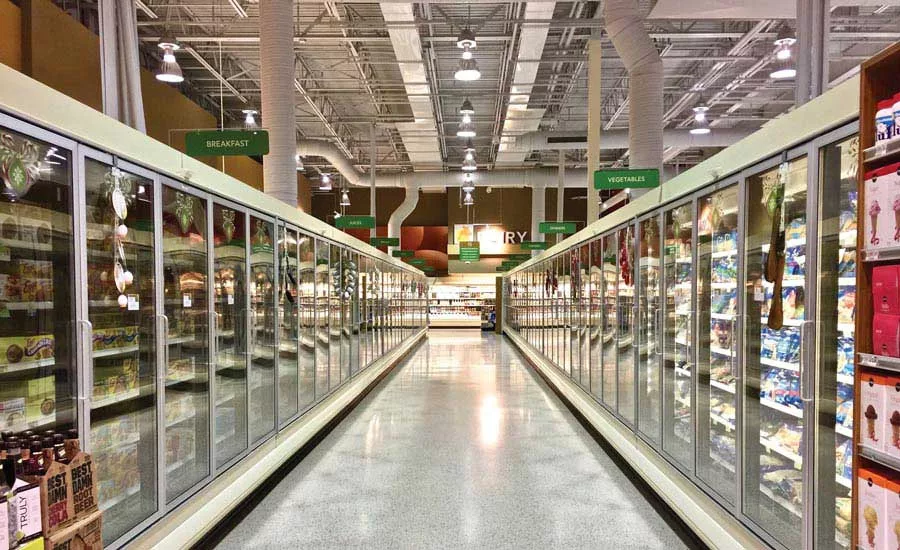
IN CONTROL: In supermarkets, new technologies and advanced control strategies have also been developed to help boost energy efficiency as well as to reduce emissions.
Over the last two decades, advances in HVACR technologies have produced significant improvements in energy efficiency. During that time, residential HVAC systems in the U.S. have gone from 10 to 15 SEER, a 25 percent efficiency improvement. For commercial buildings, the source and site-energy-use efficiency improvements in ASHRAE 90.1 standards have increased more than 40 percent, with corresponding reductions in CO2 emissions.
In supermarkets, where HVAC and refrigeration equipment use 50 to 60 percent of all electricity consumed, new technologies and advanced control strategies have been developed to help boost energy efficiency as well as reduce emissions.
ADVANCED TECHNOLOGIES
Technological advancements have resulted in numerous efficiency improvements in HVACR systems. For example, the introduction of NEMA Premium® efficiency motors for compressors has helped reduce energy consumption. In heat exchangers, advanced design has reduced the refrigerant charge while increasing the heat transfer ability.
Another example is the application of variable-frequency drive (VFD) technology. In a refrigeration system, the typical compressor rack employs multiple fixed-speed compressors.
When a VFD and related controls are applied to one of those compressors, that compressor can reduce energy consumption by modulating its speed to match the refrigeration load more precisely.
For mid-range rooftop units that supermarkets use for space cooling, a VFD can cut energy consumption by reducing compressor motor speed during 99 percent of operating hours when full cooling capacity is not needed. And applying VFDs may also help the store qualify for utility incentives.
More energy can be saved by using advanced controls. For example, implementing advanced superheat case control in the refrigeration plant can boost system efficiency by ensuring the evaporator is optimally charged, even when the load and suction pressures vary. Case control can also provide an adaptive defrost function that skips the energy-consuming defrost cycle when not needed. In CO2 racks, for example, gas ejectors paired with advanced control algorithms can save close to 12 percent of system energy consumption on an annual basis. These devices exploit the work lost during initial expansion of the CO2 that otherwise would be regarded as a loss. As another example, liquid ejectors are being developed to pump liquid exiting from evaporators in CO2 systems and will be able to adapt to specific working conditions to better utilize evaporators. In both cases, the captured energy will result in less compressor work, and thereby, more energy savings.
Looking for quick answers on air conditioning, heating and refrigeration topics? Try Ask ACHR NEWS, our new smart AI search tool. Ask ACHR NEWS
To achieve even bigger savings, technologies must be employed that can manage and monitor all major energy-consuming appliances in the store. The concept behind this type of holistic store energy management is that managing everything together saves more energy than optimizing components and systems individually.
With a holistic system, communication between all components can be directed to a central hub, which functions as the brains of the system. This hub exchanges data with individual refrigeration controllers to optimize many critical refrigeration functions, as well as manage lighting and HVAC. The result is an integrated solution that unlocks the full potential of each device and increases the efficiency of the entire store. Depending on prior energy consumption levels and scope of implementation, this type of smart solution can result in annual energy savings ranging from 10 to 50 percent.
CONNECTIVITY BREEDS EFFICIENCY
Optimizing components and systems within a store is beneficial, but even greater energy savings can occur when technologies and services from multiple stores are connected across an entire enterprise. To achieve large-scale efficiencies, supermarket staff responsible for energy management must first have access to actionable, real-time data that encompasses refrigeration, food safety, HVAC operation, and energy management. Fortunately, this type of technology is readily available through a number of manufacturers, including Danfoss.
Several supermarket operators already use a central management controller that connects multiple cooling cases, compressors, lighting, etc. By adding sensors, software, and connectivity devices embedded with an IoT level of intelligence, a higher level of energy savings can be achieved. Smart connected technology can collect and exchange data over the internet remotely at all hours, as well as communicate with applications and services in the cloud to enable data-driven decisions.
Using a cloud-based service delivery platform, supermarket energy staff can get powerful insights into individual and collective store performance. This type of enterprise-level service can deliver real-time data to store owners and managers, allowing them to make fast decisions to maximize energy efficiencies and cost savings, optimize food safety, and reduce the store’s environmental footprint.
UTILITY PARTNERS
In recent years, many utilities have offered programs to incentivize customers to cut electric consumption when power demand is high. During those periods, utilities want to avoid buying power from competitors or firing up inefficient generating equipment. When utilities can avoid these expenses, they pass on the prospective savings to participating customers either through demand response (DR) payments or peak-shaving incentives.
DR payments are paid by curtailment service providers (CSPs) to supermarkets that agree to reduce electricity use (load) in response to a particular temporary event. Customers are usually paid in cash or credits, and with proper controls and safeguards, it’s possible to reduce cooling capacity by 20 to 40 percent for up to 20 minutes, which allows compressor load shedding in response to specific grid requests.
Peak-shaving incentives often take the form of lower time-of-use (TOU) rates for supermarkets that shift some of their electric load away from peak periods. The cost savings from peak shaving can double what a supermarket receives in DR payments. This can be achieved through either load shifting or load displacement.
One way to achieve load shifting is to allow mechanical equipment for cold rooms, for example, to operate outside peak periods when utility rates are lower. Of course, close temperature monitoring is required to ensure quality. Another approach is to charge a thermal storage system during off hours and discharge during peak demand periods to minimize running mechanical equipment.
Load displacement cuts peak demand by using on-site generation, such as solar or wind, instead of using electricity from the grid.
Many utilities in the U.S. offer DR programs for supermarkets, and with the right control infrastructure, end users can tap into the intelligence and connectivity built into the energy management system in order to implement the program — no hardware or software retrofit is needed. Using smart devices that connect to energy management services and DR programs is a cost-effective way to cut energy costs now and also offer the possibility of connecting to the smart energy grid of the future, which may include thermal grid services and dedicated thermal storage devices.
As can be seen, the key to boosting supermarket energy efficiency is to unlock the potential of cost-effective HVACR technology that has intelligence and connectivity embedded at all levels of the store.
Smart devices and local controllers can boost efficiencies in equipment and systems, while enterprise level management systems can optimize the performance of all appliances and lighting. Add in the ability to connect with DR programs, and it is easy to see how advanced technologies can provide rewarding energy savings today, plus a realistic return on investment that will keep supermarkets competitive in the future.
Publication date: 9/3/2018
Want more HVAC industry news and information? Join The NEWS on Facebook, Twitter, and LinkedIn today!
Looking for a reprint of this article?
From high-res PDFs to custom plaques, order your copy today!