Regional Standards Enforcement Finally Arrives
WASHINGTON — In the year since the new regional energy conservation standards for split-system and single package central air conditioners took effect Jan. 1, 2015, the HVACR industry has adapted as best it can to the new energy conservation standards in the absence of any enforcement guidance from the DOE. But, on Nov. 19, 2015, the U.S. Department of Energy (DOE) finally released the long-awaited notice of proposed rulemaking (NOPR) regarding enforcement of the standards, tentatively ending a yearlong period of uncertainty for the industry.
The announcement comes more than a year after the Regional Standards Enforcement Working Group submitted a negotiated plan of enforcement to DOE — a year during which many HVACR distributors struggled with how, when, or even if they should prepare for the record-keeping and record-retention requirements in the working group’s proposed plan. Industry stakeholders were given until Jan. 4, 2016, to submit comments, data, and information to the DOE, which will likely release its final rule sometime in 2016.
MIXED REACTIONS
The DOE’s proposed plan is “more or less” what the working group proposed in 2014, said Jon Melchi, vice president of government affairs and business development for Heating, Air-conditioning and Refrigeration Distributors International (HARDI), which participated in the working group. “The major change is that [distributors] had agreed to a Nov. 30 implementation date [for the record-keeping requirements], which has since been pushed to July 1, 2016, which was our first preference, anyway, as it aligns with the end of the sell-through period in the South and Southwest. That’s the fallback date that clearly makes the most sense.”
Francis Dietz, vice president of public affairs for the Air-Conditioning, Heating and Refrigeration Institute (AHRI), said AHRI also participated in the working group and found the negotiated rule-making process beneficial. “This is a situation where the consensus process worked, and everyone was able to have their views and concerns aired,” he said. “The NOPR basically follows the outline of the consensus agreement that we negotiated with the working group. It’s essentially the same, so we don’t have any concerns about this.”
Charlie McCrudden, senior vice president of government relations for ACCA, also participated in the working group and said ACCA is “pleased the NOPR so closely mirrors the proposal submitted by the working group.” Overall, the NOPR is very similar to what the working group submitted last fall, McCrudden added.
However, the uncertainty caused by the rulemaking delay has been a burden on the industry, and the cost to comply with the proposed rule will only continue to impact HVACR contractors and distributors, in particular.
“The thing that’s bad is, in 2015, a lot of companies spent a lot of money and resources to gear up for a Nov. 30 implementation date and incurred costs to comply with something they didn’t need to do yet,” Melchi said. “That’s disappointing for the companies that had to incur an additional financial hit due to the DOE’s delay. But it does appear to be what we agreed to, and HARDI members should have minimal trouble complying with the proposed rule.”
Looking for quick answers on air conditioning, heating and refrigeration topics? Try Ask ACHR NEWS, our new smart AI search tool. Ask ACHR NEWS
Additionally, of the two items the working group never agreed upon in 2014, one is addressed in the NOPR while the other is not, McCrudden said. Currently, the only entity that faces the $200 civil penalty for violating the standard is the manufacturer, though there was talk in the working group of expanding that penalty to distributors and contractors. “The DOE does not include additional prohibited acts” in the NOPR, which aligns with ACCA’s stance on the issue, McCrudden said.
“The other item we couldn’t agree on is the definition of product,” he continued. “The discussion was about whether ‘product’ meant only equipment subject to regional standards or all central air conditioners and heat pumps. The difference is, the product category of central air conditioners and heat pumps includes not only central air conditioners and heat pumps but also small-duct, high-velocity [systems]; space-constrained systems; and other products. That means a routine violator — someone who has repeatedly violated the regional efficiency standards — can’t purchase heat pumps, which are not subject to regional standards. An installer can’t commit a violation with a heat pump because there are no regional standards for heat pumps, and equipment manufactured before the changeover date is legal to install anywhere, anyway. This ‘death penalty,’ as we’ve termed it, for being a routine violator is very severe. There will likely be comments filed to that effect.”
OPEN FOR COMMENT
Industry stakeholders could submit comments, data, and information regarding the proposed enforcement rule to the DOE until Jan. 4, 2016. But, potentially complicating matters is a Nov. 9 supplemental notice of proposed rulemaking (SNOPR) that proposes to amend the test procedure for central air conditioners and heat pumps.
“The test procedures of the SNOPR came out a few weeks ago, and there are potential changes to how products are rated and certified, and the changes come from a lot of discussion we had as a working group as to what constitutes a 14-SEER unit,” McCrudden explained. “You could take a 13-SEER condensing unit and match it with a certain coil or indoor unit, and it could achieve 14 SEER. This was problematic for regional standards because you couldn’t legitimately ban the sale or installation of 13 SEER condensing units in the South or Southwest because, potentially, it could be matched with the right coil [to achieve 14 SEER]. So, in the working group, we resolved that by suggesting some changes to how the DOE rates and certifies condensing units.
“There has been further discussion because the DOE has been looking at the test procedure itself, and they’ve made some changes that came out on this a couple of weeks ago based on discussions we had last year,” McCrudden continued. “So, the DOE, in this SNOPR, gives the option of some changes that we talked about as a working group and changes that are being proposed in the test procedure. The DOE took comments [through Dec. 9, 2015] on which of those two options would be preferred. This is unique because two different NOPRs are interacting with each other and could result in the outcome of one being applied to the other.”
In addition to the test procedures of the SNOPR, there is another parallel rulemaking regarding the information collection component of the regional standards enforcement plan.
“Playing into this is what’s called an information collection request [ICR],” McCrudden said. “Because the DOE is proposing that everybody in the supply chain maintains certain records, they had to go through an ICR review. Anytime the federal government asks 10 or more entities to provide or maintain records, that request for information has to be reviewed by the Office of Management and Budget [OMB]. So, there’s a parallel rulemaking that has a 60-day comment period. In this case, because the information being collected was covered during the working group, it’s unlikely there will be many adverse comments to OMB.”
THE BURDEN OF REGIONAL STANDARDS
While the industry is generally satisfied with the regional standards enforcement rule, industry leaders are quick to point out the significant burden the standards have already had on the entire HVACR supply chain.
“I don’t want to downplay this,” Melchi said. “This requirement is unprecedented in our industry. This is something that is going to cost distributors a significant amount of money and time; they estimate the changes for distributors to be approximately $50 million. This is a major change to the way we do business, and it’s not something we’re thrilled about. This is a consequence of regional efficiency standards, and we think that we did our best to mitigate and avoid some other alternatives for enforcement that were significantly more burdensome and intrusive to the way we do business. So, we don’t like this. It’s better than some of the alternatives, but, at the end of the day, for HARDI, this is something that shows the cost of a regional standard.”
The biggest problem, Melchi said, is that the DOE doesn’t factor in the cost of enforcement when performing its cost-benefit analysis.
“We’ve learned that is a significant cost,” he said. “We tried to make the best of a bad situation, and we’re pleased what we agreed to is what’s in the proposal and that there are no major curve balls. But, it does represent a significant change to the way our members do business, and we don’t take that lightly.”
To view the rulemaking website for split-system and single package central air conditioners, visit http://bit.ly/RSEnforcement.
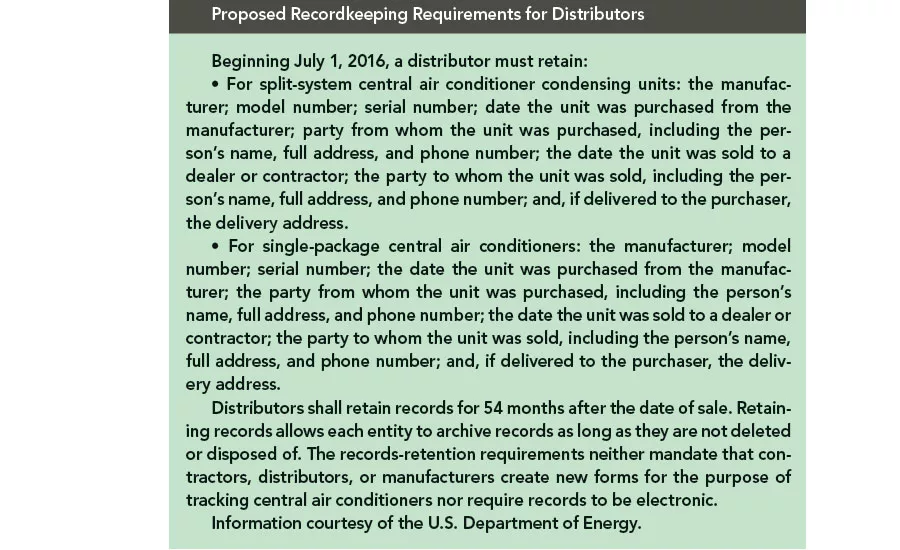
Proposed Recordkeeping Requirements for Distributors
Beginning July 1, 2016, a distributor must retain:
• For split-system central air conditioner condensing units: the manufacturer; model number; serial number; date the unit was purchased from the manufacturer; party from whom the unit was purchased, including the person’s name, full address, and phone number; the date the unit was sold to a dealer or contractor; the party to whom the unit was sold, including the person’s name, full address, and phone number; and, if delivered to the purchaser, the delivery address.
• For single-package central air conditioners: the manufacturer; model number; serial number; the date the unit was purchased from the manufacturer; the party from whom the unit was purchased, including the person’s name, full address, and phone number; the date the unit was sold to a dealer or contractor; the party to whom the unit was sold, including the person’s name, full address, and phone number; and, if delivered to the purchaser, the delivery address.
Distributors shall retain records for 54 months after the date of sale. Retaining records allows each entity to archive records as long as they are not deleted or disposed of. The records-retention requirements neither mandate that contractors, distributors, or manufacturers create new forms for the purpose of tracking central air conditioners nor require records to be electronic.
Information courtesy of the U.S. Department of Energy.
Looking for a reprint of this article?
From high-res PDFs to custom plaques, order your copy today!